


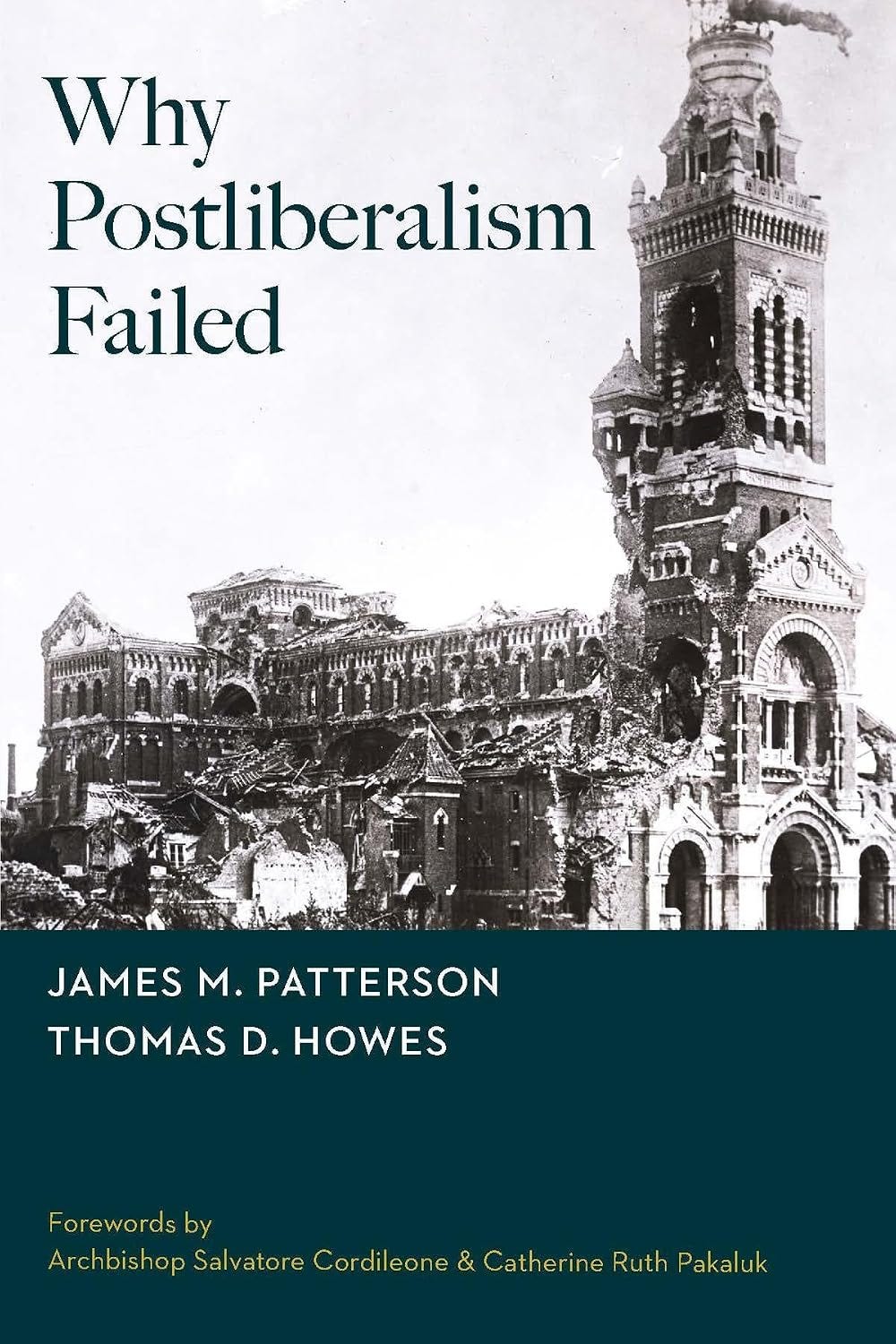
In the current era, it’s easy to get stuck in a bubble and feel too secure in your views. The increasingly curated algorithms of social media makes this problem even more difficult to avoid, and steps have to be taken to ensure you are engaging with the wider political climate. You need to challenge yourself with serious works from serious people that disagree with you. When I came across a new book from the Acton Institute, “Why Postliberalism Failed” by James M. Patterson and Thomas D. Howes, I thought I landed on such a challenge.
Like many young men, I had largely a libertarian view of government, so the Catholic libertarianism that many thank tanks of this era espoused in the 2000’s was a good fit. As my views changed to coincide more with the ascendent Trumpian right, their argumentation became less compelling as the conservative, mild libertarianism of the right got trampled time and time again by their opponents.
This doesn’t mean they are wrong, and I was looking forward to academics finally taking postliberal thought seriously. To say I was disappointed with the result is putting it mildly, and reading “Why Liberalism Failed” feels like a time-warp to the pearl clutching, guilt by association, and refusal to argue fundamental concepts I thought was left behind in the 2010’s. Unfortunately, instead of a work that has the guts to challenge foundational postliberal thinkers, it is a prime example of how uncurious the academic world has become.
Squid Ink and Handwaving Tactics
The problem starts right away with their definition of postliberalism:
What is postliberalism? We answer in more details in a later chapter, but for now a brief definition is that postliberalism is the name for an authoritarian ideology dedicated to using state power to impose a reactionary Catholic vision of the Church, family, and labor.
This view of post-liberalism is very constricted and only applicable to a narrow range of thought. You also already see the emotive terminology in place with “authoritarian” and “reactionary” that comes close to a strawman. The authors seem to define postliberalism in these terms for a sort of “inside baseball” among the increasingly powerful bloc of Catholics with anti-liberal leanings, of whom he considers J.D. Vance a participant in. Vance likely considers himself a postliberal, but I don’t see him accepting this definition. Adrian Vermeule might agree, and the authors spend an excessive amount of time analyzing him, but the vast majority inside the coalition one would deem “postliberal” would not. Patrick J. Deneen, whose book “Why Liberalism Failed” the authors based their title on, certainly would define it differently. At best, this is an aggressive subset of a subset of the postliberal sphere.
While postliberalism, like liberalism, can be nebulous to define, a a more charitable definition would be something like: Postliberalism is the rejection of the idea of a neutral public square as well as the elevation of personal license above community needs. Postliberalism advocates organic traditions over rapid upheavals and understands that human flourishing requires the State to have a paternal role in encouraging the public good.
It’s certainly not a good start to a supposedly academic book written to convince, and comes across more as a way of circling the wagons around an enemy using the most loaded language possible.
These biased and rhetorical definitions are legion in this text, often using a classic tactic of asserting what they are tasked with proving.
Catholic integralism is—or was—a discredited, authoritarian interpretation of Catholic social teaching.
In what way is integralism discredited? Is a strict separation of Church and State In what way is it authoritarian? Would banning abortion, even if the majority accepted it, be authoritarian? It is impossible to pin down the authors on what their idea of liberalism is, and the extent one’s religious views can account for how to run a country. They wave this away by stating the book is not a defense of liberalism:
As a final note, this book is not a defense of liberalism. One of us is comfortable calling himself a Catholic liberal and the other prefers to think of himself as a Catholic republican.
The authors never state what a “Catholic liberal” or a “Catholic republican” means. This comes across as a cop-out, and I am certain that the views of the two authors would be measured in centimeters along the vast span of the Overton Window. Does this liberalism mean the 1800’s laissez faire type of only negative rights. Do they coincide with the current civil right regime or an earlier one?
They do allow postliberals to define liberalism though:
Liberalism, for Deneen, refers to the emancipation of the person from natural limits, and these limits include economic, political, and communal limits. Before liberalism, Deneen wrongly imagines, people took for granted what human nature was, believed the role of an economy was to serve the common good, and wanted a politics of order to constrain license. Liberalism, however, sought to redefine the person as without limits. In science, the person becomes mutable, able to change the meaning of marriage, reassign genders, and escape death. In economics, the person becomes subject to endless efforts to grow the economy regardless of whether that growth disproportionately benefits the few.
This description of liberalism is very bad,
Usually when someone disagrees with a definition, especially one becoming more ubiquitous, one would go through the the flaws in its logic and come to a better frame of reference. This is especially true when your enemy is attempting to define your movement. Yes, Deneen’s definition is rhetorically loaded, but that’s when you come in and explain what it actually is. If liberalism IS NOT a social definition of an emancipated person as an individual without natural bonds and with infinite mutability, what is it?
They don’t answer this, taking it as a self-defeating definition stemming from the 2010’s due to the collapse of conservative moral capital. There’s no relation between the two things, as much as the authors want to associate them. They point and immediately throw squid ink, trying to pull the reader another direction by associating it with frustrated members of the conservative coalition.
The closest they get is to their stance is delineating American liberalism from Continental liberalism, a distinction they accuse postliberals of not understanding. Fair enough, but they then proceed to step on a rake.
There are much more plausible accounts of American “liberalism,” but these focus on the continuities of American constitutionalism with natural law. Paul DeHart has shown how the American conception of constitutional republicanism departed from continental republicanism in a myriad of ways, but most of all in the American position that rights and duties come from God. Continental republicans believed rights and duties came from individual consent.
……
A postliberal could respond by saying that the American republican tradition has largely declined in favor of a liberal one that surfaced during the years after the Second World War. This response is somewhat true, as secular liberal theorists like John Dewey and John Rawls worked hard to offer a secular foundation for a progressive reinterpretation of the American Constitution. For Dewey, this reinterpretation liberated “intelligence” to experiment scientifically in matters of public policy and creatively in forms of public expression. For Rawls, this reinterpretation was one committed to efforts at economic liberation by way of redistribution through a centralized welfare state. However, this argument also proves the point of this section—that these are innovations that have nothing to do with the American republican tradition.
This is an hilarious and utterly damning concession to the postliberals, and more or less destroys the premise of the book. The authors basically admit the classical liberalism they are espousing NO LONGER EXISTS. The Deweys of the nation won, and the current managerialism in public policy in the FDR era has swept away the old American liberalism in favor of a modern welfare state, and the authors have no clue how to regain it.

With regard to government intervention, the authors seem to have a very libertarian approach to state power.
Even in Deneen’s final pages in which he speaks about the need for a common Christianity to fortify “forms of family, community, church, and a cultural inheritance,” he defends them not on their own terms but to thwart “thralldom to addictions afforded by big tech, big finance, big porn, big weed, big pharma, and an impending artificial Meta world that will assuage the miseries of an increasingly unbearable world we have actually built.” The priority is not on the common good but on the hatred common among the postliberal elite they wish to instill in their would-be clients.
The assertion seems to be that Deneen only speaks about family, community, church, etc. to attack his designated enemies. What’s bizarre about this assertion is assuming advocacy for family is a cynical framing used to attack modern vices, rather than disgust at porn, weed, and other social vices stemming from their love of family and community. It’s natural and right to hate that which tries to destroy what you love, and it’s obvious these modern vices left unchecked will destroy Christian society.
Frankly, this calls to question what a society where you can set up a weed shop next door, where big finance makes housing unaffordable, and corporations are free to fill their customers full of addictive substances looks like. If this is liberalism, it’s no wonder so many people want off the train.
Myopic History
Many pages are printed documenting the various battles between temporal and spiritual powers. The power of the Catholic Church waxed and waned through the history of the Holy Roman Empire, and the authors go into great lengths about many of the conflicts. The purpose is to paint the authority of the Church over temporal powers as a vessel for mass corruption and creating unnecessary instability, ultimately falling apart during the wars of religion.
The reactionary position was that the alliance of throne and altar was necessary for the preservation of good order. However, this alliance had historically created rivalries that spilled over into countless wars and failed to prevent or reverse the Reformation. Throne and altar ruled over France when the revolution broke out. How is it, then, that they are necessary for the preservation of order, when they seem constantly to promote disorder?
The main direction for this argument is the more integralist states of times past brought conflict and strife, and the ascent of liberal republics finally brought the necessary stability. Of course, politics is never orderly, and this attempt to portray hundreds of years Medieval Christendom as a mess of instability and constant warring is jarring, given liberal republics have shown themselves to be far more unstable. The Republic after the French Revolution didn’t even last a generation before turning into a dictatorship, then into a constitutional monarchy, then a dictatorship, then a monarchy again, then a republic again. When when one looks the upheavals of the 1800’s and interwar period, you see a distinct pattern.
The original “throne and altar” was destroyed.
An unbalanced liberal regime formed
The liberal regime could not sustain balance between existentially conflicting power blocs
The liberal regime collapses and a strongman enters.
A new regime forms.
Astute readers will understand this process is Carl Schmitt 101. When the friend/enemy distinction can’t be curtailed through deliberations, the center collapses, and someone decides the state of exception and takes power. Then anew, illiberal regime rises from the chaos to restore order. Sometimes they still call themselves a republic, but its substance has irrevocably changed. The American Civil War is a prime example of such an outcome.
The authors go into depth on some famous figures, such as Salazar, Franco, and others, explaining their inability to build a lasting “postliberal” state. They excoriate what they considered to be ruthless measures to maintain order while never assessing the total anarchy they needed to impose order upon. The authors condemn Franco as a terrible authoritarian, but what’s lacking it any idea of what statecraft entails. Did they think Franco could achieve military victory, create open elections and economic freedom, and everyone would just get along? The Spanish Civil War was orders of magnitude more vicious than the American Civil War, and an amicable peace was never achieved. Forming a republic out of that chaos would have just created more bloodshed and likely a communist takeover.
When postliberals logically counter with the abysmal track record of liberal republics in the interwar period, we get the typical handwaving.
issues like economic instability, foreign interference, fear of invasion, poor statesmanship, little experience in self-government, and low rates of literacy all contributed to the critical political and social problems nations faced during the interwar years. To tie these back to an inflated concept of liberalism is nothing more than a cheap intellectual shortcut designed to satisfy the concerned yet busy reader and excuse postliberal authors from doing anything more than telling ideological ghost stories.
It’s not an “ideological ghost story” to point out the failure of liberal republics to keep stability in times of strife, and it is not a “cheap intellectual shortcut” to question whether the priors of such a state contributed to its downfall, especially when the writers themselves depend on pointing to a postliberal state’s priors to the downfall of their regimes. The authors rely heavily on the relatively peaceful post-WW2 era, where America and its satellite states triumphed after the collapse of the USSR.
Of course, boasting of a relative peace of less than 100 years is stretching things, and ignoring the main reason for that peace, a military hegemon with incredible natural resources, vast amounts of space, a massive water defense barrier, and an industrious and high-IQ population that was able to impose its military and cultural might abroad. The authors imply this with the fall of the last holdouts of anti-liberal governments.
Economic liberalization followed, and Franco’s grip on the nation loosened as he grew older and western Europe fell more firmly under the American sphere of influence.
While, as with all their views, the authors leave their opinion on foreign intervention close to their chest, there is good reason to believe they support such a hegemonic relationship.
One final part of the postliberal politics is its isolationism. Postliberals regard America as a “liberal imperium” that has historically sought to impose objectively immoral beliefs like individual liberty and economic opportunity onto more traditional foreign nations—all with the aim of exploiting those populations in some way. Hence, the only good foreign policy for America is to roll back American military positions and assume global neutrality in all conflicts.
You see a lot of the “shining city on the hill” Reagan mentality here, a sort of manifest destiny for America to be the harbinger of liberty to the world. The framing of this as implying that postliberals consider individual liberty and economic opportunity as “objectively immoral” is an amusing strawman. Talk to a postliberal and he’ll explain how US foreign influence in reality is allowing gays to proselytize to minors, forcing immigration on a populace that doesn’t want them, and using a vast NGO apparatus to subvert client populations and kowtow politicians. The reader can decide which one is more accurate. They were against the Iraq war, so I’ll give them that though.
This separation into authoritarianism and personal freedom gives no insight into the balance between individual vice and the common good, and the fact that balance is not going to be the same for every nation. It may increase GDP to outsource business, but the deterioration of communities dependent on it is a cost on everyone. It might sate the masses to play on gambling apps all days, but it is detrimental to living a good life. Postliberals understand these tradeoffs and knows restricting vice is part of necessary statecraft.
They consider the postliberals the anomaly against the clearly triumphant liberal systems, but maybe liberalism and democracies were the anomaly, put on life support for a short time by American power. Maybe the cracks we are seeing now that American power is dwindling abroad will only widen until the entire artifice collapses.
“Anti-Semitism”, “Nazi”, “Conspiracy Theory”, and Other Thought-Terminating Cliches
By far the most disappointing aspect of this book was the relentless guilt by association. They spend most of their energy explaining how post liberals are way too online, unserious. prone to wild conspiracy theories, and anti-semetic. They argue this stems all the way down to foundational figures figures in postliberalism. Somehow though, these extremely online goofballs are close to attaining the presidency.
First, postliberalism is weird. Second, postliberalism is very online, as so much of it involves in-group memes and references. Third, postliberalism relies on authoritarian ideas, even relying on Nazi political theory to defend using political authority to attack private actors. Fourth, postliberalism is now one heartbeat away from the American presidency. How did a weird, very online form of right-wing authoritarianism rise so quickly to the top of American conservatism?
The worst is the anti-semitism accusations, a sort of thought-stop that, in the authors’ minds, tells the reader these are bad people and can be ignored. For example:
The reactionary literature is anti-Semitic conspiracy theories
Lets put aside that you can find political theorists across the spectrum with politically incorrect views regarding the Jewish people. Frankly, negative views of Jews has been the rule rather than the exception until the post-WW2 era, and now modern times are reverting again to older norms. The authors go to great lengths not to address their arguments, but try to associate with with “Judeo-Masonic” conspiracy theories. Another such example:
Pico eventually rejected his work and became a follower of the radical Dominican priest Fr. Girolamo Savonarola before dying at the young age of 31. Perhaps this was the source of concern in the Simonini letter, but these events precede the French Revolution by centuries and have no obvious relationship to it. More likely this is simply anti-Semitism, as explained below.
The header of the section for French counter-revolutionary Louis de Bonald is “The Founder of Modern Anti-Semitism”. The onslaught is so relentless I wonder if the working title was “everyone I don’t like is an anti-semite.” Most of the “rebuttals” of the thinkers is done not through reading their texts and dissecting theory, but associating the people themselves with ideas of a “Judeo-Masonic” conspiracy theory. If such tenuous associations is enough to disprove their thinking, The authors are going to have to dismiss a large portion of the Church fathers as well.
Pages are also spent on De Maistre’s associations with freemasonry. If you want to get into depth about his views in his classic “Considerations On France”, you’re not going to get it. One small quote and a snarky response is the most they offer.
The worst part is Carl Schmitt. He has, by far, the most formidable argument against classical liberalism.
The work of Nazi jurist Carl Schmitt (1888-1985) is the culmination of reactionary political thought. Schmitt’s mature political work began in response to the evident failures of the Weimar parliamentary system that governed Germany after its defeat in the First World War. He found liberal proceduralism simply incapable of reckoning with the true nature of the political, which he defined as the power to declare the “state of exception,” or emergency powers during a period of crisis, and the subsequent reemergence of the “friend-enemy distinction.” Rather, parliamentary systems buried the political beneath endless hearings and regulations to avoid reckoning with crises, but the political always returned at the point of a true crisis, at which point even liberal parliamentarians would concede the need for a dictator to destroy the enemies of the state.
This is a fairly good synopsis actually. While the Friend/Enemy distinction is harsh, it lies bare why politics exists at all. While “the sovereign is he who decides the exception” is a terse and disturbing assertion to more democratically minded people, the logic follows from its premises. In order for the liberal idea of open discernment and universal agreement to seem feasible, one has to wrestle with the scenario of two groups whose views are existentially conflicting and no compromise can be made. One has to know when the process breaks down who has the ultimate authority. The authors never try to rebut him. They call him a Nazi, anti-semite, and conspiracist then call it a day.
Probably the most baffling quote is the following though:
And the labels reveal the deeper problem. Postliberals traffic endlessly in nominal categories—right-liberals, left-liberals, regime liberals, neo-liberals, neo-conservatives—yet they rarely pause to fix principles. What is human nature? What are the natural forms of human association? What are the conditions under which families form and sustain themselves, under which men and women find productive work and educate their children? These are not questions the postliberals ask,
This will come to a surprise of the theorycels who can’t get enough of Schmitt, De Maistre, Spengler, Evola, Nick Land, etc. This doesn’t even get into Yarvin’s famously loquacious posts. If anything, the post-liberal sphere is awash in incessant theorizing while often lacking in practical action. To argue that they aren’t thinking about the “conditions under which families form and sustain themselves“, you would have to ignore pretty much every popular writer in the sphere, since they all have an opinion on this.
Not only do they ask these questions, but they are fundamental to postliberal thought. The most basic principle of post-liberal thought is people are tribal, and human biodiversity means a system of government that works for one people will not work for another. They argue importing people from Somalia1 will not magically make them Americans, and they will adhere to their old customs and tribalism from back home. Of course, such obvious realities would are the ultimate crime-think, a rebuttal of modern liberal thought, and the authors have no interest in pursuing it.
It’s Already Dead
The authors admit that postliberals are rising, while taking the stance that they will ultimately fail. The authors fail to figure out any means to stop this instability though.
Postliberals wish to adopt these techniques to use against the Left. However, historically, conservatives had rejected using the “long march” because they opposed not only the ends of the Left but also its means. What conservatives aimed to conserve was not just individual liberty and traditional morality but also the proper institutional arrangements found in the American Constitution, federalism, and originalist interpretation in the courts. Postliberals see this kind of conservatism as an unwitting collaboration with the Left because of how badly the conservatives have been beaten by the Left.
Note that the book doesn’t even question that the left won institutional control, nor does it argue the takeover was not done through illiberal means. What’s left unsaid is baffling, as the authors seem to admit the left uses illiberal methods of institutional capture to gain power and wield it, but talk about the threat postliberals pose by deciding to use the more effective illiberal means. How do you gain back power after your government has been corrupted to pursue detrimental ends? I guess preach about the Constitution some more.
The authors have no answer to illiberal means of gaining power. They simply paint it as wrong by association. Maybe power has always been through conspiracy and coalition building, not “convincing the masses”. Deliberation has a place, but to argue every political issue can be solved through such processes is hopelessly naive.
They try to point to the success of conservatives, saying that postliberals are “cherry-picking conservatism’s failures as more significant than its successes.”
Finally, with respect to the diagnostic claim, the postliberal criticism of purportedly conservative failures is highly selective. A social conservative should lament the way the Biden Administration leaned in on flying Pride flags from every public building. They should not forget, however, that the “liberal” regime also accomplished the following:
Won the Second World War
Won the Cold War
Landed on the Moon
Ended Jim Crow racism
Pulled tens of millions of children out of poverty
Developed modern medicine and dental hygiene Dramatically raised standards of living
The Second World War was won through putting the United States in a wartime economy and curtailing many freedoms. Ending Jim Crow racism and other parts of the civil rights revolution were not done through liberal means, but mostly judicial fiat by defining an entirely new category called “protected classes”2. We landed on the moon by giving sweetheart deals to Nazi engineers. To call these victories of liberalism is a stretch, and one can’t help but notice the last “victory” was forty years ago, and we have continuously been strangled by managerialism, the destruction of freedom of association, and anti-white fervor since then. If this is victory, I would hate to see defeat.
This inability to see the writing on the wall is rife in this book and comes across as rolling the red carpet for the worst of society to continue to trounce their enemies with impunity. Regarding the most existential issue of Heritage Americans, immigration:
Indeed, another dark element of American habits is to reject foreigners, especially now as they compete for social welfare programs. American Catholic migrants were once such foreigners and some, in case of many of the Haitians in Springfield, Ohio, still are.
Who voted for this? Do they have any clue how corrupt it makes the Catholic Bishops, who receive hundreds of millions to support this, look?3
If one looks at American history, most upheavals weren’t from a wellspring of liberal, constitutional discourse, but raw power and constant states of exception. Lincoln arrested entire state legislatures and eliminated due process in the Civil War during the time the authors have the rosiest picture of their ideal form of government. FDR famously transformed the Washington bureaucracy by strong-arming the Supreme Court. The Warren Court found all sorts of new constitutional rights under the sofa4. The COVID panic showed the power of the administrative state when it closed churches while keeping liquor stores open. Are we actually arguing this is Liberalism? Are we seriously saying our way of life is getting conserved?
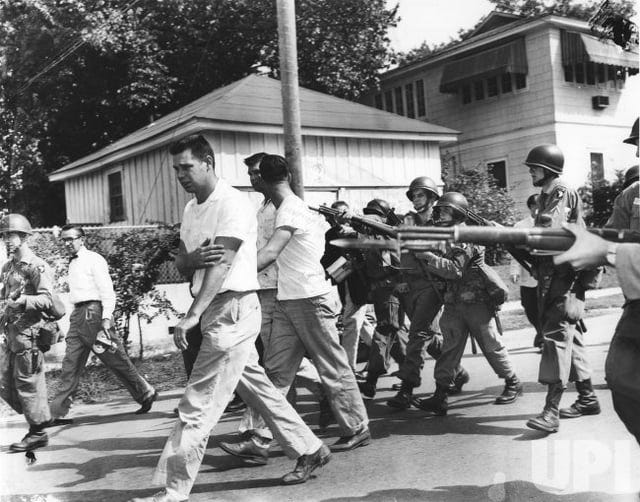
To put it bluntly, arguing that conservatives actually have conserved anything is going to give you negative converts to your cause. People can see defeat after defeat with their own two eyes.
Probably the most damning issue for Liberalism is that no one believes in it anymore.
While the temples of Liberalism are empty because faith in it is dead, “Fascism has created a living faith; and that this faith is very powerful in the minds of men, is demonstrated by those who have suffered and died for it.” In short, for Mussolini, Fascism was postliberal.
“Faith in it is dead” is a key insight. Mussolini understood that Liberalism is not a neutral space. It is an ideology with a moral framework that gradually shifts towards hedonism and infinite license. It was never a neutral framework, but built out of very specific geopolitical realities. While the authors tend to push liberalism as the null-hypothesis, with the burden of proof lying with its opponents, when there is no generalized consensus anymore, you’re on an even playing field.
They argue that a state based on Catholic social teaching will be near impossible without a wholly Catholic population.
The transition to the modern world—with its more complex social organization, technology, high education and literacy levels, and economic prosperity—destabilized and eventually dissolved Christendom, and it is difficult to imagine a stable re-emergence of it under modern conditions. Moreover, there is some historical asymmetry that prevents such a return because unlike medieval minds, we are now aware of alternative possibilities that could secure civic peace and the Church’s own freedom, without succumbing to indifference, all while better respecting human dignity and conscience.
It’s unclear what “alternative possibilities” the authors point to here, given the aggressive secularism imposed largely through judicial fiat on the entire Western world. It’s not even indifferentism to religion, but active hostility. While the authors argue that such judicial tyranny has waned, what’s forgotten is how rare the ratchet goes back. The only significant reversal to these court edicts of the 1950’s to 1970’s is Roe V. Wade and reversing the Chevron doctrine. The Civil Rights regime is still firmly in place, and the postliberals are the only ones with the intellectual arsenal to push back against it.
As for a non-Catholic population being unwilling to become a hard-line confessional state, fair enough, but if laws based on “reactionary” Catholic social teaching restores order, reinvigorates the middle class5, and builds long-term family stability, people will support it. After all, the entire point of Catholic Social Teaching is to create world that directs humanity towards positive material and spiritual ends, correct? Will it look the same as medieval Christendom? Of course not, but the principles remain the same. If such principles are “reactionary”, then call me “King Alan.” It’s a more tenable goal than to assume their ideal constitutional democracy still exists or can be restored.
No political system is perfect, but constitutional democracy has outdone all alternatives. If the case is that parsimony, generality, stability, etc., are desirous aspects of a system of rules because they allow for a more creative and innovative civil society, then it looks much less desirable to have a highly discretionary rule by experts, even if such experts rule by law.
I’m wondering what “Constitutional Democracy” the authors are referring to here. Are we talking the new Constitution after the Civil War? The new managerial Constitution built after the FDR administration? The Post-1960’s Civil Rights Constitution? While only a few amendments have been written to the Constitution, the interpretations have morphed into “de facto” new forms of government. The legislature has essentially abdicated its responsibility to “rule by experts” and the judiciary is the prime mover of increasingly unhinged social engineering. In what way is “discretionary rule by experts” not the norm now? We already live in a society run by judges and bureaucrats, with the President the only possible balance against their tyranny. When was the last time a judge got impeached for a clearly farcical ruling?
The rebellion against Kritarchy and Managerialism is what is driving the discontent, and the platitudes that we somehow live in a “Constitutional Democracy” when every politician seems to betray his constituents, when every judge is dead-set on anarchy, and every so-called organic wellspring terrorizing the public seems to be coordinated through a vast network of rabblerousers paid through NGO patronage networks.
Postliberals understand that there are no names and faces associated with the social upheavals they are seeing, and their elected representatives are ineffectual at best. They are sick of being controlled by rogue judges, faceless bureaucrats, and social engineering by an untouchable caste of academics and journalists, whom Yarvin describes as “the Cathedral”.
The authors spend a lot of time with post Vatican II social documents to bolster their case for a soft separation of Church and state along with an unrestricted market that is unconvincing. The core of Catholic social teaching is that the family, not the individual, is the fundamental unit of society. This means the state has an obligations, first and foremost, to ensure proper family formation. Modernity is destroying those bonds with lax divorce, destroying middle class incomes through outsourcing, sanctioning every sort of vice known to man, and the ubiquitous discrimination against breadwinning males in the name of equality. This also puts it at total odds with the individualism of liberalism. While it’s easy to lambast failed family formation policies such as tax credits6, at least they have their priorities straight.
Second, the Church has always taught that the spiritual realm trumps the temporal realm. It has always argued there are values every nation must espouse, regardless of the opinion of the populace. The common good has always had precedence over individual license. Small business has always taken precedence over mega-corporations. One can argue where the balance lies and how much you put the thumb on the scale, but neutrality has never been a principle of Catholic Social teaching.
While the authors want to castigate postliberals for living in the past, the truth is the authors are the ones pining for glory days. Whether it is the classical liberalism of the 1800’s or the republicanism of the days before FDR, they refuse to admit their ideals no longer exist. They can thump their chests and complain that a minority infiltrating and taking over a government apparatus is Machiavellian and immoral, but they are at odds to explain why, except it’s against their pre-determined rules. Unless they have a better plan than poorly argued works of rhetoric like “Why Postliberalism Failed”, the long march to irrelevance will continue unabated.
My main disappointment was this book could have been good. There are many insights from libertarians that are beneficial in understanding the world. I like Schmitt and De Maistre, but know they’re not bulletproof, and it’s frustrating that an supposedly academic work refused to seriously wrestle with their thought. Postliberalism is, after all, an effort to restore old traditions and social structures that were lost, and some of that are the good aspects of liberalism.
I for one support freedom of association and condemn the government destroying Catholic communities.

I condemn no-fault divorce and want to strengthen the family to match Catholic ideals.

I believe in subsidiarity and reject the hyper-financialization of society.

I’m sure the authors are serious about returning to older constitutional norms and won’t blanch at such common sense reforms.
It could have been a wake-up call not to reject everything from the old order, but instead the authors wrote not to convince postliberals, but to rally their ever-shrinking cadre of supporters. The future will not be some sort of hardline Catholic papal satellite, but it will certainly not look like what the authors consider ideal. For all their talk of postliberal nostalgia, the authors are the ones stuck in the past. By refusing to grapple with postliberal thinkers in a serious way, they have not only shortchanged their readers, but themselves.
Thank you for reading Social Matter. If you liked this article, please share and subscribe. If you want to see more of my work, consider becoming a paid subscriber.
Also known as “magic dirt theory.”
“Besides, the social consequences work for one and only one reason: there’s an iron fist in the velvet glove. Being sued for disrespecting a privileged class—excuse me, a protected class—is not in any way a social consequence, but rather a political one. Hey, while we’re chatting, could you remind me exactly how Warren Court jurisprudence derived the “protected class” from “equal protection of law?” I know the theory, actually—but it’d be fun to see you explain it.” - https://www.unqualified-reservations.org/2013/09/technology-communism-and-brown-scare/
Because I have a better-than-average historical sense, I’ve been pointing out for the past few years that American elites are mindlessly floating toward an unspoken belief in the sacredness of what I call the Zeroth Amendment: that American citizens should get no say in who gets to move to America because huddled masses of non-Americans possess civil rights to immigrate, no questions asked. And this Zeroth Amendment overrides the obsolete First Amendment, so you aren’t allowed to question it. - https://www.takimag.com/article/the_zeroth_amendment_steve_sailer/
The word “privacy” does not appear in the Constitution. The Warren Court found it there anyway. In Griswold v. Connecticut (1965), the Court struck down a state law that banned married couples from using contraceptives. Justice Douglas, writing for the 7-2 majority, reasoned that several amendments in the Bill of Rights — the First, Third, Fourth, and Ninth — create “penumbras, or zones, that establish a right to privacy,” and that the government has no business intruding into the bedroom of a married couple. - https://legalclarity.org/what-was-the-warren-court-and-why-does-it-matter/
“penumbras, or zones, that establish a right to privacy”

In any case we clearly see, and on this there is general agreement, that some opportune remedy must be found quickly for the misery and wretchedness pressing so unjustly on the majority of the working class: for the ancient workingmen’s guilds were abolished in the last century, and no other protective organization took their place. Public institutions and the laws set aside the ancient religion. Hence, by degrees it has come to pass that working men have been surrendered, isolated and helpless, to the hardheartedness of employers and the greed of unchecked competition. The mischief has been increased by rapacious usury, which, although more than once condemned by the Church, is nevertheless, under a different guise, but with like injustice, still practiced by covetous and grasping men. To this must be added that the hiring of labor and the conduct of trade are concentrated in the hands of comparatively few; so that a small number of very rich men have been able to lay upon the teeming masses of the laboring poor a yoke little better than that of slavery itself. - Rerum Novarum

Excellent essay. Couple small quibbles…there has been no small bit of progress in taming the courts since Warren. Better judges gave us Heller, McDonald, Bruen, etc. and an originalist SCOTUS, albeit one that is afraid to undue precedent perhaps to much. A few other victories exist, like the end of wage and price controls as a feasible political idea. That said, I think you’re right and the authors want to go back to 1995, but a fictional version like in The West Wing, where the rot wasn’t already showing.
Catholics, Orthodox, and the remaining real Lutherans are alien to the Anglo Protestant character of the American Republic. That requires humility and gratitude from us.
And granted that the "anti"-Federalist position remains a long-shot: Nonetheless we serve our nation best by being most honestly Catholic, Lutheran, and Orthodox than by hewing at the roots of our theology.
Only then can our national edict of tolerance survive. It might not, outside the individual States.
(Not Catholic myself, btw)
(1) The Liberals have been lying from day one.