


Some narratives are so confident, so convinced of their morality, so ubiquitous in mass media, that they’re simply assumed without any need of evidence. The popular understanding of the evolution of marriage law follows this typical whiggish conception of history. In the bad old days, women had no rights, and the husband could terrorize his wife at will. The children were indisputably his property, and it wasn't until recent times that women finally had recourse to justice.
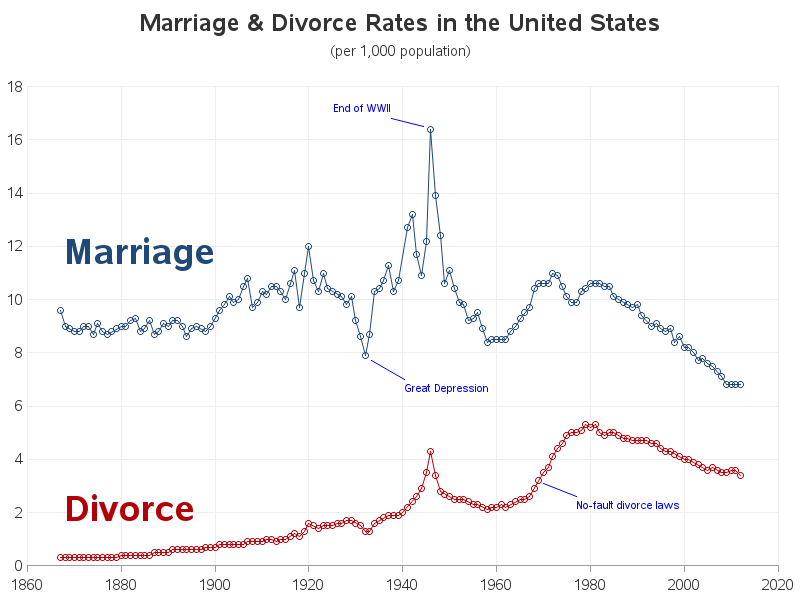
Most pundits on both sides of the political spectrum largely attest to this fiction, with conservatives lamenting at most the concept of no-fault divorce as the main culprit for the explosion of broken homes. The truth is the explosion happened much sooner, with the steady climb of divorce starting in the 1870's. Every generation since has seen either a rise in divorce or a decrease in marriage as a father's legal rights erode as his responsibilities expand.
As we will see, the common narrative is false. While husbands used to legally have default custody rights, even in “the bad old days” there were safeguards in place to ensure proper family functioning. During even the most stringent of times with regards to divorce in the West, women had recourse to courts for redress of grievances. Men had strong legal authority for the family, but it wasn't absolute, with headship carrying heavy responsibilities. What has been lambasted as an antiquated and sexist idea of marriage and custody had a reason behind it, and it wasn’t to oppress women.
A Brief History
The quotes below are from “The History of Custody Law” by Tom James unless otherwise stated. It’s a breezy read and I recommend it.
The institution of marriage is one of the most powerful social technologies ever conceived, and a strong indicator whether a tribe can reach development past the stone age. There is a balancing act requiring cooperation between the sexes in creating and nurturing the next generation and successfully transmitting cultural values. While there existed many primitive matriarchal societies, they were primitive for a reason, as the males had little say in child rearing, building a legacy, or even paternity, especially in societies where women freely had many sexual partners. They tended to idle away their time in performative martial prowess, as they had no real power. On the other end, excessively patriarchal norms that gave women the role of war prizes and breeders were not capable of transmitting cultural and moral values to their offspring, leading to a warlike people that may have been able to expand, conquer, and loot, but not create a new lasting culture.
Ancient civilizations that expanded past primitive tribes to form complex cities grappled with marriage in different ways, dealing with the rights of the couple as well as laws to manage broken marital contracts. In some, like Assyria, the father’s control was near absolute. Others, like the “Code of Hammurabi” in Babylon and “The Code of Lipit-Ishtar” in Mesopotamia, gave the father dominion over the family only so long as they were married, and the woman could divorce and regain custody of children in cases of a husband’s fault or desertion. Hittite culture had a similar structure, allowing a redress of grievances and divorce. With the Romans, marriage law shifted dramatically during its long history. It’s fundamental legal document, “The Law of the Twelve Tables”, which gave wide-reaching dominion to the husband, was superseded by later laws.
There’s a back and forth, a compromise that allows both parties to have skin in the game while adapting to new environmental realities. The civilizations that lasted and thrived learned what habits and customs fostered healthy relationships, and through centuries of trial and error came upon norms and expectations for men and women that allowed the next generation to flourish.
It was a matter of practicality as much as religion. They learned that extensive polygamy created social imbalance, culminating in a mass of men with no chance of offspring, so monogamy became the norm. Sexual practices that brought doubt to paternity led to disinterested men, so strong taboos against adultery and promiscuity were developed. They learned that forcing a woman into marriage created resentment, so mutual consent was mandated. Men wanted to build a legacy and have a little kingdom for themselves, and so the man became head of the household. Women wanted security and protection, so protections were to be given to the wife, all bound in elaborate religious customs.
Later, the teachings of Christianity and Canon Law superseded all previous marital arrangements and became the law in Europe for over a millennium. It had innovations including the practical impossibility of divorce outside of impotence, barrenness, or familial lines being too close. It maintained paternal dominance over wife and children with wider responsibilities. St. Paul gave the standards of marriage succinctly in his letter to the Ephesians.
Submit to one another out of reverence for Christ.
Wives, submit yourselves to your own husbands as you do to the Lord. For the husband is the head of the wife as Christ is the head of the church, his body, of which he is the Savior. Now as the church submits to Christ, so also wives should submit to their husbands in everything.
Husbands, love your wives, just as Christ loved the church and gave himself up for her to make her holy, cleansing her by the washing with water through the word, and to present her to himself as a radiant church, without stain or wrinkle or any other blemish, but holy and blameless. In this same way, husbands ought to love their wives as their own bodies. He who loves his wife loves himself. After all, no one ever hated their own body, but they feed and care for their body, just as Christ does the church— for we are members of his body. “For this reason a man will leave his father and mother and be united to his wife, and the two will become one flesh.” This is a profound mystery—but I am talking about Christ and the church. However, each one of you also must love his wife as he loves himself, and the wife must respect her husband.
For most of Medieval Europe, this was the norm. The man would be the head of the household and hold custody of the wife and children. The legal framework for this paternal custody was called Coverture.
Under the law of coverture, married women’s rights and obligations were subsumed within those of their husbands during the marriage. More precisely, in the absence of an agreement otherwise, a married woman had no legal right to own property or to enter into contracts independent of her husband. Coverture did not prohibit married women from possessing and exercising contract and property rights. A prenuptial agreement (then known as a “marriage settlement”) could give legally enforceable rights to a married woman. In the absence of such an agreement, though, the law treated a married couple as a unity, with the husband being the manager of the unity. Pursuant to this doctrine, the husband had the right to make decisions about the family’s residence, religion and the upbringing of the couple’s children.
Essentially, Coverture created a legal fiction of the family as a single unit, with the husband as the head.
Divorce was outlawed due to the pronouncements of Christ, but there were cases of separation where the couple was technically still married but were allowed to live separate, chaste lives. This often happened in the case of spousal abuse, the husband’s failure to provide, or adultery. There were also cases of “quiet separation” where a couple amicably decided to separate without bringing a court into it. In early medieval times, most peasants could not afford court fees, so often marital conflicts involve the community “taking care” of the problem. If a man abused his wife, her relatives would pay a visit and “convince” him the error of his ways. An immoral woman would be publicly shamed, if not worse. For those who could afford legal recourse, the husband’s authority was strong, but not absolute. When courts were used, they had mechanisms for redress of grievances for women.
Chancery, on the other hand, was capable of both awarding damages and ordering the performance of the agreement. In spousal disputes, this provision meant that the courts might effectively enforce maintenance contracts for separated wives. Although the church courts were capable of addressing this issue (and often did), chancery was more expedient. Chancery could have the delinquent husband arrested and cast in prison (without waiting the forty days required by the law of caption) and compel performance of the agreement.
So, what happened to the children in these circumstances? Outside of marriage, mothers were considered to have a natural right to their children. This means men who sired children outside of marriage had no paternal custody rights. In the marriage contract, that natural right is waived and given to the father in exchange for his protection and provisioning. This wasn’t without recourse though, as a father's marital right of custody was rescinded in failure to fulfill marital vows. A father also could not abandon his wife and take the kids, as this malfeasance went against his legal responsibilities to his wife.
After the reformation, the Church of England generally kept its prohibition on divorce. Legal separation was popular with warring couples to find an amicable agreement without making thing publicly known. In these cases, it was common for the mother to receive custody of the children if they were of a young age, largely because of the natural division of labor between the sexes.
In the case when the criteria for a total divorce were achieved, such as adultery, custody did not necessarily go to the mother, but to the innocent party. The parent who destroyed the marriage was seen as morally unfit to raise children, whether the guilty party was male or female. Custody was also refused for other immoral behavior, such as child abuse, spousal abuse, etc. This was the norm until the late 1700’s, when an increasing number of judges shifted to maternal bias.
In England during the year 1804, Mrs. Margaret De Manneville, calling her husband an insufferable man, left the home with their eight-month-old daughter. The father, in response, went into her new home and took the child back. She appealed to the judges, admonishing them to force the husband to release the child back to her care. The courts refused to intervene, citing that “a man has a right to the custody of the person of his wife; in general also to that of his child.”
This caused a flurry of outrage and indignation throughout the empire. Whenever a child is taken from the mother, whatever the reason, there’s an instinctive revulsion. This instinct, later incorporated into law as the “tender years doctrine”, stated that very young children should be in the mother’s care. It’s the crux of the then rapidly developing idea of settling custody disputes solely through the supposed “best interests of the child”. How that has been implemented is hardly consistent and often outright contradictory.
De Manneville is often cited for the proposition that English common law treated child custody as the natural right of fathers, but not mothers. In fact, however, English common law treated child custody as a natural right of mothers, not of fathers. A natural right is one that does not require the enactment of a statute, the initiation of a court proceeding, or the formation of a contract; it arises naturally.
Legal rights, by contrast, have their origin in positive law, i.e., man-made laws, contracts and declarations. Since a woman’s right of custody arose from the fact of giving birth, irrespective of whether or not she had performed the additional step of entering into a marriage contract, and irrespective of any legal enactment giving her the right of custody, it came within the meaning of a natural right.
A father, by contrast, did not have a right to custody merely by virtue of fathering a child. Rather, a father’s right came into existence if and only if he had undertaken the additional legal step of entering into a valid contract of marriage with the mother.
The De Manneville case did overstate paternal custody, even in this time. Even with a separation, if fault was found with the father, the mother could be awarded custody. The criteria of custody belonging to the innocent party still existed. The “Custody of Infants Act“ of 1839 reigned in the De Manneville verdict to make explicitly clear that mothers could be awarded custody in disputes of this sort.
This was deemed insufficient, and momentum kept increasing to not only give an equal chance for mothers for custody, even in cases where there is no formal divorce or paternal fault, especially during a child’s younger years. The “tender years” doctrine became ubiquitous, and courts saw it as their duty to ensure that mothers have full custody of young children. With the “The Custody of Infants Act” of 1873, it became a fiat accompli.
With the enactment of this law, the focus of English courts in the late nineteenth century was squarely on what were believed to be children’s temporal needs, irrespective of the mother’s marital fault. Judges assumed that children’s primary temporal need was for maternal care, fathers being necessary only for financial support. Thus, England entered the twentieth century with child custody laws expressing a very strong maternal preference.
On the other side of the ocean, the United States came to the same legal opinion at an accelerated pace. While the strong religious sensibilities of the early colonies limited divorce, the criteria depended on the religious background of the colonists. Sometimes the only recourse for an abused wife was separation, and sometimes spousal abuse was enough to allow divorce. Interestingly, the husband could not divorce based on his wife’s abuse. Until the 1800’s custody was granted, like in England, to the innocent party. The principle was simple. It is in every child’s best interest to be in an intact family and so would be a moral hazard to award children to the individual who broke the marriage. If no fault was found, they were told to work it out. That quickly changed, especially in the northern states after independence.
While Coverture was still law in principle, it had no teeth. During the 1800’s one saw the same evolution of preference to mothers and an increasingly outrageous dismissal of any paternal rights at all.
Unlike the courts in England, most American courts ignored the coverture doctrine and the rules relating to writs of habeas corpus whenever they wished to keep young children together with their mothers. These courts would dismiss a father’s writ of habeas corpus even if the mother’s separation from her husband was unjustified. On the other hand, a few courts would deny a mother’s writ, or would order the return of children to the father’s home, if the court determined the mother was an unfit parent, or if the wife was clearly at fault for the separation and the husband was without fault.
The United States has always been at the forefront of radical legal theory, and marriage judgements were no different. While common law had supposed paternal rights, it tended more and more to include all the responsibilities to his wife with none of the benefits, especially when the marriage broke apart. Judges consistently recited the “tender years” doctrine and bluntly stated the fathers had no right to custody.
A husband was required to pay for anything his wife might purchase; to pay for any necessaries a third party might provide to her or to his children; to compensate third parties for whatever injuries his wife or his children may cause them; and to bear sole responsibility for supporting the family financially.
Rather than treat the support obligation as an incident of the right of custody (i.e., as an obligation of the custodial parent alone), the majority of American courts required fathers to pay child support to the mother in those cases where she was awarded custody of the children. That is to say, courts extended the husband’s family support obligation beyond the termination of the marriage. The result was an explicit double standard in the law: If a mother was awarded custody of the children in a divorce or separation, the father was required to pay child support to her, but if custody was awarded to the father, the mother was not required to pay child support to him, even if she had the means. A woman’s marital obligations terminated upon the dissolution of her marriage; a man’s did not. His obligation to support his wife and children continued to exist even after the marital unity had been dissolved.
While the courts had, in principle, the precedent that custody goes to the innocent parent, this clashed with the newly minted “tender years” doctrine, and the result was a “heads I win, tails you lose” mess. If the mother was at fault and not a danger to the child, according to “tender years” doctrine, she received custody. If the father was at fault, the mother received custody on moral grounds. At fault divorce, though still technically a thing, became more meaningless with regards to custody.
Note this all happened far before the overturning of divorce laws in the 1960’s, and it shouldn’t be a surprise divorces became ubiquitous as this new legal doctrine became mainstream. It could be argued the only thing holding back divorce explosion was social stigma, as the legal penalties for one party became more and more nonexistent.
Nothing exemplifies the aftermath quite like the story of Robert L. Stirm, a military man who spent five years as a POW in Vietnam. You probably recognize this famous photo of his homecoming:

Beautiful reunion, right? Not really. Three days earlier he received a “Dear John” letter from his wife, as she had been brazenly unfaithful during his tour of duty. The aftermath of the divorce was his ex-wife getting custody of the two younger kids. She also received his house, car, $300 a month in child support, and 40% of his future pension.
Before you assume this is going to turn into a woman-bashing tirade, I want to emphasize it wasn’t women who developed these legal doctrines, but men. This was not a result of mass action and activism on the part of women, though feminism was becoming a minor political force, but a male instinct for protection. In truth, feminism had very little support, even among women. This instinct to protect is easy in the abstract, when it's not your kids being taken away, nor your paycheck being garnished. It's easy to decide to mandate no-fault divorce to "lower spousal abuse" when you don't have to worry about the moral hazard you are creating. While one likes to think women would not take advantage of evil legal codes, but when you create perverse incentives, you get perverse behavior. It’s human nature.
Luckily, new laws are being formed to deal with this, such as the new Kentucky law mandating presumption of equal custody. While the assertion the new law lowered divorce by 25% is overstated, it’s a positive step in ensuring the platitudes of marital equality have a measure of reality. The clear increase in custody time to fathers after it passed also makes clear that fathers weren’t being given less custody because they didn’t want it, but because of court bias.
Isn’t this a good thing? Can’t we just move to truly equal marriage rights? It seems this proves that this new model had growing pains but is now stabilizing. Why should we think this old and antiquated model has anything to teach us? Well, if you asked someone what marriage was, they would probably have some nebulous idea about romantic love and affection. It would likely be based entirely on sentiment. Maybe a few traditionally minded people will talk about creating a stable environment for child-rearing, but they would be in a solid minority. If marriage is only sentiment, and even legal rights such as hospital visitation and health insurance is increasingly offered to non-marital couples, what does this piece of paper even mean anymore? Young people are increasingly realizing, nothing.
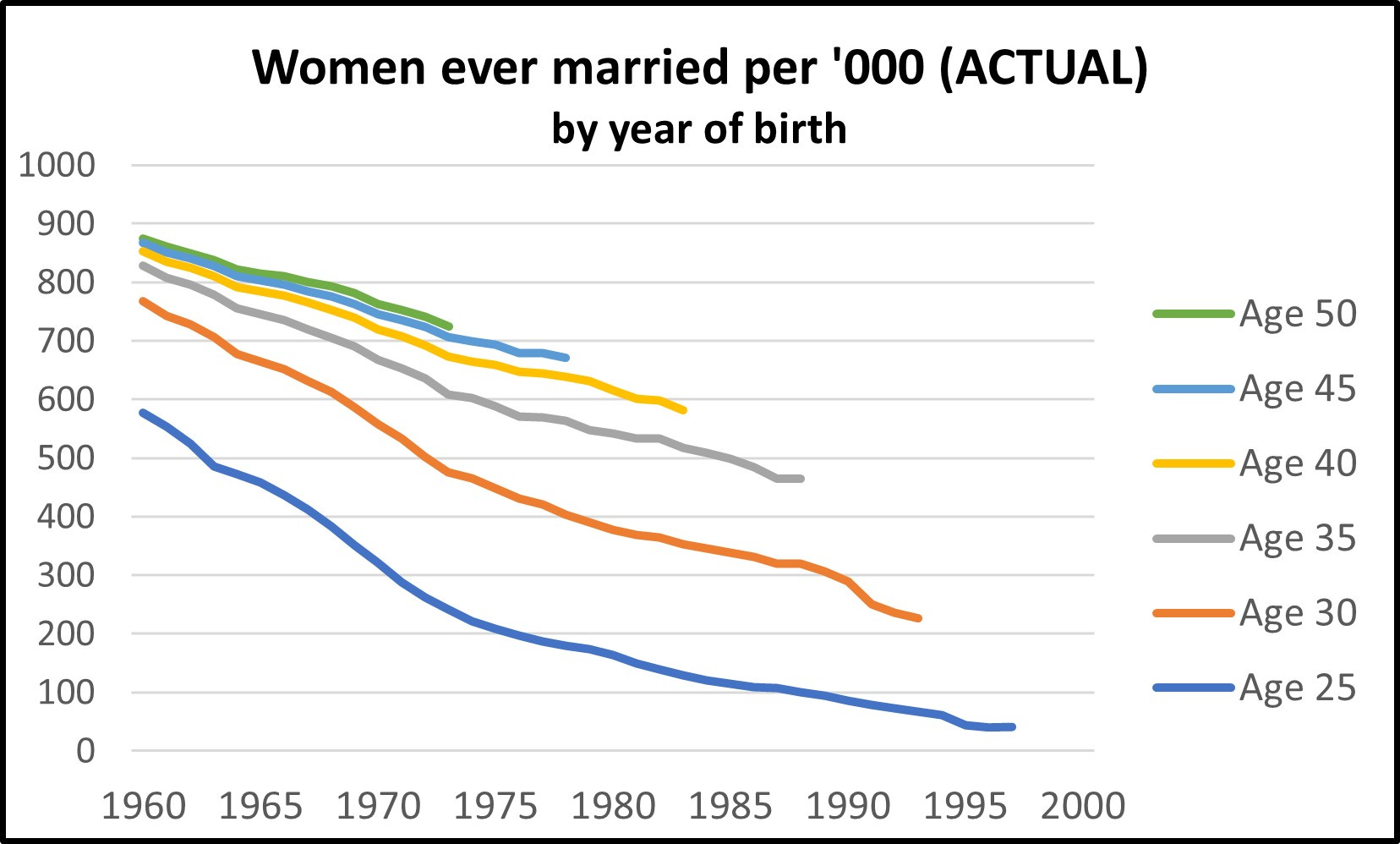

The only thing keeping marriage afloat is social inertia, and this is precarious given increasing secularization. Like a famous brand that erodes in quality over the years, there’s a delay as many people deny the obvious until a breaking point is reached and everyone realizes it’s not the same thing. Modern marriage has hit that threshold.
Putting Sex to Work
The quotes below are from “The Case for Father Custody” by Daniel Amneus. I can’t recommend it, as it’s painfully repetitive and vitriolic, but it pushed many interesting arguments that can’t be waved away.
It’s been stated often that marriage civilizes a man, and the woman is the catalyst that forces a man to be a productive member of society. The woman is assumed to be civilized from the get-go. While popular in modern times, different eras had a drastically different convention. In medieval times women were seen as sexually insatiable and had to actually be civilized by a man. Now, modern sexual license has given a real-time experiment about who is right.
It’s always been known that men like variety, often even with a woman who is less attractive and likely crazier. While some leave their wives, many are content to have an affair on the side and keep the core family and normal marital relations with their wife. Thanks to the wonders of the internet, we now see the other side. Wives that said they “just aren’t into sex” have cucked countless husbands, engaging in acts during affairs that the husband dreamed she would do for him. Then there are plenty of cases of women running off with their gym trainer and showing callous disregard for the children’s well-being.
Outside of the emotional chaos, this is unproductive action, seeking pleasure over the producing a better life for one’s offspring. Every man or woman with a random fling takes energy away from civic engagement, and every broken home creates a burden on the State. Social capital deteriorates, high-time preference brings slow decay, and the children bear the brunt of the trauma with a destroyed family while being lectured about how nice it is they can have two Christmases.
In short, both men and women need to be civilized, and Patriarchal marriage once gave the right conditions for random promiscuity and license to be restrained in favor of productive action and long-term thinking. Within the restriction of marriage, both men and women are forced into socially beneficial actions in proper action, propagation and rearing of children. One might argue the roles could be reversed or be the same. Why can’t the woman be the head of the family and the husband be submissive? Isn’t it just love and they’ll figure it out? Simply put, intrinsic biological differences can’t be circumvented by the wishful thinking of social engineering because men and women have shown conclusively, even in our egalitarian society, their revealed preferences. And these known differences need to be understood in legal precedent.
For Men:
It may seem unfair to powerful and high-achieving women that the female in this scenario exploits her youth and nubility rather than her achievements, that she counts success in terms of being a wife and mother and having a stable marriage to a successful man. The powerful and high-achieving woman might suppose that her own achievements entitle her to be admired and pursued by men, as high achieving men are admired and pursued by women. It doesn’t work that way. President Kennedy and President Clinton found themselves surrounded by willing females; Madeleine Albright and Janet Reno would get nowhere with their male underlings by making passes at them
For Women:
Women are attracted to wealthy and high-status men; but men are not attracted to wealthy and high-status women. Women want to marry men who are older, taller, more muscular, richer, better educated, and have higher status than themselves. When they do, their friends tell them they have made a good match. A woman who chooses to marry a man younger, shorter, less muscular, poorer, less educated and with lower status—or even one of two of these things—will be judged to have married beneath herself.
For Exhibit A:
Before the ideology of egalitarianism warped ideas of reality, this was common sense. The man became civilized by having responsibilities, in which family formation was the most common path. It’s also a truism one can’t have responsibilities without associated rights. A man assigned with care of dependents needs to have the authority to make unilateral decisions if necessary. If a man is sacrificing the fruits of his labor for supporting the family, he needs to have power over spending. To properly protect, he needs reasonable dominion over the children and wife. Hence the ancient concept of Coverture.
The woman becomes civilized through subordination, her fleeting wants and desires being restrained by an authority figure. In return she receives care and protection, especially during the incapacitating times of childbearing. The revealed qualities they want in a mate such as wealth, status, and strength necessitates this relationship. Deep down they don’t want an equal partnership.
One aspect of sexual discourse that makes things needlessly confrontational is the idea that men instinctually want to dominate and subjugate the women in their life. While there are scumbags in every society, the main aspiration of most men is protection, which includes in itself a need for proper authority to execute such protection. You see this in male-dominated court system in the 1800’s, the sympathy of women with young children, and social norms such as opening doors for women. A healthy society protects those who will bring forth the next generation.
Modern men have no authority, because a single judge can dissolve a marriage without recourse. It’s impossible to have authority if it can be rescinded without cause, and even less if an agent of the state can garnish the fruits of one’s labor. Women notice this, if only subconsciously, and it taints their perception of his authority. When the full force of the State can force him into debt slavery and lost custody with a single signature, he has no power. Many men have figured this out. If one has responsibilities without rights, the only good play is to exit. Hence a drop of motivation, listlessness, and anti-social tendencies, as seen in many city ghettos.
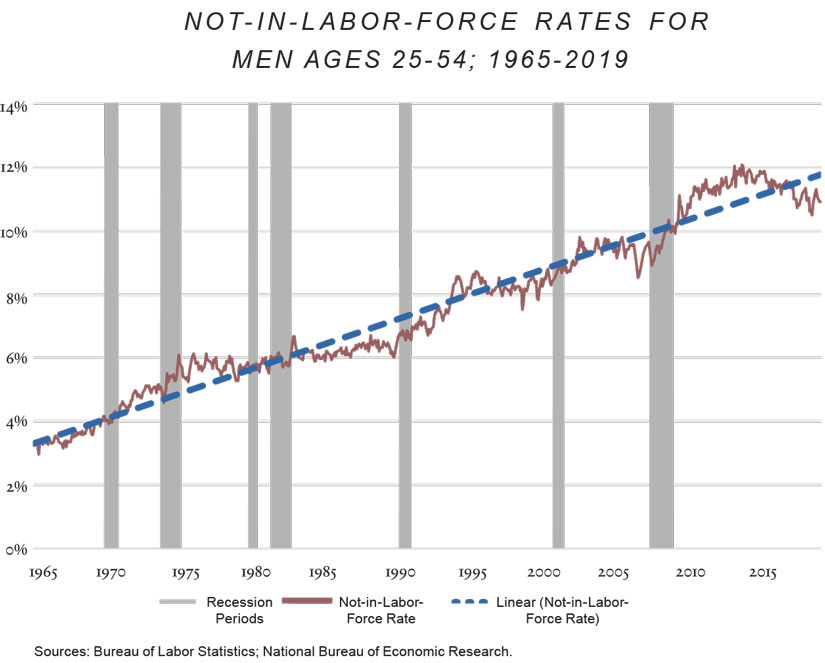
In patriarchy men earn more because patriarchy puts sex to work to motivate men to earn more. This is the genius of patriarchy: putting sex to work. Men have to earn more or they aren’t in the running for the women. Men have to confer on women the benefits required by Briffault’s Law1—and keep conferring them. Hypergamy (women marry up, men marry down) will make men losers if they can’t offer their women a paycheck larger than their own—or if the woman can depend on the dear good judge to award her a slice of her ex-husband’s paycheck along with custody of the children. Their greater earning is what gives men their role as family providers. In the ghettoes, where women support themselves or are supported by Welfare State Feminism, women are promiscuous and men are roleless.
Note that this mess all started with the idea that the children’s interest should come first. Justice and common morality were done away with to allow children to go to their mother in divorce, regardless of fault. The obvious conclusion of earlier generations, that it was in the interest of children for parents to work out their differences and stay together, was superseded with the idea that no child wants to be in an unloving home.
There’s plenty of data showing the opposite, and it’s uncontroversial now that children of divorce have worse outcomes than children in unhappy marriages. In the end, all the talk of the children was a smokescreen to rubber stamp what adults wanted to happen. A few divorces turned into more and more over the years, the stigma slowly washed away, and mass social contagion spread as divorce became normalized.
It might sound like a pipe dream to make divorce extremely difficult and mandate both legally and socially a father’s headship over the family. To the current generation, the idea of Coverture sounds outright barbaric, yet every attempt to break free from the tried-and-true has ended in disaster.
When someone proposes an innovation to modify a time-honored practice, it’s his responsibility to prove it’s better. The Marriage 2.0 of modern times has utterly failed this test. Men don’t want it, and women want it even less. This isn’t something that can be fixed with more household chores, equitable labor, or whatever non-issue is stated. If the law changed so men were de-facto legal indentured servants bound to do the wife’s bidding, women would still find reasons to divorce. Whatever they say, the real reason is simple, they don’t respect a man who is subordinate to them. A man with no power.
The fundamental reason marriage worked was because of its benefits as well as its restrictions, allowing one to focus on productive efforts and long-term planning by closing the door on other options, like divorce. As the popular idea of marriage dissolves due to its incoherence, the only ones who marry are those with an implicit understanding of the old ways, with social controls in sub-communities that police one-another. Even if divorce is technically easy, social stigma keeps many marriages in these communities in line.
Family law courts are an irrational, expensive disaster, and alternatives are going to form. Everybody hates them, they are woefully inconsistent, and their judgements can often be ignored with impunity. Until family courts have the power to deny a divorce and order the quarreling parents to work it out, they will continue to lose authority. Until divorce drops to less than ten percent, marriage rates will continue to plummet.
This is also creating a ripe environment for alternatives to form. In Islamic communities, there is already arbitration based on Muslim principles that is often used instead of the courts, and as society splinters, you’ll see the same arbitration becoming the norm even among white Americans who will start arbitration based on their sub-culture’s principles.
The problems at the macro scale will take a long time, and it’s unlikely any adult will get relief in their lifetime. At the micro level, the only option for men is to “lock in”. Few institutions will have your back, and many will be actively against you. If you want to be the leader, act like the leader. Have a vision, put yourself to the highest standards, and don’t be a moron. Be the “proof of concept”.
Even with macro changes and things improve, marital woes will not go away. Genesis chapter 3 states that there will always be resentment laboring for one’s family, and women will always have a lingering resentment towards their husband.
To the woman he said,
“I will make your pains in childbearing very severe; with painful labor you will give birth to children. Your desire will be for your husband, and he will rule over you.”
To Adam he said,
“Because you listened to your wife and ate fruit from the tree about which I commanded you, ‘You must not eat from it,’ Cursed is the ground because of you; through painful toil you will eat food from it all the days of your life. It will produce thorns and thistles for you, and you will eat the plants of the field. By the sweat of your brow you will eat your food until you return to the ground, since from it you were taken; for dust you are and to dust you will return.”
Simply put, Coverture will return because it works. It will not take the exact medieval form, and there will be many modern adaptations to the old custom. As stated in the beginning, Marriage is a social technology, and when it breaks down, society breaks down with it. Only those who can put claws and teeth back into the marital contract will have offspring who survive to continue having offspring and maintain their unique heritage.
Thank you for reading Social Matter. If you enjoyed this article, please share and subscribe. This is a free article, but I post paywalled articles also. Please become a paid subscriber to access all Social Matter content.
The female, not the male, determines all the conditions of the animal family. Where the female can derive no benefit from association with the male, no such association takes place.
Outstanding article and a wonderful compression of western legal traditions concerning marriage! I believe that there needs to be higher legal standards for divorce in order to provide a disincentive to seeking it for arbitrary and capricious reasons but the core which is rotten is the religious one. I just don’t think secular marriage will ever be successful regardless of the legal structures. If couples don’t understand that you are entering a covenant with God together you’ve lost the foundation to push through the difficult spots in the marriage and the reason you chose to be one flesh to begin with. A true marriage doesn’t need the threat of legal consequences to survive when you fear the spiritual consequences of separation. The horrible outcomes that happen to children of divorce and their parents are really proof of the spiritual consequences that occur no matter the outcome of a court hearing.
I was a product of divorce but overcame it but the truth was I was made to overcome things that I shouldn’t have had to deal with. I’m not bitter and love my parents but they never had the spiritual commitment to each other to overcome the hard times.
I loosely agree with this, it does seem to be a somewhat global and historical norm for children to be retained by husbands in marriage. One of those things tho that ends up needing caveats since our entire system is wonky. And it also seems preferable for a nursing age child to stay with his mother. But generally this seems too lindy to ignore, at least matched the book im reading on this history of marriage