


Ross Douthat recently interviewed Samuel Moyn regarding the gerontocracy. During the conversation, the idea of one person-one vote was challenged. One can tell how the sands have shifted when a smart but relatively milquetoast conservative like Ross gave an endorsement, tepid as it was, of family voting. Such a proposal is the culmination of the understanding that mass democracy is only possible with a people who have a long-term outlook on civilization. Moyn had his own idea, with a system giving higher precedence to younger voters.
Moyn: I’ve gotten in some hot water for proposing we consider overweighting the votes of younger people or assigning the youngest eligible voters proxy votes for the unrepresented children of our country
Douthat: Why not assign them to those children’s parents?
Moyn: Because there’s a divergence of interests between parents and children, I think it’s likelier that young people – not people who are raising families – will have the best insight into the interests of children.
While this is easy to scoff at, and it’s clear both sides have a bias based on historical trends of how these demographics tend to vote, it raises a fundamental question of how society is organized. Is the purpose of a civilization to fulfill the wants and needs of individuals, or to form a healthy basis for family formation and cultural transmission?
For the last several decades, the focus has been the former. One can point at the increasing funding of education, tax credits for children, and long parental leave as being pro-family. However, the acceptance of easy divorce, the pathologizing of free play, and the overall crudity of the physical world with advertisements for weed, adult stores, and coarse language make it hard to maintain a child’s innocence, not to mention the constant push for sexual content directed at younger ages. One only needs to look at trick-or-treating, once a childhood staple, lose popularity with fewer porchlights on welcoming children but a dramatic increase in gory Halloween displays and adult-themed parties.
Still, even with childless people who has aged-out of having kids, there was a cultural understanding to at least pay lip-service to families. While there are outliers like the Human Extinction Project and dark corners of Reddit that make no effort in masking their hatred, they are still pariahs in general culture. Most people have kids, most parents don’t hate their kids, and even those who missed the boat understand their value. That is now changing.
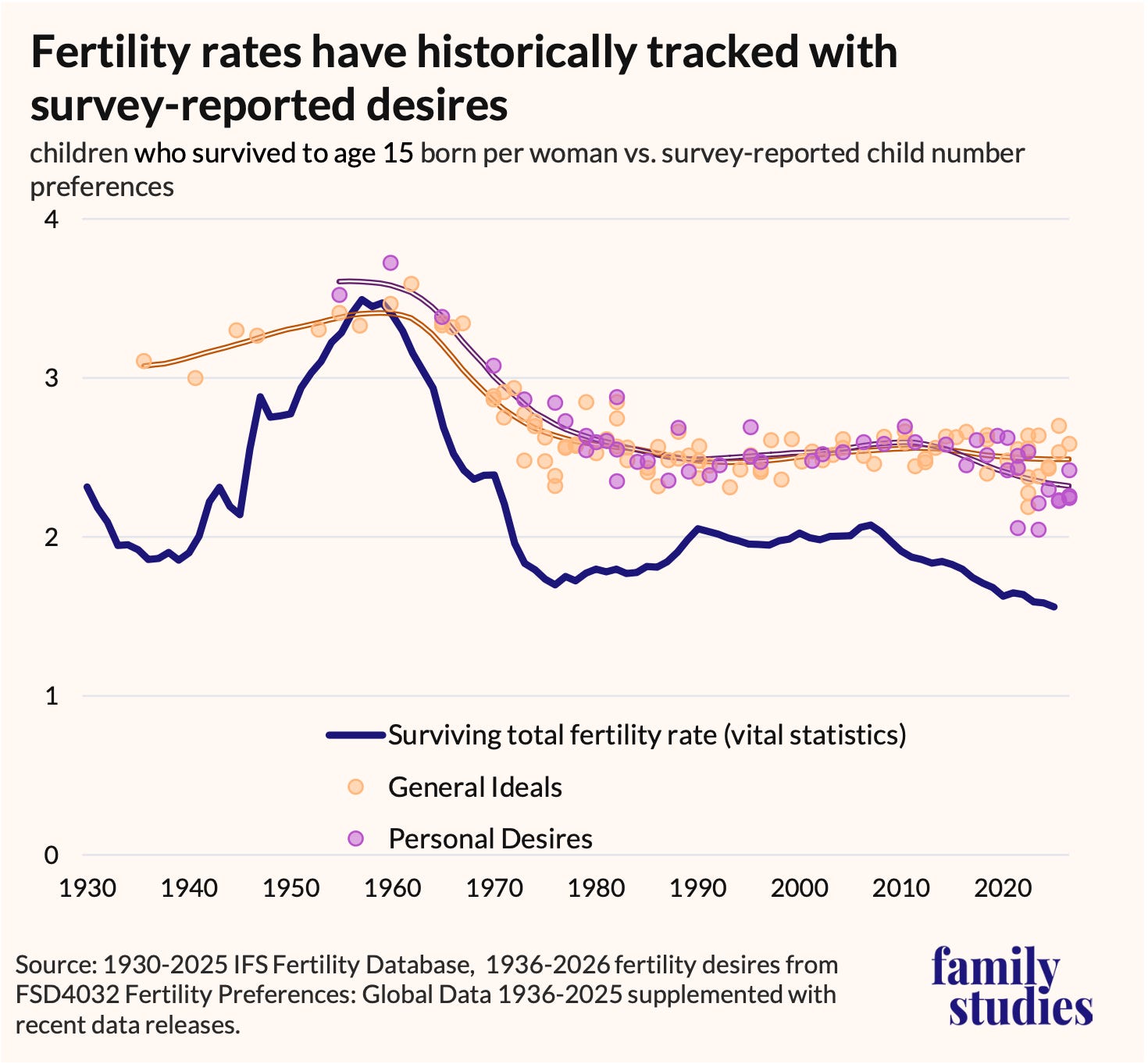
While fertility ideals have rarely been met, there is a distinct downward trend in how many kids people want, and an even steeper decline on the number of children they successfully have. You see a few narratives why this is so, with many pointing to the age of marriage rapidly increasing. You also see trends in Gen Z that point to a large cohort not wanting children at all
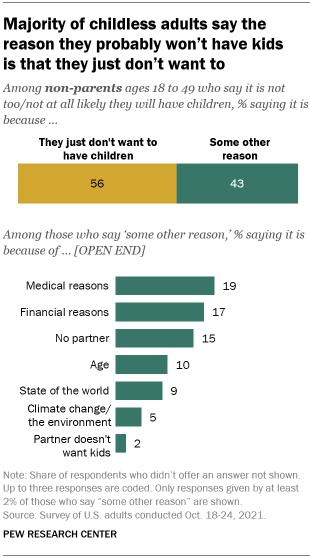
If you go through the stats, there is plenty of confusion and debate about causes, but the trends are undeniable. While there is some optimism things will level out, trends of Gen Z aren’t showing that, showing acceleration of Millennial trends.
Historically, the childless demographic has usually been small, with only about 15% of women being permanently childless, often for reasons such as disability or infertility issues. This has ebbed and flowed with the decades, with childless women in the late 1800’s being significantly higher.
Spinsters were generally known as women who never married, but the term was reserved for women over a certain age. For example, an unmarried woman aged 20 would generally not be considered a spinster, since she still had time left to find a husband. Explanations as to why women did not marry can be found in the history of the time frame. For women in the latter half of the nineteenth century in America, the Civil War greatly decreased the number of eligible men. Periods of economic decline also increased the number of spinsters, as a marriage could be seen as too costly. Women were also seen as caregivers in the Victorian era and may have stayed home in order to care for elderly parents or sick relatives. There were women who chose to live a more independent life or to focus on a career instead, but these reasons were less likely than the ones given above.
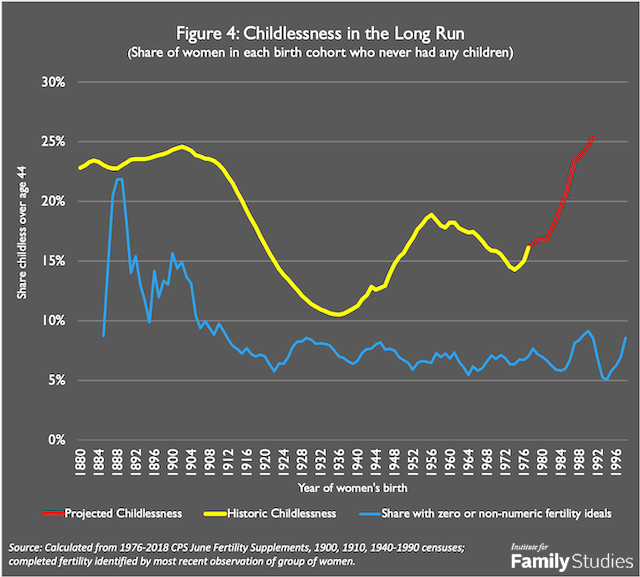
An interesting data point is the number of women who wanted to have zero children in this era. Given this was a very unique trend, one wonders whether this was sincere or a post-hoc rationalization due to the terrible conditions for family formation in that time period.
While civilization survived the Victorian era of a large cohort of women not having children, they were circumvented by less democratic power. Childless women supported large families childless where women often supported their older parents or their sister’s children, absorbing a lot of the energy that would have gone into family formation. Still, even with these opportunities, it’s likely not a coincidence that mass upheavals such as the temperance movement, women’s suffrage, and education reform was instigated in this time. It’s likely not a coincidence political cartoons of this era often featured an old, childless spinster yelling at an apathetic crowd. Not all of these social crusades were negative, obviously, but the social atmosphere with an excess of single women definitely pointed towards moral panics. I’m not going to be able to argue a total causal relationship between such upheavals and childless women, but it’s an interesting data point.
Of course, there were plenty of eras with an excess of men. The traditional way of dealing with such an excess was, of course, exploration and war. In the American frontier, these excess men could be absorbed through gold rushes, hunting, and serving in military roles. Some made their fortune and went home, many others spent their earnings on gambling and prostitution. After they blew what they earned, they would go out again. Unfortunately, without the opportunity of family formation, most men move towards listlessness and vice.
What happens when women’s energy has a broader political outlet and no family to care for? What happens to a significant number of listless, childless men with no frontier outlet? We’re about to find out.
We haven’t come close to the bottom of fertility, and the fate of Gen Z is already largely baked into the cake. It’s likely we are entering an era where around thirty percent of older adults will have no children. While women’s fertility has a clear end date, men’s fertility does not, but it’s also clear that a man who hasn’t had a kid by his fifties is very unlikely to marry a woman young enough to bear him one. We might not hit South Korea levels, but a TFR of less than 1 is a distinct possibility.
As fertility plummets, it becomes its own self-reinforcing spiral. The remaining children will be inundated with aunts and uncles but no cousins. There will be few jobs for rites of passage like being babysitters and helping mom or a relative when she has a child. Boys see fewer family men as role models. Schools will close to deal with the demographic cliff, youth groups like the Scouts will hemorrhage troops, parks will be bereft of children actually playing. With this comes consolidation, meaning longer trips to play with friends, to get an education, and a quiet neighborhood due to lack of children. Even for parents who have kids during this time, the chances are against their children being submerged into a culture that values them and eventually wanting children of their own.
As the demographics collapse, so do the priorities of those with no kids. Suddenly working two jobs to get in “a nice school district” is not applicable. Building a community that is kid friendly, with ample play areas, safe streets, and domestic tranquility becomes less of a concern. The usual civic engagement of coaching little league sports, taking part in school activities, and being an unofficial monitor of unspoken rules loses a large percentage of its adherents. In short, healthy civic engagement will plummet.
That won’t mean civic engagement disappears, but will take other, more dystopian ends. The males who missed the boat on fatherhood will not become vitalist Nietzscheans like some online spergs assume, but will devolve into all sorts of vices. Whether it is gambling, pornography, video games, or other spicy stuff, they will fight to the hilt to maintain their empty but enjoyable pursuits. If you think these are bad now, wait until there is a cohort of men who just stop caring. There will be advertisements for sex bots on billboards, more grotesque Halloween displays on unkempt lawns, and increasingly lousy behavior in public spaces. Any attempt to clamp down will be met with a cohort of angry, childless men who feel society is trying to restrain the little fun they can have. Work ethic will plummet, and the hard-working dependable guy keeping the lights on will stop showing up. The drive to children will turn to apathy towards them, and ultimately checking out of building the infrastructure for the next generation. Things will slowly start breaking, never to be repaired, and the public square will become uglier.
Many childless women, in turn, will turn into the most insufferable, moralizing Karens the world has ever seen, and they will direct their ire towards other parent’s children. Whether this is extending abortion to outright post-birth infanticide (and many are already on this train) or dominating every aspect of a child’s life, they will be a terrifying force. It will be Woke 3.0, with ever increasing powers of the school system and Child Protective Services to impose their will on parents. Homeschooling will be attacked, private schools will be stigmatized, and a massive cohort of women will both develop a post-hoc justification for not having children by saying they hate the little runts while also pretending to speak in the best interests of every child.
Everything points to a legal and moral minefield for parents, thereby removing the impetus for having children even more. This self-repeating cycle will create one of the only implicitly anti-natal civilizations in history, and no one can vote their way out of it. In 1972, 54% of households had a child under 18 living in the household. It is now 39%. It will only get worse. What hope do parents have to vote their interests when they are outnumbered by the childless? Politicians have already slinked away from the pro-family angle. I remember in the 1990’s how both political parties’ platforms focused on raising a family, now the Democratic party avoids it and republicans only pay lip service to stable families. They are already understanding it is becoming a political loser by sheer demographics.
One could retort that good families and children benefit everyone. After all, they are the ones who will pay into social services in old age, and this is when the nastiness will go the other way. Who is going to advocate for the old lady with no kids in a nursing home? Unfortunately, old ladies WITH children often have no one to advocate for her. Who is going to care when she gets bad care, or when some worker ultimately “forgets” to give her meds and she drifts off into oblivion? Is the thirty year-old nurse who pays high taxes going to tell the secluded elderly they have something to live for and MAID is a terrible option when twenty percent of her paycheck is taxed to sustain her life?
One can retort about basic humanity, that someone, whether or not he is related, is still part of a national family. One could argue the better nature of humanity will take over as technology eases the burden of running society and helps keep the social safety net in place. While such optimism is pleasant, it is hard to live life under such abstractions. The glue that has always held society together is the children, and the more unaffiliated families that can form bonds and procreate, the more solid the civilizational foundation is. One of the core reasons for Europe’s success was its ability to remove the clannishness inherent in more tribal societies, and this was done largely through prohibitions on cousin marriage. America was only able to stabilize after generations of intermarriage between the various European ethnic groups, much of which was done through ruthless destruction of ethnic conclaves.
These social technologies require maintenance, and when a large swath of citizens understand not only their immediate line, but their extended line as well is doomed, that civic bond is broken. When those wide family bonds disappear, so does the civilization. The unspoken contract for the old to build for the young, and the young to care for the old, is broken. The multigenerational legacy of the family unit is shattered. What are usually generative impulses become destructive when not bounded. Men become reckless not for glory but only to feel something. Women become authoritarian to scratch the itch of forming a moral order that was once directed at her family.
Robots aren’t going to be able to clean the parks once done by civic minded parents when all their energy is spent protective their children from the degeneration happening all around them. Childhood innocence will be hard to maintain when they are surrounded by either total apathy or psychotically controlling strangers. Parents will band together in a sort of fortress mindset as enemies seem to swarm all around them. The government originally formed for the people and their posterity will be the biggest roadblock in forming the next generation when the majority becomes hostile to them.
Will it end in total extinction? Unlikely, unless some mad geniuses manage to find a way to sterilize humanity. Eventually, biology will take care of this extreme genetic bottleneck, and the humanity that comes out will be vastly different than the behavior of the dying generations. Until then, democracy will not save us. A majority that has lost its impetus to sacrifice and think beyond their own life will be extinguished, and the only thing keeping the nation from being conquered is the fact it will be a global phenomenon, with global consequences.
While some areas will suffer more than others, this malaise will require pain across the board to get through, and that pain will cause additional pain in a self-reinforcing cycle. This might be partially short-circuited by a spiritual revival, or maybe strongman capable of decisive action, but demographics will be rough for the near future, and with it the immolation of bonds build over centuries. Buckle up gents, it’s going to be a wild ride.
Thank you for reading Social Matter. If you liked this article, please subscribe and share. If you want more content like this, consider becoming a paid subscriber.
I don't expect childless people to walk around apologizing or sad-faced - look at Dolly Parton; she had a lot of fun even though she never wanted to be childless, and did so much good for so many children. What I object to is the performative angry gleefulness of some - insisting that they be called "child-FREE" as if children were vermin. It's unhealthy and hostile.
You definitely get at something most people don’t appreciate, which is that there is a huge chasm between parents and childless adults. I’m often at a loss of how understand them as I’m sure they’re at a similar loss trying to understand me. This will precipitate conflict and distrust, and it may get ugly, particularly in progressive blue states.
But, this may bolster the sense of identity in red states where having kids is a good thing and government respects parental rights. Already, we’re seeing this split between the states. As a teacher in Texas, it’s very much the opposite of what you predict. Parents have the last word here. But I know it’s not like that in other states.
We’ll see how this goes. I intend to go forth boldly and take the high ground. I know some people are unlucky at the game of love and family, but most aren’t really trying. I have no interest in winning their approval.