


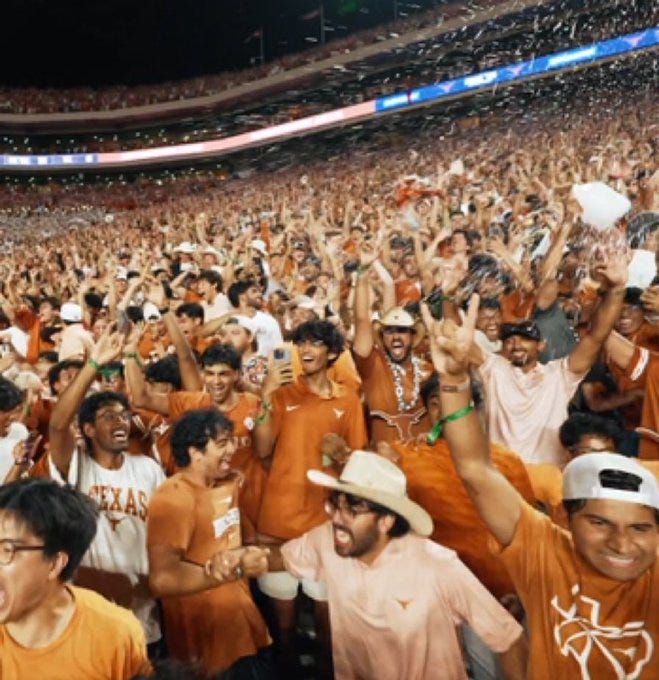
While once considered wild hyperbole by those who wanted to ignore the clear demographic transformation of the Lone Star State, even the most clueless conservative pundit now admits that Texas has been messed with. While the stats have been clear for ages, a photo is worth a thousand graphs, and everyone saw the hard reality regarding the influx of Indians that were in the student section of a recent Texas Longhorns game. The commentary followed a similar pattern, with the immigration restrictionists pointing in horror, the usual suspects talking about the glories of integration, and some Indians gloating about taking over the institutions. In the four steps of modern discourse:
It’s not happening.
It’s happening, but it’s not a big deal.
It’s a good thing.
It’s bad for you, and you deserve it.
No one is arguing step 1 anymore.
The conversation then delineated into the cause of the transformation. Some pointed to rampant test fraud in South Asian cultures, others to gaming the admissions rules by enrolling in low-competition schools and getting in the top five percent of every graduating class, and some to outright nepotism. There is some truth to this, but the hardest pill to swallow is a large percentage took the tests, got a good score, and were admitted fair-and-square. They studied the rules of what was expected and grinded to get their place. Isn’t this what young people are supposed to do?
It’s no secret that Asians do very well in test-taking, and it’s no secret that they cram a lot, doing significantly more homework at night than other groups. While there’s a lot of heat regarding DEI policies, if we didn’t have DEI policies Asians would be the majority of every elite University. White men are heavily discriminated against in college admissions, but Asians are even more so. As much as people want to harp about meritocracy, this is about as close to the meritocracy they wanted. They demanded an objective measure of capability to find the supposed best and brightest to enter the best college. Hence standardized tests. That’s what we’re getting right now, at least in the terms of the game being played. Unfortunately, this is done by destroying these young people’s childhoods and likely stifling their creativity through this relentless rat race of cramming to get the highest scores.
The philosophy for success in academia is becoming more and more conformance, more book learning, more hours of cramming to achieve… what exactly? A good job interview or empty status? The guy spending until 2am every night cramming for math exams with a significant amount of Adderall in his system might know his stuff, but it’s hardly the youth a future leader should have. Even a famously studious man like Napoleon Bonaparte had eclectic tastes that spanned several subjects beyond the classroom. Education is continuously becoming more rigid, more spiritless, more status obsessed. It’s killing the innovative spirit where true learning is achieved and turning American academics into a mimicry of the infamous Chinese Imperial Examination. Many conservatives are unintentionally advocating for a system arguably worse than the most unhinged DEI administrators.
Historically this has not been the case. Colleges were often more or less prep schools for elites to round out their education or for clergy. It was often through familial ties that they got access into these institutions. Democratizing college admissions, especially after World War II with the G.I. Bill, made a far larger swath able to extend their education. The social revolutions in the 1960’s expanded this trend, and soon college was seen as a gateway to the good life open to all.
This democratic revolution has created issues for the powers that be, especially when racial demographics of admissions never go the way that they want them to. It requires them to give many minorities special privileges while punishing others. When it was a vastly white country, this was tolerated. While some whites were given short thrift, the minority population was small enough where the impact was minimal. That is no longer the case, and what was once seen as a beneficial if rather paternal gesture has now caused ethnic feuding for slots.
While a lot of ire was direction by admissions boards that made tests optional and tried to put other criteria into account, their reasons regarding forming a more diverse student body weren’t entirely wrong. While the obsession with racial parity was destructive, the idea you didn’t want a bunch of prep kids from rich schools and its underlying culture overwhelming a public campus was a legitimate want. It blocked legitimate talent from other sources. They understood not everything was test scores, even if their methods to solve this issue were deeply wrong.
Paradoxically, the push for diversity has made every college mandate roughly the same standards. What is expected of a college essay is well-known, what stands out in extra-curriculars follow established patterns, and classes deemed college-ready completely standardized. These resume builders that are supposed to be a supplement tests and show a well-rounded person is a system begging to be gamed, and it doesn’t stop at admissions.
Relentless homogenization inside your standard college campuses matters little if you’re in the Deep South, in the Midwest, or the East Coast. Regardless of where you study, you’re likely to go through a the same sort of curriculum, largely the same sort of school policies, and standard of life and the expectations will be very much the same through all of them. This has created a bland atmosphere with little differentiation between Higher Education institutions, and hence a race to get into the “best” schools as opposed to the school that skills and personality.
Such standardization has been in place for most everyone’s lives. While one can point to significantly different college experiences in the early 20th century, the hyper-conformity has only gotten worse, with academic discipline becoming more sclerotic as the unceasingly samey nature of campus is everywhere. While the academic rigor of places like Stanford and Michigan in engineering will be far more challenging than those of second-tier colleges, it is a difference in degree as opposed to underlying pedagogical philosophy. While the difficulty varies, the material remains largely the same. Campus life is less differentiated also. While some Universities are known for their Greek societies and others for their sports, there is generally little difference in the general levels of conduct expected of the student body, nor varied expectations.
When each graduating class was expanding and the value of the sheepskin kept increasing, this worked fine. If a student didn’t get into a top-tier college, he could get into a mid-tier and have success in a similar environment. As high school graduating classes have dropped due to demographic changes and the value of a degree with regard to expenditures continues to decline, we have hit a situation where elite colleges have never had a more credentialed pool of applicants to pick from while many lower tier colleges are withering away. Colleges as a whole have suffered a 15 percent drop in enrollment since 2010. Over 400 private colleges may close in the coming years. While public colleges have the taxpayers to absorb losses, even they will feel the crunch as subsidies fail to absorb collapsing tuition revenue.
And yet why should every college be subject to this tiered system? Why can’t they play an entirely different game, with an entirely different idea of what merit entails?
Say there exists an athletics-centric college where everyone, regardless of aptitude, is required to participate in grueling college sports and has weightlifting and cardio requirements that go towards his GPA. There is not a single fat person on campus, with their philosophy that a weak body will create a weak mind, and physical discipline is just as important as hitting the books.
Maybe another college takes another approach, considering networking and comradery the key to success, as a band of people with similar goals can work wonders when together. There might be the expectation everyone enters a fraternity or sorority, and late-night parties are encouraged with the university having their own courier service to transfer their drunken students home. The friendships and experience will form countless bonds that extend into both their professional and personal life.
There are countless other variants one could have among the thousands of colleges. Some schools could have levels of military discipline that would make VMI cadets think they need to calm down a little. You could have students living like literal monks with no electronics, a tight schedule, and vows of silence. You could have colleges that eschewed textbooks entirely and just read and discussed academic papers and pivotal discoveries. You could go old-school and have a setup where you pick a master that will guide you through the next four years. You could go the aristocratic route and be an exclusive college for children of old money. You could run with the old joke about college being to get an MRS degree and form your entire campus culture around romance.
This isn’t a crazy idea either. Wyoming Catholic College famously heavily restricts electronics use and access to the internet. The students are required to follow a strict rule of conduct regarding manner and dress. Most and requires students to go on a multiweek backpacking trip into the wilderness:
This three-week stint in the wilderness gives students the satisfaction of climbing 11,000-ft. passes and summiting 13,000-ft. peaks, hiking about 100 miles, fly fishing some of the most beautiful lakes in the Rocky Mountains, and cooking their own meals. They are presented with the opportunity to learn many skills such as working as a team, treating all other members of the group with respect, performing their fair share of the work, tolerating adversity and uncertainty, and developing leadership.
Such unique forms go far beyond religious schools. Some colleges are leaning into the resort atmosphere, embracing being a sort of finishing school for children of wealthy parents. While a resort for rich prep kids seem elitist, but what is elite but cultivating these wealthy young people and putting them into the world of prestige? North Carolina’s High Point University epitomizes this:
Beyond the physical plant, High Point boasts a high-end steak house, a first-run movie theater, valet parking, an arcade, a car wash, an ice cream truck, an indoor track with built-in pacing system, and a concierge at the student union. High Point even has a “director of wow” charged with delighting students. It’s higher education run by Disney.
You also have elite schools that wear their political leanings on their sleeve. Hillsdale College, pretty much the Ivy league of the old-blood conservative, famously does not accept any federal funding so they can maintain their independence. Walk across campus and read their bulletin boards awash in Christian events, reverence for the past, and general wholesomeness and it’s like entering a bizarro world where the campus revolutions of the 1960’s never happened. While you get to tackle conflicting views, the college wears its ideology on its sleeve.
The College values the merit of each unique individual, rather than succumbing to the dehumanizing, discriminatory trend of so-called “social justice” and “multicultural diversity,” which judges individuals not as individuals, but as members of a group and which pits one group against other competing groups in divisive power struggles.
There are also schools that relishes frontier spirit of its homeland and the value of hard labor. Deep Springs College, with a whopping enrollment of 100 people, has a very unique style of higher education.
In addition to their academic and self-governance responsibilities, each student at Deep Springs works approximately twenty hours a week. Students do everything from milking our two dairy cows, to irrigating our 155-acre alfalfa farm, to cooking meals and cleaning the community’s dishes three times a day. Most students switch labor positions every two months, though some positions require a four month commitment.
There are others, such as Oberlin known for its aggressive left-wing activism, and Reed College known for its eclectic curriculum and customs. HBCU’s have been a mainstay of higher education for over a century.
Likely the most destructive misnomer of the past century is the evolution of the idea of Meritocracy, but little understanding of what it entails. It’s assumed merit has to be objective and quantitative. In the end, though, it is always filtered through the moral lens of what’s fair. Poor kids should get the same opportunities as rich kids because that’s fair. You can’t discriminate based on ethnicity because that’s not fair. You have to have clear rules everyone follows because that’s fair. While this sounds nice, what does this entail?
Focusing on fairness flattens everything. In a purely meritocratic system based on test scores, a supposed conservative dream, it means that smooth party-goer that has potential to be an elite salesman will go to a small state school instead of a top-tier business school. It means Texans whose ancestors have been there since the Alamo will compete with South Asians whose parents just showed up. It means virtue means nothing, heritage means nothing, and only activities that have a clear impact on GDP is acceptable.
Even in the spiritually barren idea that colleges are primarily for job training, such rigid thinking misses countless intangibles. As anyone who has suffered through HR sanctioned “Leadership Academies” knows this isn’t something that can be simplified down to a credential. As much as you want to streamline every aspect of human existence, some things can’t be whittled down to their base parts. While a good process can streamline many things, it can’t streamline the intangibles that make a business culture flourish. The idea that a hyper-neurotic, status-obsessed student subjecting himself to nonstop cramming in his field of study will naturally lead to better outcomes than the mild loose cannon that skips class once in a while to work on his passion project is often false. One only needs to see the visionaries who dropped out of college to realize that. The rigid rule-followers are great for incremental improvements, but wholly unequipped to handle risk. Yet every college is designed to conform everyone to similar rules and standards.
Instead of colleges focusing on competing on the international level, perhaps it would be better for higher education to have a sense of place. It would be better for Midwestern land grant colleges to embrace its agricultural past and instill it in all its students rather than to be embarrassed by it. It would be better for west coast universities to embrace its frontier heritage and offer an experience that brings it to the next generation. Colleges that were formed for the benefit of the progeny of a certain people should not be ashamed that those children get preference. It’s not about fairness or quantitative merit, but an understanding of a more grounded purpose.
To hell with certifications. To hell with standardizing curriculum. To hell with the faceless admissions process. Imagine what a more interesting world it would be if all college interviews were face-to-face to see if you were a good fit. Imagine if culture was more than wearing team colors and going to an overpriced football game. Imagine a University having a stronger charism than competing to be in a "Best Colleges” list or making sure their students fit the same academic mold as Yale.
This would require the college bureaucracy to wither away and personal contacts taking precedence over sterile applications, but in this age of easy travel it’s doable. It would mean college campuses of tens of thousands will become unmanageable, but I fail to see how this is a bad thing. It’s not like this level of scale has kept down tuition costs.
The only thing that can kill the resume-padding game striverism encourages is to change the game. It means removing status from the equation and putting a unique sense of place and identity in its place. This means something more parochial, more limited, but ultimately more human. It means the “citizen of the world” mindset of status-obsessed students makes way to something smaller, but far more fulfilling. Instead of thinking in terms of an all-encompassing idea of merit, reform of colleges starts with understanding that bigger is not better, and impersonal standards can never fully quantify human potential.
Thank you for reading Social Matter. If you enjoyed this post, please share and subscribe. If you want to support this Substack even more, paid subscribers are greatly appreciated.