


It’s well understood across the political spectrum that American history has been whitewashed. Progressives have had grievances about how schools teach history for decades, with many students familiar with the holy writ of educators, “Lies My Teacher Told Me”. The fact that most modern history books are little different from Howard Zinn’s works hasn’t eased this criticism. For more reactionary types, there has been strong momentum in dismantling the Whiggish story of World War II, with McMeekin’s “Stalin’s War” bringing much needed discourse to the subject. Another vector of attack has been the Civil Rights movement with the publication of Caldwell’s “Age of Entitlement”. A decade earlier, Burroughs’ “Days of Rage” brought to public attention the wave of violence and unrest the decade following the tumultuous 1960s.
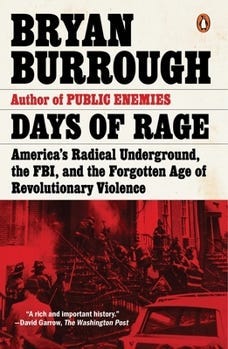
When I began reading “Days of Rage”, I was expecting to read the exploits of hardened radical-left terrorist organizations that embroiled the nation in relentless bombings and police attacks in the aftermath of the Civil Rights movement. I already heard of Bill Ayers, the mastermind bomb plotter who decades later kick-started the Obama campaign, and had cursory knowledge of Bernardine Dohrn, the radical Marxist who later had a successful law career. I was curious about the clever machinations these underground figures employed to not only have long bombing campaigns, but successful careers in the public sphere after their notorious past.
I expected a captivating crime drama. What I got was a dark comedy.
I am increasingly convinced the exploits of the Weather Underground were memory-holed not because of their violent nature, but because the organization was a clown show. Originally an arm of the Students for a Democratic Society (SDS), their first major operation was the “Days of Rage,” a fierce protest designed to bring the unrest of the Vietnam War home. They congregated in Chicago on October 9, 1969, intending to riot until the city fell to its knees. The lackluster turnout didn’t dissuade them, nor did the overwhelming police presence. The outcome was predictable, with hundreds of vandals arrested and the protests fizzling out with nothing gained.
A reasonable organization would reflect on this failure and pivot. Not the Weathermen, who doubled down on terrorist violence they neither had the manpower nor public support to continue. This was brought to a head during an SDS convention in December of 1969, when the Weathermen started a civil war in the ranks after gaining the Black Panther’s backing.
Sycophancy to black militants was a common theme in every left-wing revolutionary group then, and things haven’t changed. It becomes comical as the book progresses. These white radicals received blistering contempt and humiliation from black radical groups, only to kowtow to them even more. When the Weathermen left the SDS and opened their own field offices, the Black Panthers would walk in and steal equipment as the staff watched on helplessly. They were then called cowards and racists for their trouble.
When several Weathermen blew themselves up from poor bomb-making skills, they pivoted to avoid killing. The black radicals were a different story. There is a stark dichotomy between the black radicals from crime-ridden neighborhoods and the often upper-middle-class whites in organizations like the Weather Underground. The black militants were less organized but had far more propensity for extreme violence, killing police officers and other targets. The chapters give the reader massive whiplash, as one chapter will document the white militants having countless discussions, debates, and impotent bombings, followed by chapters on black militants documenting the wildest shootouts you will ever read.
One could go into countless detail to the absurdity of these movements. From the struggle sessions to the orgies to the irony of their Marxist leadership living the high life while subordinates starve, there are countless avenues to explore. And this doesn’t even get into the bizarre love triangles. Charles Haywood has an excellent summary of the book here for those who want to know more.
The aftermath of this mess is that these militants, while killing several innocent people and inflicting massive property damage, did little to disrupt everyone’s day-to-day life. Outside radical circles, no one had any sympathy for bombings. The constant explosions got a yawn from the population after a while, and even the famous kidnapping of Patty Hearst became little more than tabloid gossip. They gave law enforcement a headache for a decade, but the revolution never happened. The only outcomes were the terrorists being killed or arrested, often with shockingly lenient sentences.
There is the obvious explanation that the American people were simply sick of the violence and mayhem, but this only tells part of the story. Many leftists fawned over hardened criminals receiving justifiably harsh sentences. George Jackson published “Soledad Brothers” to international acclaim while he was in prison for armed robbery. There was strong progressive sympathy for the Black Panthers, even with their violent rhetoric. There was still an appetite for mayhem among the left if the messaging fit.
The biggest failure of all these groups wasn’t their clownish antics. Ridiculous movements have often stumbled into power, but not with terrible messaging. Reading the comms of the Weathermen, Symbionese Liberation Army, Black Liberation Army, etc. one will notice the constant dropping of names such as Che Guevara, Mao Zedong, Vladimir Lenin, etc. as if they have any resonance with average Americans. The black militants also replaced their American names with Africanized ones. You would see names like Kwame Ture, Assata Shakur, and others that sounded weird and exotic to your average American. While this was designed to give blacks a sense of unique identity, it failed. Most blacks didn’t understand them. There was nothing relatable about it. It didn’t feel American.
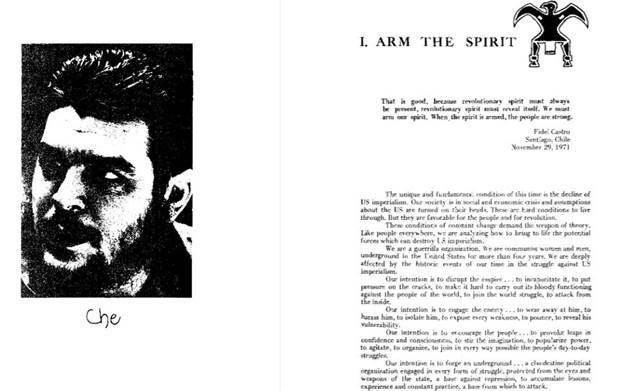
From the vantage point of the internationalist left, this made sense. They considered themselves part of a global revolution that sought to topple not just the hegemony of United States, but all non-Communist nations. They visualized the globe wrapped up in the same flavor of revolution that seized Cuba, Russia, China, and Vietnam. No American saw it that way though. Poor whites, their so-called proletariat, saw themselves as part of a distinct culture, and no amount of Marxist theory would force them to change their core identity into some sort of red revolutionary. Even minorities such as Chicanos, American Indians, etc. saw nothing in their identity to transform a Communist an ocean away into a brother in arms. The Weathermen experienced a powerful deracination that sought to repent of their bourgeois upbringing with violent rhetoric. As much as they tried to escape their youth, in the end it really was just a LARP. When they tried to reestablish themselves with other radical groups, it failed miserably. All the theorizing and mental models they produced were just strange abstractions having little resonance with so-called allies that were supposed to be their vanguard.
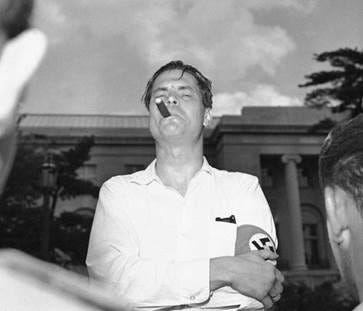
This wasn’t only a left-wing radical problem either. Hard-right activists also employed foreign symbols, with equally lousy results. Many of these rotated around fascist parties in the World War II era, with George Lincoln Rockwell infamously giving strong praise to a certain Austrian painter. If Marx, Lenin, and Mao felt incredibly foreign, doing an about-face and praising a man we went to war against was even more so. These efforts, while less violent, made a perfect boogeyman to use against rightists with valid concerns about immigration, civil rights, and crime.
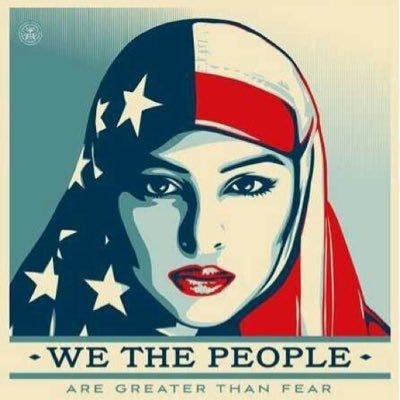
It's a common trope that you can't work with what you want, but with what you have. When dealing with a nation with a long history, this goes doubly so. The most successful movements have always made their propaganda sound as American as apple pie. There are many avenues one can take that fit the national story. The left has employed the ideas of the land of opportunity, equality, black liberation, and immigration to profound effect. As much as the right dislikes it, these have always been part of the national story. For example, the Women's March in Washington in 2017 featured a Muslim woman in the veil in a red, white, and blue scheme like the wildly successful Obama campaign, emphasizing core American values in a new manner.
Since the 1990s, any photo of a large group of whites is now seen by a large demographic as strange and Unamerican. The American Story has shifted its emphasis on diversity to such an extent that segregation, whether formal or informal, is viewed as a blemish on our core values.
In response, the right has focused on the founding fathers, the nation being built on Anglo principles, federalism, and implicit “New Rome” qualities in its founding. When the left tried to protest Trump in the "No Kings" marches, they tried to correlate a strong executive with the Unamerican value of kingship. This was a failure to read the room, as the right does not see Trump as a king, but a Caesar figure brought in to restore order. This sort of authoritarian president is a deeply American concept with powerful executives like Teddy Roosevelt, Abraham Lincoln, and Franklin Roosevelt. It’s been baked into the fabric of the nation.
It needs to be emphasized that these the old left and right values both coherent narratives, and which one dominates is more a matter of will and rhetoric than discourse and reason. There's plenty of room to shift a narrative to your goals and get the population on board. The left has faltered in recent years as their blatant anti-white policies can't be squared with the idea of equality. The Civil Rights angle culminated in gay unions being legalized, but while propaganda sanitized the realities of the gay subculture, the transgender movement has become small, strange, and disgusting. Black liberation has reached its apex, with the average man wondering what mass riots and looting have to do with giving blacks a better life.
Their new top intellects have floundered. The left was very effective in deconstruction, but ineffective in creating anything to take its place. They have the advantage of some homegrown talent though. Whatever your opinion of Ta-Nehisi Coates, he represents a historical continuation of the black civil rights movement. Robin DeAngelo represents the modern iteration of the march for equality. They don't quote Marx, Lenin, and such anymore, realizing the dead end, but these figures still lack charisma and a cohesive model that explains the world.
Trump has threaded the needle between aggressive overhaul and Classic Americana well, focusing his rhetoric on equality under the law, keeping our unique heritage, and pushing order for real this time instead of just tweeting it. Contrary to the haphazard messaging of the first term, he knows his mandate and how to sell it to the public.
The dissident intellectual sphere has rediscovered brilliant figures like James Burnham to come to terms with the drastic changes in American culture. They have also found many other foreign thinkers once lost to time who give powerful insights into the human condition. Right wing spheres talk about Spengler and his cycles of history, De Maistre and his criticisms of the French Revolution, and Junger's heavy calls to resistance in the face of an all-encompassing state. The more esoteric ones have experimented with such mystical figures like Julius Evola. The problem is that these figures can feel just as distant and foreign as the left-wing revolutionaries of the past.
While America started as an offshoot of old-world Anglo culture, it quickly developed an identity of its own with its own symbols, ideals, and slogans that separated it from the land it rebelled against. Reading any of their works shows a mode of thought drastically different from intellectuals in the American tradition. While the themes are universal, the method of delivery is not. Give your average Joe a copy of Junger’s "The Worker" and he'll walk away confused. Give him a copy of Evola’s “Revolt Against the Modern World” and he’ll want you institutionalized.
Not that there is nothing useful in these thinkers, and any man worth his salt should read deep into not only his own history, but the chronology and struggles of all the great civilizations. Being able to notice patterns and build a framework of how politics works, both in the abstract and the real, is critical to any movement's success.
What needs to be done after contemplating all these thinkers and forming them into a cohesive whole is the ability to make a cultural translation of their thought in a way palatable to the society you live in. Some translate better than others. Junger's “Forest Passage” fits in well with the American ethos of freedom, but De Maistre's Catholic monarchism is a tougher hill to climb. It becomes a matter of taking these thinkers and distilling them down to their essence, a slogan if you will, that can resonate and transition the old national narrative to the new.
There's always been this myopia among intellectuals that assumes that once they find a solution everything else will fall into place. You see this in the idea of Marxist ideology, which sees a worker's revolution as inevitable. As it has failed again, new interpretations and appendices are given why. In the right, there's often a sort of fatalism that says no matter how well you understand the problem, there's no solution. You just have to wait it out. You see this in Spengler’s rise and fall of civilizations and the assumed inevitability of a Caesar figure rising when social conditions become unbearable. It's arrogant confidence that allows one to feel intellectually superior while doing nothing as the world burns.
Right now, the disparate elements of the American right have ideas, but lack a proper form that fills the American ethos. The argument over the best form of government is always a misnomer, as no government has been formed from a clean slate, and the ones that tried were savagely bloody and chaotic. There are the Monarchists who want a king but do not know how to square that circle with the founding ethos of the nation. Will they accept a Caesar? There are the secular rightists who want to see the remnants of Christianity wiped away, but even Soviet Russia failed to do this. You have the euro-ethnonationalists who want a racially pure population, but it's hard to square with the reality that blacks existed in large numbers here since the nation’s formation.
There's agreement that what we have doesn't work, and agreement on policy that needs to be put in place, but little in terms of an evolving story that legitimizes them in the public mind. As the left-wing radicals like the Weather Underground found out, you need legitimacy to give your movement traction. Both the left and the right are stuck, being unable to come up with an electrifying narrative that tells the current American reality. Perhaps with the mass deracination of the population such a thing is impossible now. How can you thread the needle of resonating with both the countless immigrants coming in from Hart-Cellar and the citizens whose ancestors tamed the frontier? How can you mesh those Indians who went through the H1B to Citizenship pipeline with the citizens who can trace their ancestry to Plymouth Rock? And if we can't have an all-encompassing ethos, can we even call ourselves a nation? Are we destined to be a conglameration of economic interests?
While culture changes in fits and starts and there is a distinct homogenization happening all over the globe, it’s still true that Americans aren’t Africans, Asians, South Americans, or Europeans. Heritage Americans are still a distinct people with a long history. The massive upwelling of newcomers also have a long story, just not in this country, and an interest in diluting the American mythos to give themselves a place. While this has worked with other minorities like the Italians, Irish, etc. it remains to be seen whether the American narrative can survive the influx of Asians and South Americans.
At a certain point, broaden a narrative too much and it becomes abstract pablum, representing nothing real.
This might be the final transition from nation to empire, where the idealism of a distinct cause is replaced with the pragmatic realpolitik of varied interests wanting a piece of the pie. It becomes a question of whether people accept the empire model of interests to sate, or have a totalitarian urge to homogenize the empire into the same form. It’s likely we’ll host fractured narratives within a vast, powerful country. The ones who can foster a dream among both the elites and the salt of the Earth will have a powerful advantage in the next era. It’s clear though, that neither the left nor the right will be happy with the outcome. It’s just a matter of how unsatisfied they are.
Thank you for reading Social Matter. If you liked this article, please subscribe and share. Remember, real Americans become paid subscribers.
While culture changes in fits and starts and there is a distinct homogenization happening all over the globe...
===
This doesn't seem to be happening anywhere. Groups don't mix much. America's version, with Italians eventually marrying the Irish and even the WASPs (to pick one example) was unusual because American culture -- Anglo culture -- was so strong. The Italians were so keen to become American many refused to speak Italian to their children and often gave them English names.
Now its own people seek to undermine it, as if American culture is something to be discarded, but it still doesn't change anything. The newcomers are not mixing. No one in India thinks Vivek Ramaswamy is American, for example. Only Westerners entertain these ideas. None of the immigrants want multiculturalism because no one can survive it. Everyone eventually is forced to carve out some territory just for basic safety.
Homogenization isn't happening anywhere. Global homogenization, globohomo, is a strategy that is failing. It seems to have devolved into us shipping out junk food, feminism and porn to a totally unprepared world with devastating effects. Obesity is on the rise in the Gulf States due to American junk food outlets, if you can believe that. And I suspect feminism will destroy the Far East and ultimately the Islamic world too.
Shipping the global south to America and Europe just creates strife. It homogenizes nothing. If anything it polarizes to extremes. The end result I suspect will be the emergence of tribalism across the globe, not homogenization.
As for public propaganda in America, the founding fathers are ALWAYS a good choice. Largely, they hated democracy and also cautioned against licentiousness. Quote John Adams and George Washington! Their own ideological diversity also helps because you can pick and choose the right quotes for the right topic. Cautioning against foreign influence? There's a quote for that. The ills of democracy? There's a quote for that. Distinguishing between liberty and licentiousness? There are also quotes for that.
Generally, your message should be tailored towards said nation, both because us right-wingers are generally patriotic, and also it is practically successful with normal people. The right-wing message in America should be distinctly American, in Britain distinctly British, in Germany distinctly German, etc.