


The ritual sacrifice has been performed ever since man developed a religious identity. It’s the wholehearted giving of something valuable, whether it’s for one’s ancestors, to save those you cherish, or to appease an angry god. Sometimes the sacrifice is made out of a pure altruistic love expecting nothing in return, sometimes it’s part of an incantation that expects a clear outcome. Every religion has different theologies, stemming from the sacrifice being the demand and obligation to one’s deity, to the deity sacrificing Himself for mankind. The level also varies, from basic rituals a few times a year to demanding the entirety of one’s life work.
The Book of Genesis recounts the story of Abraham, a godly man whose wife was cursed with barrenness. When they reached old age, and Sarah came to terms with her station in life, God appeared to Abraham proclaiming that not only would his wife conceive a child, but his seed would be the wellspring of a new nation. Abraham told her of his fantastical vision, and she responded with mild derision at such an impossibility. Isaac was born soon afterwards.
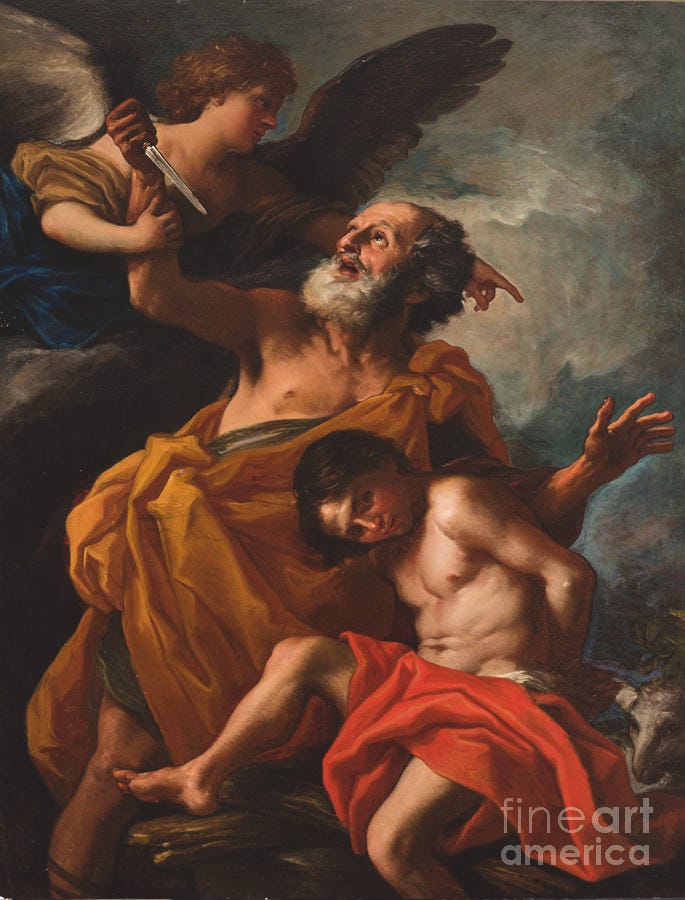
The family grew together, and Isaac became a young man. God then appeared to Abraham again with an unconscionable order. He was to sacrifice his son Isaac back to Himself. Abraham, not understanding but obeying, took him to the mountain for the sacrifice. Just as he was about to plunge the knife into his son’s tied body, an angel appeared and told him to halt, ordering him to sacrifice a nearby ram instead.
Familiarity with the story lessens its shocking implications. Most everyone, even the secular, heard the story as a young child. It's a tale where the more layers you peel, the more disturbing it becomes. How could Abraham be certain of his mission? How did he know this wasn't the ravings of a madman? How was he expecting to justify killing their son to his wife, the woman who waited more than a half-century to have a child? How could he look at his son in the face after the angel saved his life? Wouldn't the son now see the father as a monster? Even in those times, there was no moral principle to justify the horrifying decision Abraham made, and yet he was called to do something no one else would understand and would seem to betray God's own promise.
How is one to explain the contradiction illustrated by that orator? Is it because Abraham had a prescriptive right to be a great man, so that what he did is great, and when another does the same it is sin, a heinous sin? In that case I do not wish to participate in such thoughtless eulogy. If faith does not make it a holy act to be willing to murder one's son, then let the same condemnation be pronounced upon Abraham as upon every other man. If a man perhaps lacks courage to carry his thought through, and to say that Abraham was a murderer, then it is surely better to acquire this courage, rather than waste time upon undeserved eulogies. The ethical expression for what Abraham did is, that he would murder Isaac; the religious expression is, that he would sacrifice Isaac; but precisely in this contradiction consists the dread which can well make a man sleepless, and yet Abraham is not what he is without this dread.
Soren Kierkegaard, Fear and Trembling
Soren Kierkegaard, the father of modern existentialism, went over this dilemma in his most famous work, “Fear and Trembling”. An eccentric, solitary man, he railed against the Danish Church of the time, accusing it of catering to milquetoast comfort rather than radical discipleship. His preeminent idea was that faith went beyond reason, experience, and even ethics, a radical leap into the divine. He argued that there were times when even universal ethics fails, and it's demanded that one acts in a way that will be seen as monstrous by everyone else, making sacrifices that only make sense between the faithful man and God. The man of faith doesn’t see this as tragic, as he walks with a conviction and hope for the future. To this man, faith is the assurance that, through Virtue of the Absurd, whatever you sacrifice will be returned to you.
This brings incredible issues to resolve, as it would seem this philosophy is more a sophistic rationalization to act in deeply immoral ways than living for a higher purpose. One has to wonder whether there is such thing as universal ethics exists if the man of faith steps right over it. Still, if one looking at history and the struggles of life, there’s logic to it. Sometimes the faithful man is forced to act in a way where it's hard to differentiate him from a tyrant. Think of the man who must rebel against his government, leaving to the deaths of countless people, because of a vision of the future if he does nothing. Think of the only child who defies the wishes of his parents, possibly leaving them destitute in old age, to become a missionary in a foreign land. Think of the peasant woman who has a vision to command a great army and push out invaders. There are situations that no ethical code, no matter how robust, is able to give direction for. Situations that make one look like a madman. Even with the most internally cohesive moral system, there are times they must be broken for the greater glory of God.
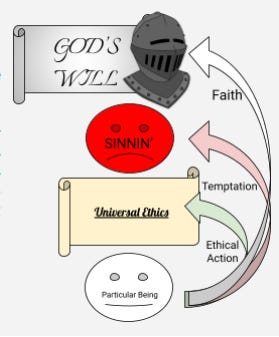
Whether you get moral education from secularists or the devoutly religious, they all give a framework to follow, a list of rules and commands that one is expected to live a good life. Don’t kill. Don’t steal. Respect other people. With time, this moral code acts as a barrier, limiting options one is willing to take. While suitable for the everyman and daily situations, Kierkegaard argued God demanded much more, and everyone had to come to terms with the terror of making a ptruly terrifying decision.
Realizing one has the ability to make an infinite number of decisions, no matter one's state in life, is a paralyzing, anxiety inducing realization. When one looks at the heroin riddled junkie in the corner and understands that is an option just as much as a stable home with a picket fence gives an understanding of the tenuousness of human existence. Of course, it's impossible to contemplate every single option all the time, and everyone takes mental shortcuts in making decisions that are less extreme, socially acceptable, and a known quantity.
When one has nothing to lose, the drive to extreme and dangerous actions is far more tempting. There’s a reason it’s easier for a military commander to order eighteen-year-old soldiers up a hill in a vicious firefight than a thirty-year-old dad with a wife and three kids. The father will have no stomach for it. As one goes through life, the bonds and obligations of day-to-day life is a chain limiting one’s choices.
Strangely enough, even when one’s state is misery, the sheer inertia of daily living creates an empty familiarity that feels comfortable in its predictability. Until life reaches a boiling point, most people would prefer the known entity of their lousy job with lousy pay than embrace the risk of something new. As one grows, so do the habits of mind that limit what one conceives as their options. Countless mental walls insulate a man from the psychic pain of making a difficult and necessary choice.
You see countless men who become demoralized, angry, and slovenly rather than confront the cause of their misery or breaking the chain binding them. It’s not only sloth, but terror of what would happen if he actually reached his goal or failed trying. It’s a means to always tell oneself you could achieve something if you took the option. It’s the mental pain of changing everything about oneself that leaves one in stasis with his miserable existence. There’s a terror or what might happen, and what others will think if you succeeded.
A primal urge of humans as social beings is to be seen as a good person. Even when one’s life is upside down, there’s that pro-social want to be assured that, while they are embittered, depressed, and detached from life, everyone sees them as more or less decent. He’s predictable. He doesn’t have crazy dreams that will strain the social fabric. He’s not dangerous. For many, this is the most they can aspire to.
There is a fear of the fanatic who is willing to upheave everything to bring his vision into fruition, to act in ways that defies the moral paradigm of general society. Often, he will be by all external indications normal, but will have a light-heartedness about him, a soft confidence that even if everything around him is taken away, he will still walk with serene lightness contemplating the miracle of life. It’s the mind of a man who exists outside the world even as his physical form walks among us. He lives by ethical norms, until the moment he’s called to suspend them for something higher. He enjoys what he is given but is willing to give it back at a moment’s notice. This archetype is what Kierkegaard termed The Knight of Faith.
He lives as carefree as a ne'er-do-well, and yet he buys up the acceptable time at the dearest price, for he does not do the least thing except by virtue of the absurd. And yet, and yet–actually I could become furious over it, for envy if for no other reason–this man has made and every instant is making the movements of infinity. With infinite resignation he has drained the cup of life's profound sadness, he knows the bliss of the infinite, he senses the pain of renouncing everything, the dearest things he possesses in the world, and yet finiteness tastes to him just as good as to one who never knew anything higher, for his continuance in the finite did not bear a trace of the cowed and fearful spirit produced by the process of training; and yet he has this sense of security in enjoying it, as though the finite life were the surest thing of all. And yet, and yet the whole earthly form he exhibits is a new creation by virtue of the absurd. He resigned everything infinitely, and then he grasped everything again by virtue of the absurd. He constantly makes the movements of infinity, but he does this with such correctness and assurance that he constantly gets the finite out of it, and there is not a second when one has a notion of anything else.
If being seen as a terrible person is a lingering fear in all men, most would prefer to die than become an outcast. People will create immense moral frameworks in order to act virtuously and also to avoid decisions they fear. They are formed by one’s upbringing, the community one finds himself in, and one’s own personal conviction, built from years of personal experience. Still, most will find themselves staring down a situation where they know in their heart none of their ethical codes, social conventions, or experiences can give a definite answer. Only one’s faith. The choice becomes taking the leap and doing the right thing or doing the wrong thing to avoid the angst of being seen as evil by general society.

The Old Conservatives and Virtue of the Absurd
Its impotency is not hard, indeed, to explain. It is worthless because it is the conservatism of expediency only, and not of sturdy principle. It intends to risk nothing serious for the sake of the truth, and has no idea of being guilty of the folly of martyrdom. It always when about to enter a protest very blandly informs the wild beast whose path it essays to stop, that its “bark is worse than its bite,” and that it only means to save its manners by enacting its decent role of resistance: The only practical purpose which it now serves in American politics is to give enough exercise to Radicalism to keep it “in wind,” and to prevent its becoming pursy and lazy, from having nothing to whip.
Robert Dabney
It’s well understood that the defenders of tradition in previous generations failed miserably. The quote by Robert Dabney above is just as true now as over a century ago when he penned it. There has always been a deep anxiety in conservative people. They want to maintain the social order they know is better for both themselves and for human flourishing but lack the radicalism by their very nature this is necessary to defend it. There is always some progressive victory where the conservatives get routed and their talk about principles turns into a milquetoast plea to not rock the boat. The new radical innovation becomes a core bedrock of people who exclaimed it was a hill to die on just a decade ago.
It’s cowardice, of course, but not in the way that’s usually expressed. Conservatives live within a culture, a culture they love, even as it degrades. As a battle becomes a lost cause, they are trapped with a stark decision. They can either surrender, or burn the whole system to the ground. Conservatives, living within the ethical paradigm of day-to-day life, are unable to find moral justification to go to war and cause mass destruction and mayhem, essentially destroying their beloved country in order to save it. Within the ethics of daily life, it’s wrong to bring up arms against one’s government and it’s wrong to burn and destroy when a political battle fails to go one’s way.
Most of all, one of the most terrifying experiences is truly winning and bending the world to newfound power. It’s bound to create lifetime enemies, and the possibility of being condemned in the history books as the embodiment of evil. A man who continually loses, while he is not respected, is tolerated. For most eras of the American experiment, when someone loses a political fight there is an implied surrender, and the victor nods his head and lets him continue living in the new order.
Now, in modern times this is not true, as the January 6th protestors know all too well, but there is a safe comfort in being the perpetual loser, the rationalization that you really did give it everything, and in retrospect the cause not that big of a deal to begin with. Life goes on. There’s still plenty to be thankful for and doing something drastic would run the risk of losing everything. As much as they cake their platitudes in religious terms, they are no Knights of Faith, and refuse to be seen as evil insurrectionists, terrorists, or reactionaries to defend what they cherish. They dismiss the lingering thought that suspension of the ethical was not only possible, but demanded.
This suspension of daily ethics brings with it an enormous responsibility. As you become the sole arbiter of the act of faith, the decision is solely between you and God. Can you say, with total confidence, that your suspension of the ethical is from the will of God and not your own ego? Are your decisions made out of divine mission as opposed to malice? Are you willing to have total faith that, no matter what, the Lord will restore what you sacrificed? Are you willing to possibly be seen as a lunatic by your friends, family, and peers in order to pursue God’s command? You will need to have the virtues of a saint to take this cross on oneself.
And yet many of us will be called to this in the years ahead, and we can’t cower like our leadership of yesteryear. Many of us already have ideas that is considered inhuman, and soon we will need to wield power in ways that are not an internet LARP. The question will become whether we can choose this Golden Path with a serene and joyful heart, willing to make the awful sacrifices coming our way to bring about a better world. The crumbling of the old order will make our choices skyrocket, and vengeance and malice could easily swarm and overrun those who never disciplined their worst impulses, and failing in their ultimate goals in the process.
Courage is almost a contradiction in terms. It means a strong desire to live, taking the form of a readiness to die. "He that will lose his life, the same shall save it" is not a piece of mysticism for saints and heroes. It is a piece of everyday advice for sailors or mountaineers. It might be printed in an alpine guide or a drill book. The paradox is the whole principle of courage; even of quite earthly or quite brutal courage. A man cut off by the sea may save his life if he will risk it on the precipice. He can only get away from death by continually stepping within an inch of it
G.K. Chesterton
Thank you for reading Social Matter. If you like this article, please subscribe or share. If, through Virtue of the Absurd, you want to support my work even though all my content is free, please consider a paid subscription.
Very insightful and so much truth there. You have to give up your desire to be perceived as being right, in order to make the difficult decisions, especially when what is at stake is the very existence of Western civilization. This truly is the last stand on earth, and once again, sacrifices will have to be made to water the tree of Liberty. I think because those on the right abhor violence so much, that they're trying to fight the battle online for as long as possible, at least to win over hearts and minds. Cowardice? For sure with many, but courage is contagious. We are truly at an inflection point. But no sooner are we to claim victory, the enemy will have already adapted, shape-shifted, rebranded and begun implementing its new plan of attack. The thing about evil, it's like a virus. You have to learn to kill it, without catching it.