


In 1889, an artist named Franz Stuck crafted a piece called Wilde Jagd (The Wild Hunt). The painting portrayed a younger looking, ominous Odin leading a mass of nocturnal creatures behind him in a mythological sky-hunt. In itself, there was nothing too controversial about the painting. While a darker and more visceral take on the old Germanic god was unique, with the color scheme giving a sensation of dread to the work, it was well within the range of art for the time. What gave it the controversy came later, when a certain man was born in the same year, and Odin’s features had an eerie resemblance to the new Chancellor.
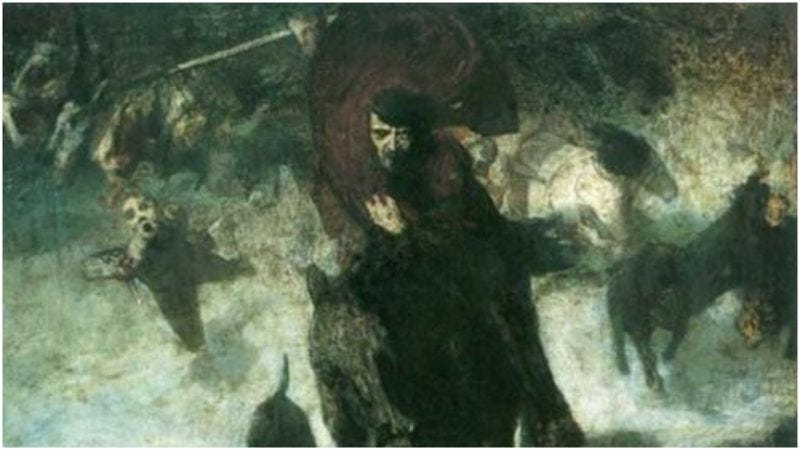
Some might argue that this new Chancellor took on the features of the painting on purpose, while others might just point to an eerie coincidence. Still, many pointed out the energy unleashed in the solitary man, able to bend an entire people to his will. This didn’t seem possible for a single man, almost like he unleashed a primal force lying nascent within his people for eons. Now, with the German people humiliated and defeated in a great war, the ancient one devised his return to lead his people again. Or, as Carl Jung puts it in his paper “On Wotan”
Perhaps we may sum up this general phenomenon as Ergriffenheit — a state of being seized or possessed. The term postulates not only an Ergriffener (one who is seized) but, also, an Ergreifer (one who seizes). Wotan is an Ergreifer of men, and, unless one wishes to deify Hitler– which has indeed actually happened — he is really the only explanation.
To a hyper-rationalist mind this would sound ludicrous. He would say that all this talk of the consciousness, of primordial forms in nature a folk latches onto, is nonsense. He would ask “do you really believe in old gods from past ages still live and prowl the Earth? Is it really reasonable to say that Hitler was the avatar in which Odin returned to Earth? Are we really saying other ancient deities, swimming unseen in the murky depths for millennia, are rising again? Are you being literal here?”
My answer, of course, is yes.
Age of Myths
For a more exact investigation of his character, however, we must go back to the age of myths, which did not explain everything in terms of man and his limited capacities, but sought the deeper cause in the psyche and its autonomous powers. Man’s earliest intuitions personified these powers. Man’s earliest intuitions personified these powers as gods, and described them in the myths with great care and circumstantiality according to their various characters. This could be done the more readily on account of the firmly established primordial types or images which are innate in the unconscious of many races and exercise a direct influence upon them.
Carl Jung “On Wotan”
In ancient people in the time of oral transmission of culture, being able to recite myths in various forms was critical to maintaining their culture through the generations. This, on top of sacred spaces and shrines ensured that the connections to their traditions and gods would pass on to their children and grandchildren. With these stories and rituals, every people had a unique connection to the primal forces at work in their world. They had their stories of how their gods created the world, interacted with man, and the events of the end of time (if they considered it to ever happen at all). The myths they told weren’t history, but, in a way, even truer and more fundamental.
These myths had layers upon layers of meaning, and the ancient texts of the Eddas, Greek Mythology, and others, likely has hidden meanings and symbolism we will never know, as these myths took advantage of common wisdom and cultural tropes that needed no explanation. The cultural air they breathed every day is lost forever, even if some of their written myths still exist.1
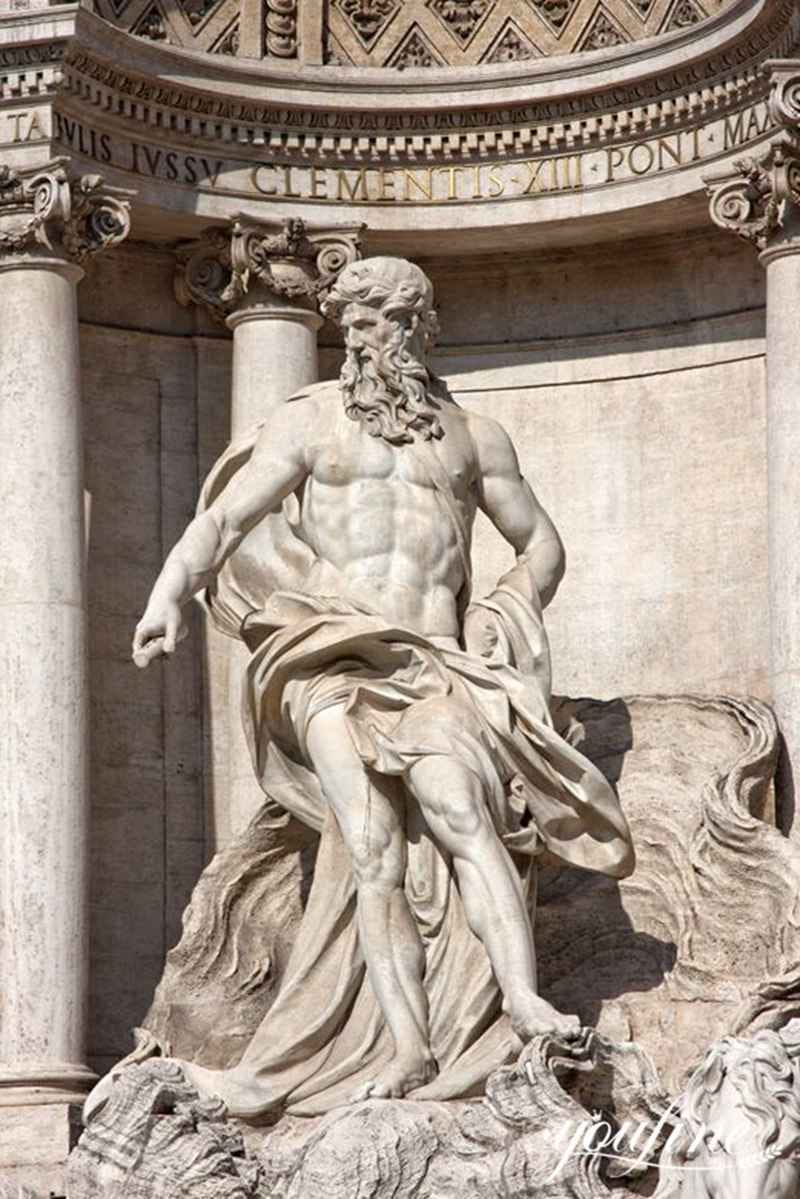
In such a world, a people’s gods were the consciousness of the people, and their enemies knew this, which is why a conquered people would see their gods destroyed and replaced with the victor’s gods. In a long enough time frame, the conquered people will likely forget their past, and their spiritual history will wither and die. When the wellspring from which the lifeforce of a people emanates is sealed, those people cease to exist and get assimilated to the dominant culture.
The old gods also were largely folkish, a god only for a certain people. Whether it be the Germanics with Odin, the Greeks with Zeus, or the Irish with Morrigan, and the Egyptians with Ra. The metaphysics of the gods coincided with the culture, with the story of the Germanic gods being harsh, brutal, and nihilistic to the outsider, and the Egyptian mythology shared its culture’s incredible amounts of bureaucracy (check out the passage to the netherworld in The Book of the Dead sometime).
However, there was no sense of missionary zeal to convert outsiders to their religion. While their gods acted over the whole world, they saw no need to share that knowledge. Each had their unique superstitions and rituals and saw the primacy in their way of life, and had little missionary zeal.
The gods couldn’t be seen as fully benevolent or fully evil, and the lives of these deities were often filled with the foibles and passions of human beings. In Hellenistic societies, it was easy to make a one-to-one mapping of the gods to aspects of human life or nature such as Ares, God of War, or Thor, god of lightning. The real nuance on how a folk saw their relationship with nature was not in the gods individually, but with how these gods interacted. Zeus despised Ares’ bloodlust (and, paradoxically, Ares is often portrayed as a coward). Odin grew tired of mischief-maker Loki’s constant pranks that it would cause an unsurmountable rift, followed by Ragnarok.
Age of Christianity
With the dawn of Christianity in the West, there came a new form of universalist religion whose mission was the conversion of the whole world. Once the Roman Empire was conquered though, the rise and spread of Christianity outside the Hellenistic world dealt with a very different type of people. Unlike the evangelism in Roman cities, comprised largely of atomized, deracinated people, the monks going north contended with tight knit communities with strong ethnic bonds. They had their own customs and rites closely associated with their sense of identity as a people. James Russell argued the Germanic ethos impacted Christianity as much as Christianity influenced the Germanic Tribes.
The worldly, magicoreligious, heroic, folk religiosity of the pre-Christian Germanic peoples was transferred from Odin, Tiwaz, Thor, and Freyja, and the shrines and lets dedicated to them, to Christus Victor, his loyal saints, and their shrines and relics.[…] However given the depth in which a worldly, heroic, migocoreligious religiosity was rooted in the world-accepting, folk-centered Germanic worldview, the general result of this policy of accommodation, or “inculturation,” whether included or not, was the emergence of a worldly, heroic, magicoreligious, folk-centered Christianity.
Russell, The Germanification of Early Medieval Christianity2
Instead of the idea of a universal culture for the universal religion, the Germanics accepted a Christianity more suited to their specific culture. The same happening occurred for the other folkish religions, every one developing their own saints, architectural style, and feast days that would turn into massive celebrations, all within the umbrella of the universal religion. Through much of the middle ages, this idea of a universal religion with local peculiarities functioned well. It gave a flexibility to frame it to a cultural consciousness, able to sublimate the primal forces unique to a people into folk avatars in the form of saints, whether it be the heroism of Joan of Arc in France or St. George in Britain. With this system, everyone have their cake and eat it too. They maintained their identity as a unique people with a unique history, but under the umbrella of the universal Christian religion.

Trough this time, folk tales with a largely Christianity worldview were common, but dealt with the primordial aspects of unleashed nature that inhabit almost a dreamlike quality in a people. While they became Christian, they didn't forget the old ones prowling beneath the surface, making themselves known in strange and surreal forms. They understood there were parts of nature that couldn’t be fit into a theology or philosophy book.
The Age of Legion
When he saw Jesus, he cried out and fell at his feet, shouting at the top of his voice, “What do you want with me, Jesus, Son of the Most High God? I beg you, don’t torture me!” For Jesus had commanded the impure spirit to come out of the man. Many times it had seized him, and though he was chained hand and foot and kept under guard, he had broken his chains and had been driven by the demon into solitary places.
Jesus asked him, “What is your name?”
“Legion,” he replied, because many demons had gone into him. And they begged Jesus repeatedly not to order them to go into the Abyss.
32 A large herd of pigs was feeding there on the hillside. The demons begged Jesus to let them go into the pigs, and he gave them permission. When the demons came out of the man, they went into the pigs, and the herd rushed down the steep bank into the lake and was drowned.
Luke 28-32
The idea of the current era as the Age of Reason has always been more marketing than reality. Outside the rhetoric of advocates who tout how the modern era has removed superstition from society in favor of science and rationalism, the underlying motivation has always been, at its core, a license to vice, and sometimes worse. It’s not a coincidence that the French crowned a prostitute as the Goddess of Reason at the conclusion of The French Revolution, and it’s not a coincidence that as the French toppled the old and decaying aristocracy, genocidal passions were unleashed as repressed forces from the bowels of the earth were released.
The idea of a mass of demons infesting a people portrays a huge disconnect from the older forms where strong, dominating gods dominating the worldview of a people. The old gods would galvinize a people to war, to great marvels of architecture, to constant expansion. They would inspire their followers to forms of organization that would span generations. While often vicious, poorly-tempered, and excessive, they knew how to build.
While the strong gods seek glory, the mass of Legion is baser, full of little disjointed passions that demand immediate satisfaction. They despise social customs, responsibilities, and any sort of hierarchy and organization in a community. Most of all, they despise the strong out of an insatiable jealousy. Legion is the civilizational equivalent of the crab bucket, hose purpose is to ensure everyone is as miserable and despicable at the lowliest member of society. Their number is immeasurable.
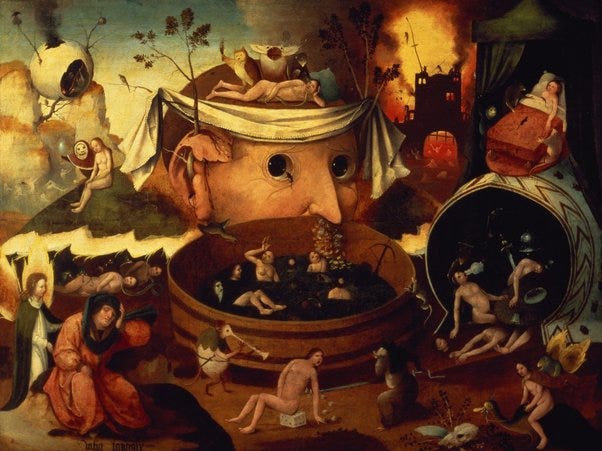
Legion is also rabidly universalist, and despises differences and any form of uniqueness. It will tear down the heroes of a culture and replace them with the weakest specimens of a people in order to bring them down to an equal footing. Legion does not have the capability to create the liberated world they envision, but only how to dismantle the current world, and assuming the world that springs up will fulfill their desires. If the current society is dismantled and the utopia still does not come about, it was simply not dismantled thoroughly enough.
It’s no coincidence Democracy is the government of Legion, and it’s no coincidence that democracies on a long enough scale take the side of criminals and lowlifes over the citizens who make society function.
Crowns in the Gutter and the Rise of the Old Gods
It anticipates the conflict between the realm of ideas and life, between Wotan’s dual nature as a god of storm and a god of secret musings. Wotan disappeared when his oaks fell and appeared again when the Christian God proved too weak to save Christendom from fratricidal slaughter. When the Holy Father at Rome could only impotently lament before God the fate of the grex segregatus, the one-eyed old hunter, on the edge of the German forest, laughed and saddled Sleipnir.
Carl Jung “On Wotan”
The rise of Legion brought about the dissolution of Christian norms in statecraft, and the idea of Logos in the people, but the destruction of those barriers between man and the ancient forces brought immense energy where the old, powerful forms rose from the depths and found vessels to begin a new reign of glory. As Christianity waned and the entropic nature of Legion spilled throughout the populace, it didn’t take long for a massive void in power structures to form. Crowns lay scattered in the gutter, once worn by great kings, looking for a new champion. Some rose to repair the old, Christian order, and others to create a new, glorious order in their own image.
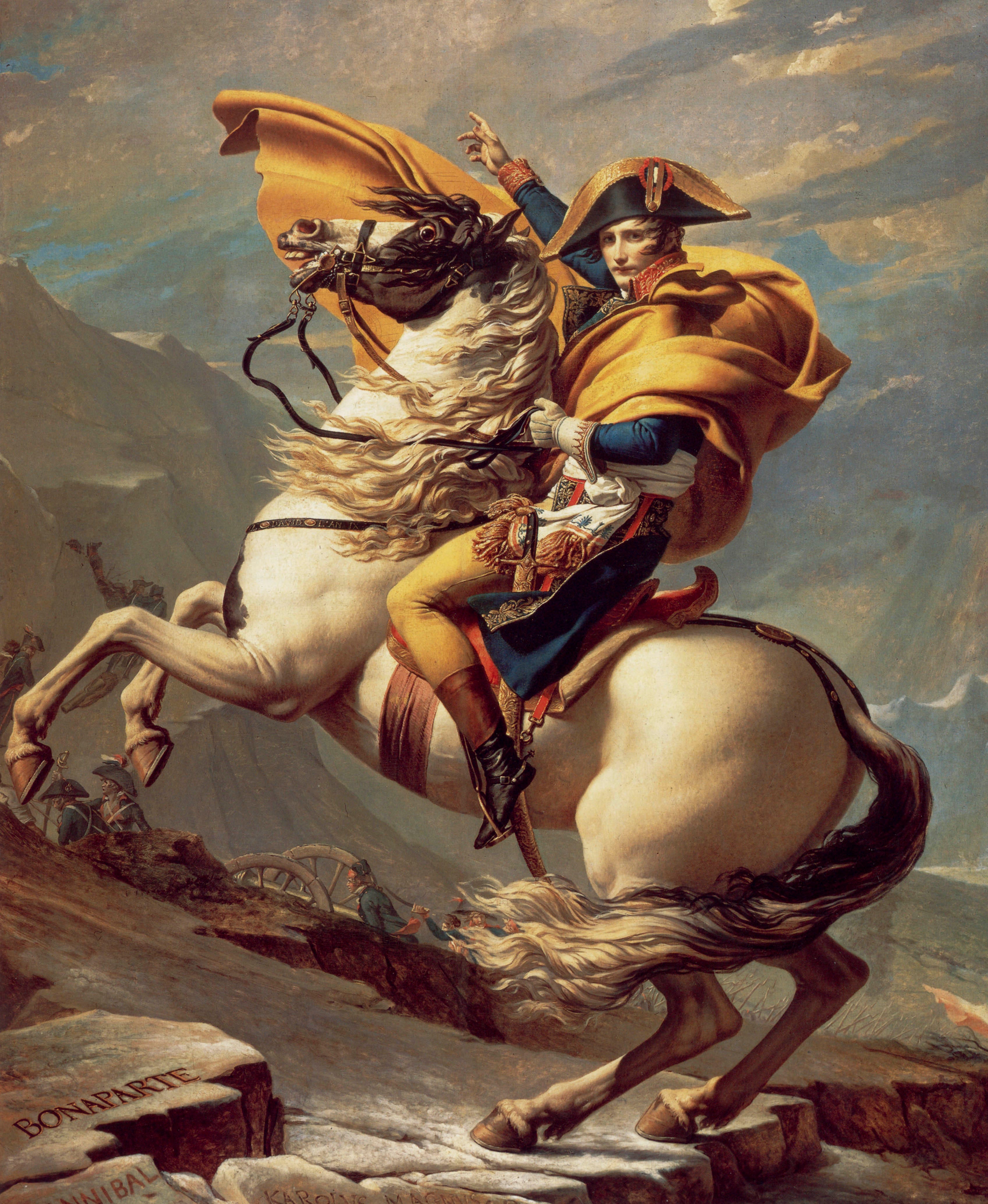
These cosmic entities fought back against the forces of Legion, creating order from the ashes left from the spiritual wreckage of their people. They brought respect and a sense of purpose. They demanded excellence where bad actors wanted to play in their vices. If they showed restraint, they could have been known as powerful leaders, if following an essentially pagan ideology. The old gods don’t know humility though, and being imbued with the aggressive, hubristic aura of the old gods, they went to excess, and ultimately brought about their own downfall.
Legion didn’t defeat them, but the remnants of Christian culture that existed, though in a modern, weakened form. After their defeat, Legion used the defeat to gain more ground, their poisonous rhetoric arguing the idea of great men itself was akin to evil. The ones who create conflict, whose eyes are wild with life, are not to be followed. Those who equate physical and mental discipline with ones spirit is the same as being a fascist. To take your identity from your heritage is the same as being Hitler, and the new way is to choose your identity based on a vice of your choosing. One must keep sulking in that cave, with the rest of us. It’s comforting down here.
Gotterdammerung
For now, the great cultural flattening of the Age of Legion has progressed unabated, as vices continue to be raised as virtue and historic peoples are slowly being eroded into undifferentiated widgets. The current day has seen new avatars rise.

In a time of existential crisis, the populaces are rallying behind new heroes, symbols of their culture and values, emblems of primeval instincts emanating far below rational thought, a limbic reaction to the reality that their lineage may end within a generation or two. As flawed as these avatars are, the great flow and ebbs of those ancient forces have come and possessed these actors, now imbued with a chaotic, wild spirit that puts them beyond mere mortals.
The question remains whether they can harness and tame these powers under the guidance of the all-encompassing Logos of the universe like the medieval saints of times past, becoming not only great leaders and warriors in their own right but also holy men, able to drink from the source of all Creation to fight for their people’s survival as demons swarm all around. It remains to be seen whether the powers of Legion will bring the combatants to heel, defeat their champion, and swarm and overtake the remnants of the unorganized folk, subsuming them into itself.

Victory is never assured. History is full of folk who have disappeared, even those with ancient, seemingly insurmountable power. At the conclusion of the westward expansion as Americans conquered the entire frontier and relegated the natives to reservations, the Ghost Dance movement took hold, promising that the dance would make their ancestors rise from the grave, restore the buffalo, and drive the Westerners out. Their ancestors did not rise, and they were ultimately eliminated as a people.
In a couple generations, Heritage Americans may be relegated to dressing in red, white, and blue, shaking their fists in the air shouting “fight” in a strange ritual, hoping that another Orange Hero will appear as their homeland is swarmed, their way of life eradicated, and go extinct in all but name.
For instance, in the Poetic Edda there are names of many dwarves for which we have no other reference, but the people listening would recognize.
I don’t actually subscribe to this theory, interesting as it is, but it is true as Christianity spread among the Germanics several rituals and customs were retrofitted in.
Wow, what a hopeful and encouraging piece.
You might like Rudolph Jettmar: https://www.leicestergalleries.com/browse-artwork-detail/MTY1NDE=