


I saw the best minds of my generation destroyed by madness, starving hysterical naked,

dragging themselves through the negro streets at dawn looking for an angry fix,

angelheaded hipsters burning for the ancient heavenly connection to the starry dynamo in the machinery of night,
Such were the opening lines of Allen Ginsburg’s Howl. Written in 1955 it was the war cry for the Beat Generation. In it, he lamented his compatriots’ lost to mental anguish and served as a visceral condemnation of modern society. It was a passionate, spastic work, meant to be voiced loudly and without breaks, hence the name. You will find phrasing that makes little sense, such as “hydrogen jukebox” and “kind king light of mind”, meant to give an emotional resonance with its tonal qualities more that its coherence. Controversy buttressed the poem, including the poem being censored in Britain, adding to its mystique. The controversies made a spectacle almost as stirring as the poem, a piece of performance art in itself.
Was it a great poem? People in the era gave it mixed reviews, with some pointing out its intriguing but garbled messaging while others praised its anarchic nature. What’s without question is that a class of poets, revolutionaries, and outright crazies latched on to it, and what was once the anthem of social outcasts is now taught in high schools across the nation.
Poetry has fallen on hard times. Probably the first victim in the decline of real literacy. The masses today are unlikely to read any of the famous poets after their stint in school has ended. It doesn’t help that poetry was also one of the first domains that became gatekept by a cadre of hacks, giving the art form a reputation of empty pretension with the modern man. Attempts have been made to create the next great poet, the most pertinent example being Amanda Gorman.
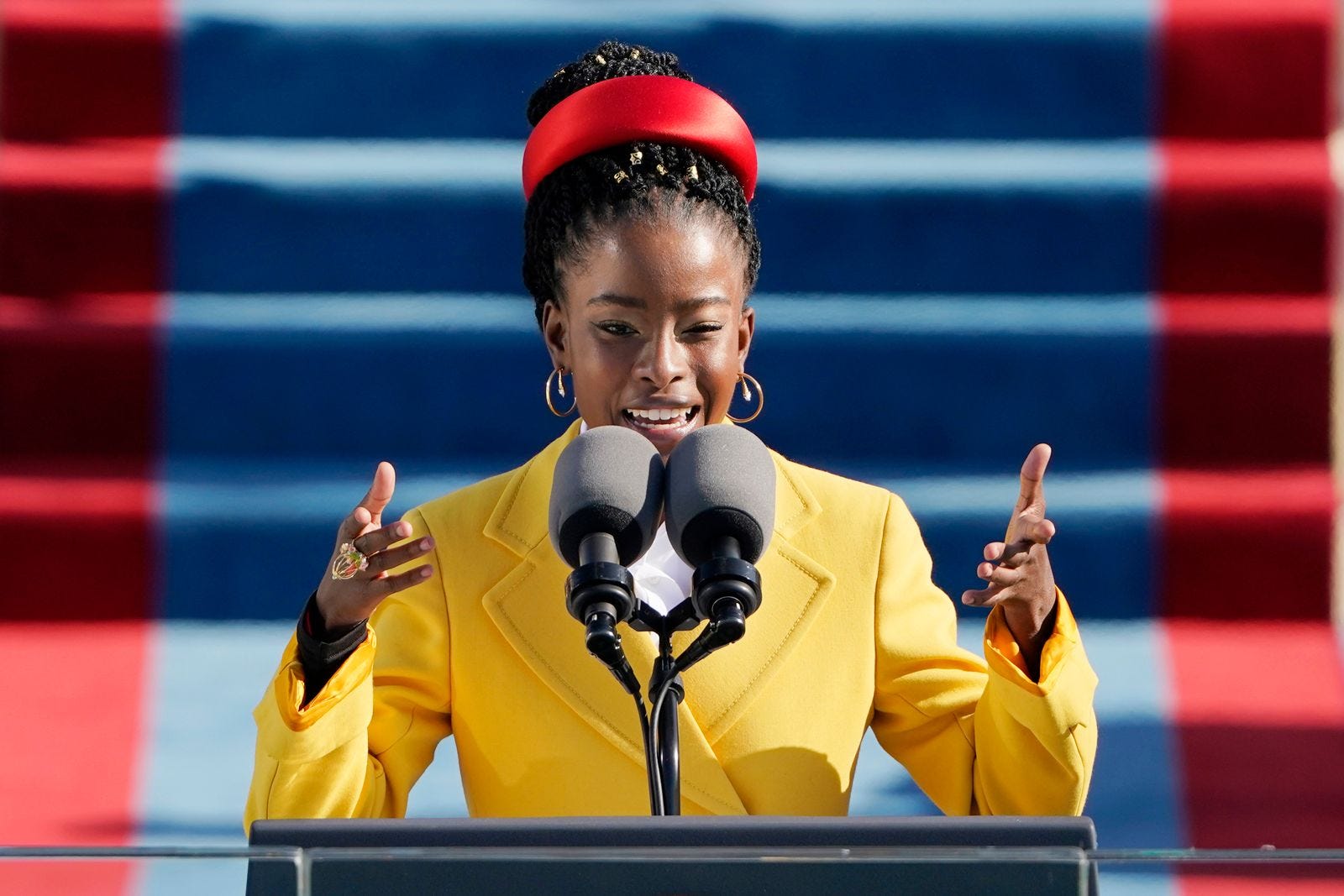
During Super Bowl LV, she recited a poem during opening festivities. This was its climax.
Let us walk with these warriors,
Charge on with these champions,
And carry forth the call of our captains!
We celebrate them by acting
With courage and compassion,
By doing what is right and just.
For while we honor them today,
It is them who every day honor us.
Tennyson she is not.
Contrast this to poets they used to have on broadcast television, such as the incredibly witty Robert Frost being featured on NBC News.
One can tell the malaise of modern times in that there is no real crying call of this era, no mantra of a generation. There is no great poem, music, or movie that serves as the anthem of the Zoomers, or even a subset of them. Regardless of one’s side on the political spectrum, regardless of one’s background, there is no cultural artifact that speaks directly to your identity, to your predicament, that is embraced as a cultural marker. Instead, millennials have nostalgia for the comfort of commercial slop, and many zoomers have nostalgia for an era they never lived through.
Everywhere there is a lack of words for their place in the world, a piece of art that gives them emotional, rational, and spiritual meaning to their existence.
I recently read through the second edition of Ghost of Arthur Powell’s poetry compendium, Horizons of Iron, now sold through Imperium Press. For those unfamiliar with Arthur, he was the editor of an online poetry journal, Atop the Cliffs, from 2017-2024. His attempt to create an art culture in the wild west of the late aughts internet was commendable, if quixotic. The sphere was full of edgelords who were interested in getting a rise out of their enemies and hyper-intellectual types who delved into theory. They could make great memes that distilled a complicated issue down to an essence that packed an emotional punch, but such rhetorical themes can only live in the fleeting attention ecosystem of social media.
The poems comprise several themes, from dejection on immigration transforming a familiar homeland to a foreign country to universal themes of love lost. His style is a terse, tough, melancholic tone, more like what a steppe warlord would recite in his times of contemplation than a sensitive academic.
MOUNTAINOUS DECAY

Life blood drains away
Mixing with the dry dust
Bleeding into the pints,
The steel gilded with rust

From death in the valleys
To spires in the sky
Opioid fever dreams
And medications gone awry
For
Death in these valleys
Comes both quick
    and slow
The mine creaks to a halt
Fentanyl killing without fault
Soot caked no more
Languish unkempt
Mirroring a dying people's faces
Reading through the compendium, one fact that struck me was the more a poem “smelled like the internet”, the less punch it packed. It isn’t just that memes become stale quickly, but there is a barrier between the two worlds the terminology is trapped in. The Non-player Character meme(NPC), for example, referring to a large cohort of people who seem to follow a rigid script, sounds natural in the internet space but jarring when used in poetry. The weakest portion consisted of poems that used these terms, as they came across as depending too much on fleeting memes that quickly grow stale for a work of art. For example:
TAKING THE BLUE PILL
It's bitter pill brother
Seeing you adrift in normalcy
Once you were another

I stood by your side
Spoke a good speech
As you made her your bride

Today we barely talk
Politics cut us deep
Both turned to walk

Far away we drift
Occasional messages
Cut across our rift

Trump Derangement Syndrome
Branch Covidian
Compare this to a more subtle poem that leaves itself more ambiguity and gives more sensory punch:
UNMARKED

Those graves I do not know
Headstones without names
Lettering that does not show

For there they lie at rest
In quiet green corners
Visitors pass by in Sunday best

Were they washed clean away?
The glorious dead quietly resist
Perhaps soon we'll hear what they have to say....
While the collection could have used some more pruning, it’s overall a good collection with some excellent essays. What works and what doesn’t is also a powerful lesson in what sorts of art work and where they thrive.
While the crisis in art is often politically polarized, there is a dearth of artistic works across the board. Even the lower-tier forms or art, such as comics, have seen a rapid disintegration. The regular institutions that would form the next generations of prophets, whether they be art schools or MFA programs, have proven themselves incapable of creating great works. Progressives have largely tried, and failed, to create traction by being tastemakers with the support of large institutions to make traction for their preferred people, such as Amanda Gorman, but losing prestige as made them ignored. While at one time a subpar poet like Maya Angelou could be forced down people’s throats, those days have long passed.
However, the collapse of tastemakers has created excitement as the barriers to entry have evaporated, but the cost of having no social proof. Even an online presence isn’t enough to move pieces of art, as even prominent writers find their followers tough customers if their works do not fit into expected genres. And heaven help you if you write poetry. In the rampant attention economy of the web, one can easily consume a product, but this is actually a weakness.
What is interesting about Allen Ginsburg’s “Howl and Other Poems” is it was published by an extremely niche publisher. Not only was it a small publisher, but they had a brick-and-mortar bookstore situated in San Francisco that served as a base of operations. Through its reputation of publishing Ginsburg and other radical writers, it became a cultural landmark a sort of mecca for radical artists that remains to this day.
While ignored, there were also right-wing version of bookstores back in the day. The The John Birch Society used to have chain of bookstores called “American Opinion Bookstore” that was full of anti-communist and other political writings. Of course, the right has always existed as a conglomeration of largely oppositional ideologies forced to become bedfellows through dual-party politics, so brick-and-mortar outlets are often of an evangelical Christianity with a conservative bent, traditional Catholic bookstores, and others.
A lot is said, justifiably, about the necessity of culture being done in physical space rather than through online chats. There are the basic arguments of how people act differently when there is more nuance in body language and demeanor, as well as the real chance to get punched. A more important aspect boils down to human nature. People respect what is difficult more than what is easy. People respect something that takes effort more than an easy commodity. On the other side, the suffering artist is a trope for a reason, and while one’s suffering does not make a work a masterpiece, there needs to be that difficultly, whether it be a personal struggle or a technical challenge, that is dutifully overcome to have something meaningful to write. The friction is the point.
Unfortunately, you can’t escape the medium, and the Internet is custom-built for transitory interactions. Little is required of you, and even less if given back. While meeting at a particular time and a particular place requires planning, an internet chat is a no-space, available anytime and therefore incapable of creating forms of commitment past momentary consumption.
It’s not a coincidence that the quality of movies died as special effects simplified the filming process. It’s also not a coincidence the audience quality has nosedived as theatres were replaced by phones. Truly great albums are a rarity in a time when the playlist in streaming services have become ubiquitous. As AI slop permeates through the ecosystem, the quality of both artist and audience will continue their decline.
Of course, if every artist took the lowest-tech route of reciting their poems on street corners, they would have as much success as, well, the average author selling his book on Amazon. Not that no one has not created meetups like this. A while ago Rolling Stone magazine clutched its pearls over the indie book scene in Los Angeles. BasedCon, an independent book conference, has been running for 5 years. In New York last year, a renegade art show caused a ruckus.
While laudable, What’s missing in these attempts is creating a specific scene. Whether one is talking about the Inklings or the Harlem Renaissance, disparate individuals over large areas rarely form artistic movements. Andy Warhol’s The Factory hosted an assortment of different painters and musicians. You could have countless other examples, from wholesome and largely pedestrian to completely depraved. They are a cadre of aligned people meeting in a shared space in a specific geography. They form, for lack of a better word, a scene.
Unfortunately, there is little of that energy in a specific place anymore. While there are still literary recitings and poetry sessions, most independent booksellers and other locations are more interested in the appearance of counter-cultural energy by mimicking past subversive efforts than being willing to host true modern creatives. Most niche artists delegate their work to the internet, hoping to figure out the social media algorithms that will make their existence known to a wider audience.
As much as people prefer to think of a work of art as an independent artifact, there has always been a social aspect to classic works. You are studying not only the work in itself but the wider reaction such a work brings. The controversy around “Howl and Other Poems” was just as important to the work as the words in the page. The life and times of a poet is inextricably linked to the words he writes. While the artist may isolate himself for a time, part of one’s are is to be personally in the world, to interact with other minds in the creative sphere. Whether one’s sphere is in the streets of San Francisco wrestling with the drug-addled minds of your generation or a group of professors talking in a study over whisky, these interactions are what makes art ascend, when readers not only have a work, but can contemplate a specific time and place where their thoughts were argued and defined.
Even more, it creates a pilgrimage area for those enticed to become enmeshed in the culture. Just as a simple bookstore in San Francisco became a holy site, once a movement plants its stake on a plot of land, it creates a point of origin, a part of the world it calls its own. The digital sphere can only create a facsimile of this. Creating these spaces is easier said than done. The cities fester with anarcho-tyranny, lawfare is a constant threat, and the digital sphere has made many would-be artists perfectly content in their electric cocoon.
The tastemakers are dead, and the vivid scenes of old times are a graveyard. Maybe the next great artists will be musicians, maybe poets, or maybe users of some medium that hasn’t been invented yet. Whatever form they take, they will take root outside the glow of the web.
Why
Were you passing here?
On a journey home?
Or maybe an adventure?

But now there is a fragment
Flowers faded
Of you

Small memorial
Many miles from anywhere
They come to tend
Wonder and mourn

As the cars speed past
Thank you for reading Social Matter. If you enjoyed this article, consider sharing and subscribing. To support artists in this sphere, consider purchasing Horizons of Iron.
I just remembered the project of a friend of mine from ~10 years ago. In one of the cheaper not-yet-gentrified neighborhoods of Pittsburgh, he and his then girlfriend rented out this old sort of carriage-house type building, made it into a goofy sort of art studio/theater and called it the Runaway Hotel, along with a poetry/literary journal of the same name that they published a couple volumes of.
All sorts of bohemian types came around to hang out, goof off, make art, read poetry, put on plays, all sorts of stuff. One weekend they'd put on a play, another weekend would be poetry readings. I only went once, but it was super cool and I think it's the kind of place that could still foster poets and poetry. A real goofy place the surrounding neighborhood kinda tilted their heads at, but there was stuff going on and a lot of life.
I don't remember the exact details of how it ended, but it was something to do with the owners of the place either had plans to sell it or renovate it and raise rent or something to that effect.
“Maybe the next great artists will be musicians, maybe poets, or maybe users of some medium that hasn’t been invented yet. Whatever form they take, they will take root outside the glow of the web.”
Here we are!