


Few things exemplify pure Americana more than the backcountry, the idea of driving those dirt roads as dust flies behind your truck and fields of crops reaching for the sky pass by. There’s the feeling of homecoming when seeing quaint white farmhouse in the distance where an older grizzled farmer and his homely wife live. For generations this was the staple of a child’s life when visiting his grandparents, even as more people left for the cities. It still exists in the American consciousness, but fewer now have that direct experience. Countless children of those country homes took their chances in the city, often never coming back. However, both the humble couple living in the backroads and the ambitious young man leaving his parochial life to make his fortune are as American as Apple Pie.
The quintessential American has always had a schizophrenic urge for world greatness while also harboring the intrinsic need to simply live life in peace. The conflict between the agrarian vision of Thomas Jefferson and the industrial ambitions of Alexander Hamilton have put these conflicting visions on the forefront since the founding of the nation. While Jefferson thought in terms of the general character of the nation, preferring the independent parochial farmer watching over his small, local world, Hamilton saw the ambitious industrial man as the avatar to of the future. Sometimes both ambitions have coincided well as the nation fulfilled its Manifest Destiny by trekking West all the way to the sea. Then dramatic factory production ascended to the forefront as no more land was available to conquer and cultivate, creating a diaspora to the cities.
The Industrial Revolution swept the nation, and its technologies would forever alter the social landscape of the nation. Countless tasks could done orders of magnitude quicker, and the increasing complexity required vast networks of infrastructure to keep the factories running. Running at smaller scale, the small towns and shops spread over vast areas could not address the new reality. The increased competition against industrial goods along with the new opportunities led many to uproot and take their chances in the city, with mixed results. The chirping of the robin and the light breeze swaying tree branches gave way for the harsh clang of metal and the persistent rolling assembly line through. Some made their fortune and a better way of life, and some found themselves in squalor.
As years progressed, America went from an overwhelmingly rural country to one with a large majority being in an urban area. High skilled jobs in the city, personal transportation, and the availability of higher education created a mass exodus away from the rural villages of yesteryear. The transformation from local economies to mass scaling has never subsided since, and their encroachment continues. Hamilton won the battle, hands-down.
As one example, a town I went to as a youth was large enough to sustain a Walmart. While many were excited by the increased business it would bring to the area, the council was worried about its impact to the nearby downtown. There was a long, protracted struggle, ending with the council refusing the permit to build. In response, Walmart then just bought a plot of land a half mile out of the town and built the megastore there.
Local tradesmen are also feeling the crunch, their services now needing to compete with massive companies employing cheap, often illegal labor. Even with the overhead, the law of scale makes it hard to compete on price, with their only favor being personal trust and assured quality, more difficult in a world where everyone is conditioned to go with the lowest bidder.
Farmers are being hit the hardest, as it’s a constant struggle to expand and streamline their operations to make enough to justify growing crops and raising animals in the wake of ever-decreasing margins. The once small family farm needs to be a vast operation with a large workforce just to be able to function, and the infrastructure and equipment necessary only becomes more complex and costly.
While these create hard times, nothing comes close to the decimation of rural America caused by internationalization. Many good farmers can find a way in a tough market (often through using illegal labor), and tradesmen can expand their scope. However, when a factory that employs a third of a town gets shut down and the work goes overseas, the village largely shuts down too, with all the dysfunction associated with it.
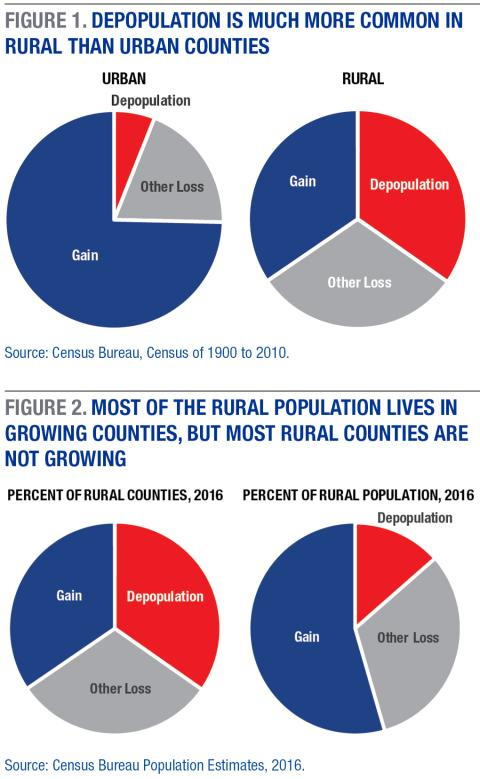
In recent years, the percentage of the population in rural America has stabilized to 20%. This masks the devastation that has occurred in places that depended on factories and other working-class occupations. Once people in a town can’t find work, the smart people leave. Once the smart ones leave, other agentic people follow, and hence a cascade effect creates a mass exodus. Soon, there are only the ones who, through either apathy, stubbornness, or criminal instincts that can thrive in the new condition, stay behind. A critical mass of this type of person will introduce all the pathologies associated with it. While a community of people with strong character and values can police and apply social pressure to those who are more prone to let their vices get the best of them, once the town is deserted enough where this low-agency type is left to their own devices with no oversight, the spiral is swift and devastating.

In modern times, the total divorce rate between rural and urban areas are about the same. In what would be a shock both the conservatives who espouse wholesome rural life and progressives who think rural folk are religious nutjobs, religiosity in rural areas is on par with urban areas. Drugs also percolated rapidly, with the devastating opioid crisis wiping out hundreds of thousands of young men and women in these devastated towns. To add insult to injury, these dying towns were often flooded by the ruling class with Section 8 housing and immigrants, thereby permanently sealing their fate. These forgotten ones were the core constituency in Trump’s rise to power.
Looking at the core stats is misleading though. There are really two rural Americas now: the hollowed out, dead-end of remote villages where work is nonexistent, and the middle-class towns that still have an economy, whether through agriculture, specialized trades, or a nearby city residents commute to. If one looks at the shift in population, it’s unprecedented. While many rural areas got hollowed out, the same amount went to other non-metro areas. This is due to the availability of jobs, and also these stable communities attracting a certain type of person wanting a certain lifestyle.
In times past, those who lived in a rural village lived did so because they were born there. Given the lack of easy transportation and a lack of a social safety net, they kept close to friends and relatives they could count on. In my youth there was a village priest who expressed the choices of earlier man succinctly: “I could either be a farmer or be a priest. I chose to be a priest.” Only those with very high risk tolerance or extreme talent went out to the wider world. As conditions made it less risky to leave, more people took the opportunity. The ones who stayed were largely parochial people with deep roots, often knowing the name of the ancestor who first stepped off the boat.
This is changing now, with an increasing population who are immigrating to rural areas where they have no direct roots in order to pursue a certain way of life. Instead of a village that they didn’t choose, but were born into, people can shop for towns. Small villages understand this trend and are transforming themselves accordingly. Incredible amounts of money are spent updating schools, building walkways, and creating a wholly pleasant and quaint atmosphere. As opposed to the purely practical, minimalistic thinking of older times, they know their future is based on newcomers coming in. While fertility in rural areas is better than urban areas, it’s still below replacement, meaning they have to compete for outside attention.
If this sounds like modernity rearing its ugly head again, where even a community has to become a marketing campaign to attract outsiders in, you would be right. The rootedness of saying in the same place for generation, with the general cultural nuances of a place where one’s parents knew your friend’s parents during childhood, spanning all the way to the first immigrants, is no longer a feasible reality in most places. The local economy needs a pitch, and its long history needs to become commercialized. It’s become a product like any other.
By their very nature, small towns are not scalable, limiting the amount of financial and social success one can achieve. Cities will always have the edge there. However, as urban dysfunction worsens and suburban life becomes increasingly more expensive and stifling, many start to recalculate their priorities and realize that a pay cut is worth a lot of the non-monetary perks rural areas have to offer.
For grassroots entrepreneurs, there is opportunity to differentiate oneself from the countless other faceless corporations by building a personal presence. Whether it is a guy who wants to make a few pizza joints, the roofer everyone sees at Church on Sunday, or the farmer with a large farming operation, there is opportunity for independence. Most people would be shocked by the sticker price of a farm, as even a smaller operation will set you back a few million. There’s an independence hard to find anywhere else, as well as a natural safety net of lifetime friendships if things go south. It may not be as sexy as Silicon Valley Venture Capital, but it’s a step up for your average corporate drone.
One of my friends rejected his father’s offer to take over his insurance sales business because he wanted to live in the wider world. A few years later he came back and realized the opportunity he missed, as his father already sold the business. He still moved back and worked 80-hour grinds for several years to get his business up from square one. It succeeded, using personal contacts and local marketing to develop a niche.
Many professionals working in a nearby city find the commute worth it. They get the benefit of a high-income job with a high-trust community to live in. They also get to be a big fish in a small pond, having a higher income as well as social prestige where they would be another nameless face in suburbia outside the city. That being said, many self-assumed bigshots get a big piece of humble pie when no one is impressed with their smug aura of superiority. Still, money talks, wherever you are, and they can push their weight in local affairs.
You see power dynamics in the local Church as well, still the primary social organization in most towns. While religiosity has gone down, the Church punches way above their weight in local affairs. Local residents also have much more clout regarding pastors and how the schools are run. In my hometown, a priest who railed against hunting and refused to do Memorial Day services for “glorifying war” was run out of town.
While the schools are still enemy territory, with the teachers often having open disdain for the town they teach in, they can be put in check by a unified force that ensures the worst aspects of modern schooling is limited. This is a big change in the last 20 years, as communities have developed a vigilant bunker mentality when they realized the relationship between schools and the town was not mutual respect, but combative in nature. When I grew up, the local Catholic school was practically an Atheist factory. Since then, it’s been ruthlessly purged and put back on track.
Parents love knowing all the kids and their parents. Knowing their kids practically going feral in the summer hanging out with their friends across town is far easier than driving twenty minutes for a play date. As the stranger danger mindset has made parents in suburbia terrified of their kids even playing in their backyard, rural parents can let their kids disappear all day without even needing to check in on their phone.
When one looks at finances, the non-financial perks often allow for a higher quality of life on a smaller budget. You don’t need an expensive private school because you are in a “bad school district”. Your house is likely 40% cheaper than a similar one in suburbia. The relatively lower income area has far less “keeping up with the Joneses“ striverism, as this is frowned upon. Instead of costly and time-consuming travel sports, the local school has a perfectly fine team.
The tight knit nature of small populations is a double-edged sword. While it’s nice to know everyone in the town and all the drama and crisis, that means one’s own life is an open book too. If your daughter crashes the car in a drunken stupor, everyone is going to be talking about it by the time the morning’s over. Having a messy divorce? Expect everyone to know the juicy details. While there’s plenty of individual autonomy, your personal life is an open book.
While the schools are safer, it comes at the cost of applying to the median. If you have an exceptional student, there are few, if any, gifted programs available. With regards to the arts, you’ll get a basic marching band and art class, but if you have a kid interested in becoming a professional violinist, good luck finding a skilled teacher.
You can have a small business, but there are strong limitations. The personal touches of rural businesses do not scale well, and the advantages taper off the further you go from your home turf. The world you live in is by its very nature anti-scaling, and will not be enough for ultra-ambitious men.
I remember a post advising to go to a small town and find a nice girl to marry. Don’t try this. All the good ones get snagged soon after high school or college, and you’re left with chaff where it’s clear why they’re still single. There is nothing for a single man in a small town. Villages are designed to be high-trust baby incubators for families, so if you didn’t snag your High School Sweetheart or your Girlfriend in college, you’re going to have to look elsewhere.
There’s also an unspoken, implicit culture that is different for every town. The best way to describe it is a vibe, and often through no fault of one’s own many people find they don’t fit in. It could be because of an eccentricity that deviates too much with established norms, or just lacking that deep, instinctual connection everyone else shares. There’s a core feeling that understands if someone is “one of us” that goes beyond a checklist.
Most importantly, if you cross the initial barrier of acceptance, the small town will slowly change you. If you have a mild eccentricity, if will be smoothed out. If you have a pet hobby that isn’t shared, it will gradually become less important. Any fringe view will likely stabilize closer to the median with time. You’ll digest the unspoken rules, first consciously, then instinctually. It will be “just the way things work”.
You’ll be immersed with a way of thinking that is parochial as opposed to cosmopolitan. National politics will still be talked about, but flattened to basic viewpoints while local politics takes a larger role.
Much of this isn’t unique to this environment, as spending time with your work buddies slowly morphs your entire identity to your job. Being around people with status-signaling beliefs often leave you sympathizing with said beliefs. Where in the city you can more easily seek out a microculture, in the village you’re forced to interact with everyone.
Politics in rural America are overwhelmingly right-wing, for obvious reasons. As much as the hicklibs try to push the regime’s boutique values, they only solidify common animosity towards nonsense. Small towns are practical, and have no place for faddish ideas with no grounding in reality. Unfortunately, there is still a decent percentage of this type, and they go out of their way to be utterly insufferable. Usually, their core ambition is to see themselves as intellectually and morally superior to their contemporaries. Small town politeness will often tolerate that BLM flag or Pride sign, but their tolerance often has a limit. Then they get mean. Most of the time, these types try to gain power through worming their way into a position in the local Church and School to inoculate minds not formed yet.
I’m sure there’s a genetic as well as cultural component to the type of American who thrives in rural life. The ones who don’t get boiled away quickly. The dichotomy between the rural and the urban will deepen as self-separation occurs. Contrary to Jefferson’s idealism, it’s not a matter of the wholesome agrarian village versus the degenerate city. Anyone who has lived in a village knows the petty politics and absurd jockeying for status that makes the most absurd academic spat seem Homeric. There’s no idyllic place in the boonies that hasn’t been hit by modernity, and even the quaintest small town has seen tumultuous changes. There’s hope many rural parts destroyed by modernity and immigration can be nursed back into health, just like many cities are finally recovering from riots over fifty years ago.
While farming will only become more difficult, and the hyper-efficiency of corporations will continue to spread their tentacles everywhere, changing dynamics isn’t all against ruralism. Many of the laptop class have realized they can work remotely from a village just as easy as the suburbs. There is a generation of health-minded, crunchy folk interested in getting a large plot of land to grow food. While a good percentage will find their ideals clashing with hard reality, enough will make it work to form a new, resilient culture.
The new rural reality will be based more on temperament than genetic lines. At the same time, a new, folkish, genetic phenotype will form as the migration in and out of the cities continues. Just as the Amish through Rumspringa ensure that the young adults that return to the community are more Amish in composition than the previous generation, those whose world model are more conducive to small town life will gravitate back from the city and suburbia. Times change, and much of the old ways will be lost. Still, there’s opportunity for the wholesomeness of a slower, simpler life to reemerge from the all-devouring god of efficiency.
Thank you for reading Social Matter. If you enjoyed this work, please subscribe and share. If these articles continue to give you value, please consider becoming a paid subscriber.
the small southern Missouri town I spent most of my school years in actually won against Walmart in the 1980s.
after extended wrangling led to building permits being denied, Walmart bought land a half mile out of city limits at an intersection of two highways.
the town promptly annexed the area and denied building rights again, and the corporation gave up and left.
I enjoyed the article, but I think that every small town or rural area is completely different and you can’t generalize too much. There’s probably a lot more variation than urban or suburban areas, since everything depends on the physical environment and proximity to urban areas.
I would also note that there is a massive difference between a town of 10 or 20 thousand versus 1 or 2 thousand. The former is just a small urban area, the latter is the type of place people have been for generations and all know each other.
As someone who grew up in a small town, I can point to a lot of downsides:
1. The physical environment can actually be pretty bad. I grew up with asthma and allergies from all the dust and pollen, which partially cleared up in the city.
2. The peer group can be pretty junky if you’re an intelligent young person. Think Wayne’s World. The city or suburbs have much more in terms of gifted and specialized programs.
3. More and better summer jobs and internships for young people. I was pretty much limited to factory or farm work. I still have mild right hand stiffness from a summer spent using a screw gun.
4. Your kids would have to go elsewhere for university and when they grow up. They can’t live at home and spend a lot more money. You also can’t supervise them as young adults.
5. Medical specialists are a long drive away. Family doctors may or may not be available. Emergency services may also be sketchy.
I found that all of my university bound friends left and didn’t come back, other than an optometrist with deep roots. Interestingly, a lot of the retired parents traded up to bigger centres or suburbs to be close to their kids. My parents were the last ones from their peer group around until they finally packed up and left.