


The study of history is incapable of being an exact science. Because of the practical inability to document every actor’s movement and frame of mind, assumptions must be made based on our limited understanding of human nature and simplified models of how the world works. The less information available, the more we depend on these filters to make sense of past events. While all honest actors try to discern the past from an objective frame, biases are unavoidable, drawn from both personal experience and one’s academic training.
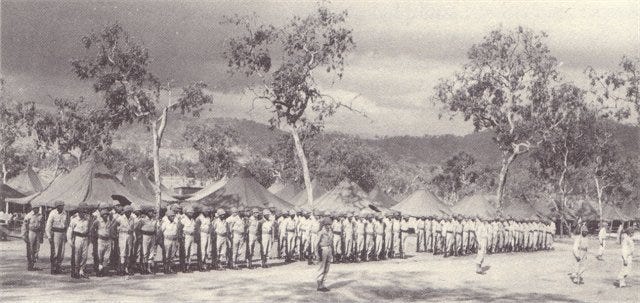
During World War II, several regiments of United States troops were stationed in Australia to support the military campaign against Japan. Many of them had the relatively safe but thankless and grueling task of building airfield strips, barracks, and other support infrastructure. During this time, the Army was segregated, with one of the black regiments stationed near the small city of Townsville.
Tensions were high, as the black soldiers had a sour relationship both with their white commanding officers and the adjacent community. They had recently been banned from going into town after 100 of them were involved in a brawl. Weak attempts at entertainment at the base failed, and spirits were low. The brewing resentment led to an explosive confrontation when, on May 22nd, rumors spread that the white leadership had assaulted a black soldier. In retaliation, the black soldiers opened fire on their superior officers.
More than 700 rounds were fired during the riot. At least one person was killed and several dozen were seriously injured. The Negroes fired machine guns and anti-aircraft guns (probably heavy machine guns) into the tent lines of the US white officers who were drinking at the time.
One of the many to hear the shots that night was the late Arthur Kelso who was riding his horse on his property at Laudham Park, on Five Head Creek in the Upper Ross area just outside Townsville. He heard the initial shots and judged them to be about 1.5 miles away. The shooting continued and he could then hear Thompson sub machine guns. The firing continued until about 11pm.
Many of the locals who heard the firing thought the military were playing “war games”. However all hell had broken loose at the camp. One local source suggested that the riot started when a white Captain struck a Negro soldier. Arthur Kelso indicated that drunken Negroes started to fire guns at their white officers, who then returned the fire.
Road blocks was [sic] set up by various Australian Army Units to prevent the rioting Negroes from entering Townsville. There were reports of 250 Negroes on the rampage and that they had commandeered some trucks and were heading into town. Arthur Kelso reported that he later heard that 19 coffins had been ordered to bury those killed in the riot (this is unconfirmed).
This led to a standoff as Australian troops made roadblocks and scrambled to quell the mutinying soldiers. Hearing the commotion, the neighbors assumed a drill was in progress as havoc ensued. The battle prolonged over three days before ending. However, there were reports that several of the soldiers escaped the dragnet by Australian and American troops and terrorized local farmers.
None of this would have seen the light of day if it weren’t for the journalistic work of Robert Sherrod, who documented the incident. While he received accounts of the mutiny and documentation, his reporting was stymied from leaving Australia by the wartime censorship board. Angry at his treatment, he met with then-Congressman Lyndon B. Johnson when the future president visited Townsville. Sherrod gave the ambitious politician his report, hoping he could bypass the censors. Then the report disappeared.
It was only uncovered again after historian Ray Holyoak investigated why such a powerful congressman was visiting such an inconspicuous site. This led to the discovery that Lyndon Johnson had sent the report to President Roosevelt, but likely for self-serving reasons.
Holyoak believes LBJ passed the report off as his own when he returned to Washington and presented his findings to Roosevelt. “The copy I have suggests he tore the front and back covers off Sherrod’s report and took the credit for it with Roosevelt,” Holyoak told The Weekend Australian.
Johnson said the report was “too hot” and kept it under wraps. Where it remained for over 75 years when Holyoak found it.
The lack of details about the incident, what happened afterwards, and the major players involved is infuriating for those who want the full story. We don’t even know the extent of the punishment stemming from the incident. Were there mass hangings? Did the mutinying troops get quietly discharged? Did many soldiers go AWOL and disappear into greater Australia? Perhaps there is documentation, reports sitting in a warehouse somewhere unseen for several decades. Perhaps they are lost for good. For the everyman, he is left filling in the blanks regarding the incident from their model of the world to determine the narrative that makes sense. The best we have is an account of a native, passed down through the years.
On 11 February 2012, I was told by an acquaintance that her 91 year old mother had been talking about this riot for many years. Her mother had been working at the Herbert Hotel at the time and she was told about it by a number of her American friends and a local policeman. Her recollection was that the Policeman had told her that there were 600 to 800 dead (would seem highly unlikely as probably not that many in the unit). She also advised that some of the rioters were shot and buried near Roseneath
100 men of the 96th Battalion involved in a fight in Townsville on 15 April 1942
For civil rights advocates, this is a classic case of FAFO, where the cruel and racist white commanding officers along with bigoted Australian natives got what was coming to them. In their minds, this was equivalent to self-defense against horrific abuse, and therefore not only permissible, but commendable. This has been bolstered by nonstop propaganda since the civil rights movement to see everything through the oppressor/oppressed lens of history.
For those in the dissident sphere, this is a clear-cut example of black criminality and impulsive behavior. They couldn’t handle the discipline of the army and lashed out in the most violent way possible, wreaking havoc on their own nation as it was on a wartime footing. They dismissed the moral and philosophical framing of the current regime, while adding its own biases regarding race relations.
Then there’s the question of the motivation of President Johnson. Did he really take the reporter’s report as his own? Why did he consider the incident “too hot”? Because it was embarrassing to the war effort? Was he trying to protect the black troops stationed elsewhere from retaliation? Was he worried such an incident would encourage copycats? All we have to go by is Johnson’s other actions from his infamous political career to wrestle a plausible answer.
It’s doubtful we will ever get the full story, and there are countless other stories like this lost to time. For a long while, the story of the mutiny was given orally by locals who knew something happened, even as official channels stayed silent. This is another conundrum of modern times, our relationship with older institutions. We once thought them at least ostensibly interested in the truth, but no more. First-hand witnesses can be notoriously unreliable, often with their own biases, but with the Townsville mutiny our government actively suppressed it without blinking, so who do we believe? Or maybe the entire boondoggle never happened, the report suppressed because it was fake, and the locals simply engineered some tall tales. What level of trust is reasonable? How far are you willing to humor a conspiracy theory?
When Trump was elected, many pundits decried the ascent of the “post-truth era”. They weren’t entirely wrong. As trust degrades and a shared moral and ideological framework vanishes, we are entering an era of multiple facts, multiple truths, and multiple narratives. Navigating this new space is going to require a nimbleness of mind to escape common pitfalls the previous narrative regime fell into. History is never black and white, but most of the time it has a clear light or dark hue. Reports from clearly biased sources have to be taken with a bucket of salt, but that doesn’t make them useless. The dominant narrative of one’s political friends is not, in itself, a sign of full truthfulness or sincerity.
The current cycle of controversy involves a young Scottish girl from a bad part of town and a Bulgarian Gypsy who has been a resident for four years. As a video went viral showing the girl brandishing an axe and a knife, yelling at the man recording to stay away from her sister, the battle lines were almost immediately drawn on the incomplete evidence available. The mother came with her own story exonerating the kids, and the Bulgarian, unsurprisingly, has his own where he is on the side of angels. Maybe enough evidence will accumulate where all reasonable parties come to a consensus. Maybe it will remain a mystery.
Interpreting history is a cultural battlefield like any other, and is subject to the fog of war. Grand sweeping conclusions from scant data will often lead to disaster when the mists clear, and dismissing data points because of blind ideology will leave one’s world model brittle. When in doubt, “I don’t know” is a valid option. History, like any other discipline, has to have a truth focus as opposed to one of convenience. This doesn’t mean that one should immediately assume the stance of one’s enemy, that you should believe in dubious sources, or even that your instinct shouldn’t be to take your own side. It simply means reasonable evidence, pro or con, must be acknowledged. Being omniscient isn’t a power any mere mortal wields, so we need to do the best with what we have.
Thank you for reading Social Matter. If you enjoyed this article, please consider sharing and subscribing. Paid subscriptions are also deeply appreciated. For those with a literary bent, my novel, “The Rhinelanders”, is now available
Ultimately, logically reasonable.
The only thing being fought over is whether the Scottish girl gets to serve as a resiliently credible symbol of the current pro-natalist movement in the UK. In other words, it’s a meme battle
Interesting historic anecdote.
As to the Bulgar vs Scotch girl. I don't know and am waiting for more info before judging.