



So you’ve decided to homeschool. Maybe the local private school is unaffordable, maybe your kid has special needs, or maybe you just hated regular school and want your kid to avoid hours of boredom. Whatever the reason, welcome aboard, you’re in for a grand adventure.
While some of you are stay-at-home dads, I’m assuming most of you are working. Some of you might have homemaker wives, while others may be dual income. In any case, there are going to be responsibilities to lay out and goals to achieve. Whether you are a parent of an ultra-striver who wants to do everything, or have a more free-range kid, expectations have to be set. You need a strategy. One thing that needs to be clear is:
“My wife is taking care of homeschooling” is not a strategy.
This goes for whatever your setup is. I’m sure your wife is supermom. I’m sure she is supremely competent, intelligent, and hard-working. Even with all these qualities, regardless of whether she spends hours poring over curriculum making sure she finds the “right” one or has researched the hottest trends inside and out, she’s going to have blind spots. She is going to need direction. This is more than checking their homework at night and helping with math. You need to be the “big picture” guy, and even if the wife is tackling a lot of the day-to-day aspects, you need to have a good idea of your kid’s strengths, weaknesses, and gaps in education. That’s on you. This doesn’t mean you micromanage the hell out of your wife if she is doing the majority of the day-to-day teaching, but the responsibility is on you to ensure your children are getting a good education, and your responsibility to pivot if it’s not getting done.
This is especially true since you are the main source of discipline, and if you don’t know what’s going on, good luck getting your kids on board. Your kid’s education, whether they go to a school or at home, needs your attention. The previous generations just assumed the best of schools and let them do their thing, and this slow deterioration is likely a reason you are homeschooling now. Your wife is going to be more reliable than a random school, but you still need to have a handle on things.
This is mostly focused on kids from the K-8 grade level, as these are the ages of my children. I don’t see why most would not be applicable to high schoolers with some modification though.
“Meat and Potatoes” Subjects
Probably the most insidious part of homeschooling is work that feels productive while giving nothing of value. This is especially true of the younger ages, where it is a lot of play that feels educational while giving little value relative to time spent. Yes, it’s fun having craft time and getting your fingers sticky with Elmer’s glue as your dear little one pastes her name on a posterboard. It also does next to nothing to teach her how to read. It might be fun to create a diorama display on a topic, but now you’ve spent most of the day on inconsequential stuff and little else was done. All sorts of rationalizations are used to justify this. Maybe it is a mommy blogger your wife wants to keep up with. Maybe there is less struggle than getting to the hard work that makes tangible progress. Maybe there is a new fad and every “expert” is telling you that little Timmy will be traumatized for life if you him do an hour of book work. Your job is to rip through this nonsense and set the standard.
Lucky for you, core skills are simple and are relatively easy to assess. They really are as simple as Reading, Writing, and Arithmetic. The strategies for success in these areas have been known since forever.
Reading:
For reading, phonics is still king. Even the educational experts have admitted defeat in any other method, and there are a multitude of different resources. What doesn’t work is the suite of sing-song games and other products that promise to make learning to read “fun”. It isn’t fun. It’s work, and the faster you accept it and put your nose, and your child’s, to the grindstone for twenty minutes each day the less time you’ll waste. I personally swear by “Teach Your Child to Read in 100 Easy Lessons” by Zig Engelmann, though the 100 lessons are anything but easy. I also recommend “The Ordinary Parent’s Guide to Reading” by Jessie Wise, but there are plenty of other options.
While sounding out letters is just a matter of repetition and confidence, blending is the part that will make you tear your hair out in frustration. It’s something that eventually just needs to click. Luckily, once they get through blending, it’s off to the races. The lessons get harder, but there is tangible progress with every lesson instead of feeling like you hit a brick wall.
Reading is also a joy since once she learns how to read, she will maintain it. Once she is at the level of being able to read something like “The Boxcar Children”, though not necessarily understanding all of it, you’re good. Just ensure you keep a library of quality books in the house and ensure she is reading every day, and her skills will continue to improve. This doesn’t mean your work is done. You will still need to discuss what is being read to ensure she understands the story, its themes, and messaging in an age appropriate way and slowly increase the difficulty if she is too comfortable at a certain level, but it largely becomes autopilot.
Writing:
I’ve seen the wildest discrepancies in core skills with my kids in writing. One can write entire paragraphs with ease, others have trouble putting three words together. Just like reading, getting good at writing is work. At the youngest ages, simple copywriting is sufficient. The child copies words, then sentences, then paragraphs, then full stories. It’s boring, but it gets the child acquainted with pencil to paper for an extended period of time.
Once this phase is over, your child should be able to write sentences independently, but may have trouble with a cohesive narrative. The next stage is also boring, but necessary. Your child will then receive a sentence and try to rewrite it in her own words. The process is the same as before and you move to rewriting paragraphs, then stories. After this is accomplished, more advanced skills like writing essays can be taught.
The tools I swear by for naturally weak writers are IEW (Institute of Excellence in Writing) products, though they are pricey. These are also very rigid and I would recommend using other resources once the child’s core skills are locked down, but they get the job done. For more advanced writers, I recommend Memoria Press’ writing products. You goal is for the young child to be comfortable writing a solid five-paragraph essay. Once they reach high school more extended research projects and stories can be explored.
Arithmetic:
The most infuriating part of teaching math is how fast they forget everything. While reading and writing is cemented in, your kid will forget eighty percent of what she learned after a month. The other aspect to understand “mental load”, not in the silly gender war meaning, but how many items your child can juggle in his head before everything breaks down. I haven’t found any modern strategy in math pedagogy to work, as it tries to teach strategies that come naturally after working with the material. Old is better. Memorize those tables. They will pay dividends later.
There are two main philosophies in how math is taught. The “Spiral Method” where concepts are taught in a mildly random matter and a built-in 80% review in every lesson. The “Mastery Method” goes in depth on a single subject until the student has everything down. Which is better? It depends.
Kids with a naturally strong knack for mathematics and don’t forget fundamental concepts as easily can steamroll through mastery based books. Your child can quickly get several grades ahead, especially if you go through the summer, which I recommend. If you look through math books, easily 60 percent is review from last year, even in mastery books. If the lessons are sticking, just keep plowing through. The best mastery based book I’ve used is Math Mammoth.
Ones who are not so gifted are going to give you far fewer headaches using the spiral method. They are boring as hell, but they will ensure you are not re-teaching the same thing four or five times, aggravating both of you. They are also useful in that the lessons are bite-sized enough that independent work can be done quickly. All you have to do is teach the concept, if that, and it’s off to the problem set. My kids actually get mad at me when I try to help with math now, because they prefer to work on their own. I’ll get questions about specific problems from time to time, but that’s it. For spiral math, Saxon is still king. It gets a bad rep with education majors, but it gets the job done. Contrary to what detractors say, it is not plug and chug. It does a very good job at teaching fundamental concepts.

Domain Subjects
Having a solid foundation in the above three will put your kids on a solid footing for any of their endeavors. Whatever your child has to do, a solid base in the three R’s will be a net benefit, and is easily the best use of your time. Still, the meat and potatoes is not enough, and your child has to be acquainted with domain knowledge. Lack of doing so will make reading and writing much more difficult in the advanced stages. That being said, it is important to make clear that:
‘There is no such thing as transferable skills!
Contrary to popular mythology, learning a foreign language will do little to help you in the sciences. Learning piano will not make you better at math. Domain knowledge is domain knowledge, and while there is some overlap, being good at one thing does not magically make you proficient in another.
Luckily, these subjects don’t need to be as stringent of a bookwork grind as the fundamentals. They is also little pressure, as most kids remember shockingly little about these subjects once they leave school. You likely can’t do any worse. Your job is to not only give a strong foundation, but a healthy balance that will ensure not just information is transmitted, but a mode of thinking.
A lot of this depends on state requirements. Some are very stringent with mandatory testing and allotting a core set of topics to discuss. Others are a free-for-all. When making your plans, keep this in mind. How you tackle domain knowledge is also contingent on your personal skills. If you are a STEM guy who never studied the Babylonians, you’re probably better off getting a learning package. If you are a veterinarian, you’re going to give a far better animal science lesson plan than the boilerplate stuff. Know your strengths. It’s here where one should look into co-ops and tutoring. One can have the core skills down pat, but there are always gaps that need to be filled.
When it comes to the humanities, I prefer the method used in classical schools of going over an era and integrating history, social studies, art, geography, literature, and poetry into an cohesive whole. You might be studying classical civilization and discuss Roman law, read an age-appropriate version of the Aeneid, and study roman sculpture. Everything feeds off each other and creates immersion that helps get a feel for the era. Classical resources are also more matter-of-fact and far less moralizing than standard textbooks.
For the sciences, you really can’t avoid textbooks without the child missing some core knowledge. Luckily, the book learning can be supplanted with interesting projects. Going to the zoo with a specific educational purpose breaks the monotony of just poring over a book. There are also an unbelievable amount of hobbyist options at one’s disposal. You can make engines, do chemistry experiments, make circuits, you name it. Mind you, a lot of the stuff for kids advertising STEM features are garbage, but any reasonably intelligent middle-schooler will likely be able to use a reasonably safe kit designed for adults. Domain knowledge is important, but so is domain comfort, the ability to work on a tangible task in a certain sphere. Kids with just book smarts will forget everything by the time they enter adulthood.
This is where you can eschew much of the busywork schools like to give. Crossword puzzles are useless, worksheets have limited use, and you are much better off simply discussing the topics or having the child write essays to determine understanding. While some testing and memorization is necessary, it’s far more important for the child to have a coherent narrative on the subject and be able to counter any objections or integrate a counter-narrative.

Cultural Transmission
One of the strangest quirks of many homeschoolers is the obsession with their children keeping up economically with their peers. Much of the time when you read homeschool parents with graduated children, they are bragging about the college they went to, how independent they are, or how financially successful they’ve become. While that’s nice, that is only a small reason to homeschool.
While your child might have graduated top of his class in an Ivy and now works for a megacorp, what is left unsaid is whether the child is carrying on the family legacy. If you raised her in a certain faith, does she still go to Church? If you raised her to honor family, does she to have a family of her own? Does she know who her grandparents and great-grandparents were? Do they know where their ancestors immigrated from? Are the old family customs living on in your children?
Probably the most insidious idea, something that has infested every political persuasion, is the idea of the child as an autonomous individual as opposed to a person born to a certain family in a certain place, all of which is an immutable part of who she is. The most fundamental part of her education is not writing well, playing violin, or getting a good test score, but having a distinct identity.
Traditional schools are designed to replace one’s core identity with a makeshift identity to serve the modern State through standardized pedagogy and textbooks, and most of the time private schools aren’t much better. This is contrary to education historically, which was focused not as much on economic output and having a workforce ready population, but transmitting a heritage that survives another generation.
The most destructive impediment to this cultural transmission in marital instability. In divorce, it is next to impossible to transmit your values effectively, as the parents are no longer a unified force. Whatever disagreements you have, work it out. The worst thing you can do is contradict each other in front of the kids or do petty sniping. It leaves the presence of a coherent authority in shambles, and with it the associated respect.
If you are homeschooling, your family likely has values in conflict with mass culture. This is fine, but it means you need to eventually ensure your child is aware of the majority having a different value system. Coddling them will lead her to ruin later in life if she has not developed the right antibodies. The advantage is you can engage this culture on your own terms. Just like a vaccine is inert but still capable of creating an immune reaction, you can engage the culture in a way that reinforces your own moral framing. At some point, you need to engage with thinkers and propagandists antithetical you your values in a serious but uncompromising way.
Planning the Day
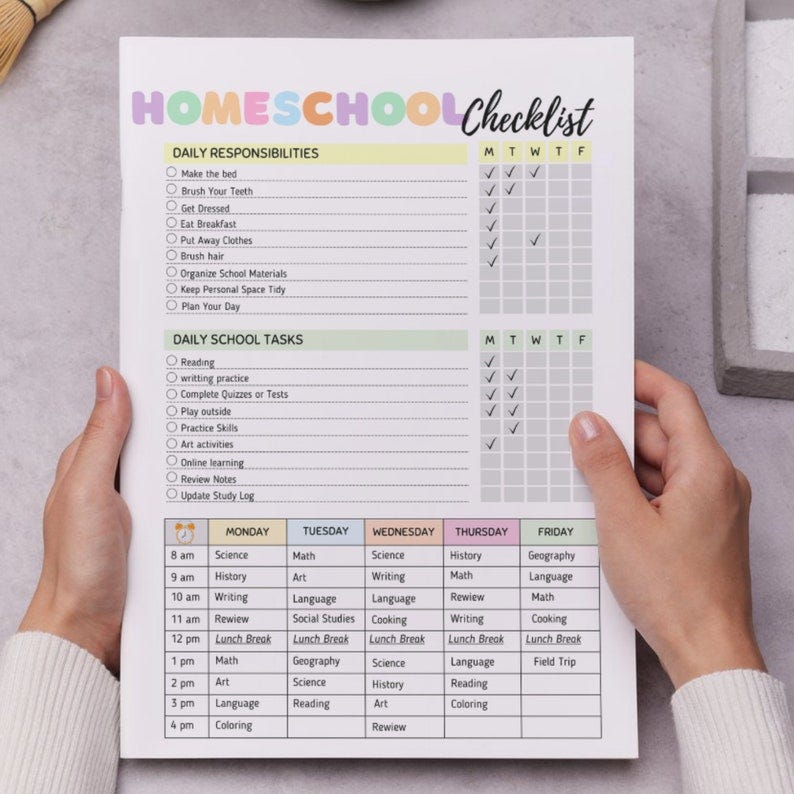
No day is going to be perfect, but it can at least be consistent, and education is ninety percent consistency. A sixty percent effective day is far better than a perfect day followed by a week of not following through at all. Contrary to people who think kids want to be constantly entertained, they thrive in consistency. If they have a clear idea of expectations, there is far less frustration all around.
Getting such consistency is straightforward. You set up your list of tasks the day before. If it’s a stay at home day, there is a full load. It there is an afternoon excursion, you make things lighter. The routine goes beyond schoolwork too. Make your list have basic items like “brush teeth” and “eat breakfast” to give easy things to check off and get into the rhythm of the day. Checking off lists is satisfying.
Also, before setting up book work, get those little runts tired. Have a list of calisthenics to do, hard enough to get them huffing and puffing but gentle enough not to wreck them for the entire morning. Get them tired enough to be able to sit still but not so wasted they want to take a nap. While this is most important for boys, girls thrive on this also.
Procrastination never works, and you’re going to deal with stressed-out kids who have work on the back of their minds if you don’t insist they get it done first thing. An hour of work followed by a ten minute break repeated until completion will ensure the work gets done with plenty of time for free play. Also, procrastination kills routine, and without internal discipline to follow the schedule both parent and child will get stressed and easily agitated. Just get it done.
I advocate school year-round with few breaks, as it is much easier to have an easier load for the summer, consisting of a couple hours of math, writing, and the arts to keep their skills sharp than waste months getting back on track after a lazy summer. There are vacations and such and you can be flexible here.

Planning the Home
A large percentage, arguably a majority, of your child’s education will be outside of designated school time, and your home environment should reflect that. This means regular prayer time and catechesis if you are a pious household. Your child should be into the routine of having basic life skills long before they leave the home.
Children past the toddler stages can clean their room. Children as young as seven can do dishes. They should be doing their own laundry and prepare basic meals by the time they are preteens. Everyone should be able to follow a recipe and do basic modifications by the time they are teenagers whether they are male and female. They should also be acquainted with basic home maintenance skills regardless of sex. I’m not asking every girl to be able to lay floorboards, but she should be able to use a drill. I don’t expect every boy to be able to make his clothing from scratch, but he should at least be able to patch a pair of jeans. Your little girl doesn’t need to hunt with the boys, but should know proper gun safety. Your son doesn’t need to scrub to a perfectionist wife’s standards, but he should be able to make a bathroom reasonably clean.
With regard to free play, while I am not a total screen luddite, any sort of easy entertainment should be limited. This means TV shows, video games, cell phone use, etc. Don’t worry, you will have plenty of time to make you kid “tech-savvy”, whatever that means. A good rule of thumb is to encourage activities that require engagement with the world instead of passive reception. What form this takes will vary. If you have lots of land, this will involve exploring outside, others might pain figurines, and many will play board games with absurdly complex rule sets.
Note that this is a spectrum, and I would argue that reading involves a lot of passive reception. While most parents would kill having the problem of their kid reading non-stop, there is a healthy limit, and even a kid who reads all day can be unhealthy since it avoids engaging with the world for fantasy.
By far the most important part is setting an example. If you think your kid doesn’t notice you ban phones for him but are spending all night scrolling your own phone, she does. She notices your workspace is trashed while he has to make his bed every day. She notices you just cook slop and expect higher standards for everyone else. The hypocrisy is infuriating, and any value you try to create is thwarted if you don’t live up to your expectations for others. Get your own habits in order first and set a good example.
Conclusion
Rest assured, I fail at a lot of the above. Even your best laid plans will be thwarted, whether it is through a colicky baby, long work hours, or contentiousness in the home. As stated before, no day is going to be a complete success, but different levels of failures and victories. What’s most important is to keep your high aspirations, even after the prospect of taking the sixth kid through the same process makes you groan. From what I’ve seen, its not the most educated who have success, nor the most successful. It’s the parents who grind, day after day with an uncompromising consistency while also having the foresight and flexibility to not demand too much nor too little.
This is a general outline, and I’m more lessons learned are on the horizon. This isn’t a task you can offload, and you can feel stranded when all the institutions teaching pedagogy say all your efforts are wrong, but every year you will see a little improvement, a little better understanding, and a little more maturity. The best part is, you will be a part of all of it. Good luck, you got this.
Thank you for reading Social Matter. If you enjoyed this article, please like and subscribe. Paid subscribers are also deeply appreciated.
A great summary. Have to agree especially with the exercise before mental work! Get them moving throughout the day and everyone benefits.
do you have an opinion on teaching them ancient greek and latin?