


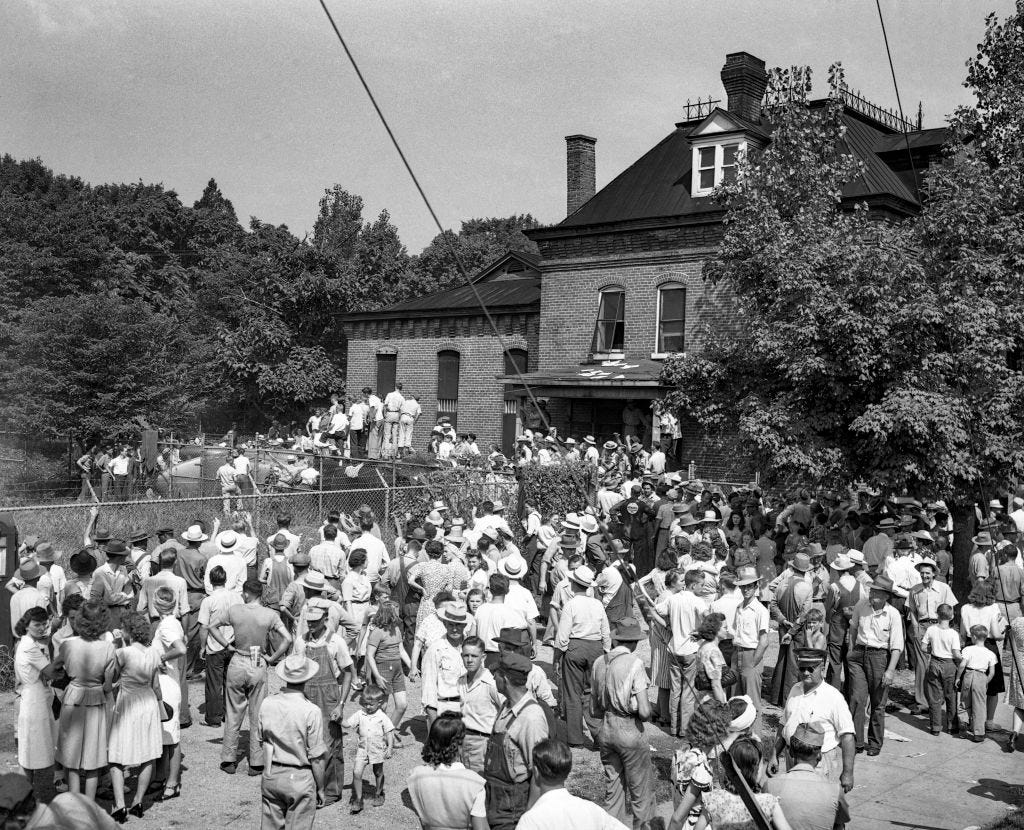
In the 1940s, citizens of Athens, Tennessee, were at the mercy of a conniving, corrupt local government. The local sheriff filled his coffers through targeting visitors with bogus claims of drunkenness. Soon, returning veterans were also targeted with heavy, bogus fines. As the U.S. Department of Justice refused to take action, the veterans tried to change things the democratic way, running their own candidate, posting poll watchers, and keeping on the lookout for voter intimidation. It didn’t take long before legitimate requests led to poll watchers being jailed, and outbursts of random violence from the deputies made the environment explosive. As a final insult, the deputies took the ballot boxes to be counted secretly. The veterans gave up on peaceful means and stormed the local National Guard armory for weapons and had an armed standoff in the local jail, concluding when it was dynamited and the deputies surrendered.
Reading about this incident is akin to researching ancient texts, as it is near impossible to ponder such a situation in modern times. Most would run to social media to claim voter intimidation, or videotape the poll watchers being arrested. There would be pleas to higher authorities to fix the injustice. Hundreds of men storming an armory and taking matters into their own hands is an incredible case study of coordination, group cohesion, and sheer will. Yet the incident also showed the incredible restraint of men just returning from war, as they tried every other option until they were met with the prospect of either violence or surrender. A classic case of pushing hard men too hard and chaos following. One must question if such prompt action and organic organization is possible today.
Men’s groups are an endangered species, and the ones that remain are shadows of their former selves. The Elks Lodges are emptying and secret societies like the Freemasons have lost their mystique. Church groups are often the only place available to have male camaraderie to relax and chat with other guys without the stifling spectre of the modern panopticon looming over them. Unfortunately, these are a mixed bag, and don’t fulfill the purpose of the Mannerbund in times past.
Anyone attending a men’s religious retreat knows they get two different types of speeches. There’s the emotive, broken speaker: my life was crap, and then it turned around. It’s still kind of crap, but it's tolerable now. He ruminates on hitting the depths of despair with alcoholism, divorce, or estranged children. The speakers deliver the sort of speech that offers peace to one’s predicament and motivates listeners to accept hardships.
Then you have the tough-guy speech. The guy gets on stage, gets energized, gets angry, gets in your face, yells a lot. He tells you how you need to get better, tells you how you're failing to meet your duties, and how everyone around you deserves better. Apparently listening to a stranger berate you is seen as manly in some quarters.
Discussion groups follow the same format. Some men’s groups encourage what are essentially trauma dumps, encouraging men to “be vulnerable” and open about their struggles and concerns with the other guys. My table this week had a guy who spent fifteen minutes spewing about how his dad’s infidelity led to anger issues that have carried him to the current day. Another guy had to leave halfway through the presentation to emote his issues to a few listening ears. Then there were more mundane ones, where a father with young kids lamented how he felt he had to put his ambitions on hold.

On the other side, there is a sort of faux machismo, often over brats, beer, and other “manly” stuff, talking about how to be a better man, to be a leader, to “go to war with the world.” The more violent the terminology the better, the more bravado over the mundane aspects of life the better. They try to form a military grammar around the struggles of modern life, creating a sense of conquering something that is so important to the male psyche. Often they will go on hikes, go to the range, have a barbecue, backpack, or another action-based activity revolving around traditional masculine roles. Still, what they espouse as an alternative is more of a hugbox in a different direction. It’s still emotive, and while it’s not as weak looking from outside observers and likely healthier, it’s just as artificial. It runs into a lack of agency in the real world.
They can talk about leading the family, but the conversation will quickly get uncomfortable when actual action is prescribed. They pontificate about being leaders in the home while walking on eggshells to avoid making their wives mad. They talk about going to war with the world but are terrified of Human Resources. The room gets quiet when a man tells another man in blunt terms he is screwing up and needs to stop whining, though it’s okay for a guest speaker in the church hall to tell that to hundreds. It eschews victimhood, but places a sort of helpless stoicism in its place once the meeting ends.
Still, it can’t be said that nothing good gets accomplished in either group type. While trauma dumps are cringe-inducing, performative, and often focus on creating an emotional high more than finding a solution, some guys need to talk. With the erosion of relationships, there might only be the random guy in a church group to chat with. Some are on the precipice and need someone to listen and talk them down, and these groups are offering a valuable service trying to give the cognitive tools so they don’t check out of life entirely. That being said, it’s questionable whether encouraging emotive displays should be the norm rather than an outlier and risks creating its own pathologies and sense of victimhood.

Those who have a mildly perilous adventure with the guys come back rejuvenated and sometimes more confident. What happens when the adventure ends though? Is there a path from a retreat with the guys to direct action in the world? Should the core message stop at “come to terms with your plight”? Okay, say that has been achieved. What now?
In every civilization, a man has had primary loyalty to two institutions, the family and the warband. In earlier times, the people often overlapped, with much of his extended family being part of the same military group. This warband, the Mannerbund, ensured the safety of the tribe, allowing for mass coordinated action against a foe, whether for riches, protection, or conquest. The warband could be seen as collective families banding together for mutual benefit.
The family is more mundane on the surface but holds the key to generational survival. He would run the family, delegating and prioritizing tasks while being a line of defense to his immediate property. His duties included tilling the fields, teaching his son skilled trades, building shelter for his expanding family, and being the last line of defense against predators.
There is always tension between these two worlds. The Mannerbund carries exceptional risks, but broader society depends on it. Without it, a man’s family and those of his entire tribe are left exposed to ruin. Men are drawn to it because it is necessary, but an imprudent raid, a rash expedition, or a neglected farm will ruin a family just as surely as marauding invaders. A balance must be struck between family and tribal interests.
When one looks at the lives of prominent figures, the tension is everywhere. In the case of famous Korean War and Vietnam veteran David Hackworth, he saved countless soldiers’ lives through his strict discipline and ability to build rapport through wild adventures and drinking binges. On the domestic side, he ignored, berated, cheated on, and eventually abandoned his family. Then there is the modern example of Prince Harry, who renounced his royal duties to appease his wife, and together became the most insufferable couple in existence. Neither extreme is exactly a role model.
Well, it’s good to have individual talks and talk about individual action during individual lives. What’s missing from all of these is group action, a group collective, group cohesion. Instead of a world where we can not only talk but take joint action, and have joint responsibilities, we’re stuck at the individual level. We talk individually about how we can be better husbands, but not how we can act like a group in order to make the world better, to impose our will.
In contrast, the Mannerbund, rather than a self-help session or an enjoyable night with the guys, is a force multiplier, giving a wider swath of options through collective action than can be done individually. And let’s be honest, the Mannerbund, as traditionally understood, has been wiped out. The most collective action a group of men can make is maybe planning a pancake breakfast, helping someone move furniture, buying an ultrasound machine for a pregnancy resource center, and other nice but nonconfrontational efforts. Anything that operates in the gray area of the law or even has the potential to ruffle feathers will make that group a social pariah on par with mafias or criminal gangs. Ask yourself if men’s groups would still be welcome to gather if twenty military-aged men gathered around to protest a school board proposal, canvassed neighborhoods to get one of their guys into political office, or tried to get ideologically aligned people hired into a business.
Everyone knows why there is an underlying animosity to men banding together for common cause. When a large group of men gather and create tension, even within legal means, the potential for violence exists. Power, at its core, is the ability to either inflict violence or be impervious to your enemy’s violence. The only way to circumvent this reality is to make the gathering so banal that such a threat is impossible, to make the men as obsequious as possible. And forget about supporting any scenario where the threat of violence is explicit, such as training for church shooting scenarios, security networks in the event of riots, or legal help for a guy who “took care” of a problem law enforcement wouldn’t touch.
There’s good reason for the fear. The Irish rebels often met in bars to scheme in the 1910s. The Austrian Painter planned his first insurrection in a beer hall. The Stonewall riots were kicked off when police initiated a sting in a bar. The State looks with suspicion, and Church organizations have no will to run afoul of such a powerful force, or look like they are aiding and abetting radical groups.
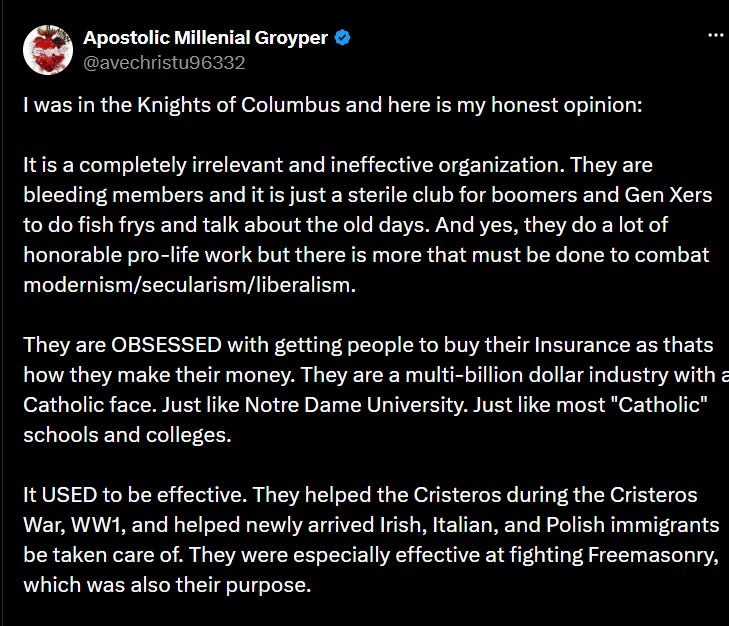
If you ever wonder why every large Church organization is so limp-wristed, even if run by men, this is why. While I can give multiple examples, likely the best example of such cuckery is the Knights of Columbus, which owns vast swaths of wealth through dues and insurance policies. One would think an organization with $1 billion in revenue could enact incredible projects. They could fund businesses of fellow Knights with favorable terms. They could use economic leverage to fund projects that give members local power. They could buy out businesses in advantageous areas and put their own guys in charge. They could use their networks and leverage to completely transform business towards developing real power. What do they do instead? They offer a fucking credit card with a 26% APR.1
This is also why the relentless mockery of the “wifeguy” is counterproductive. When there is no Mannerbund, the wifeguy is inevitable, and the immediate family becomes the default outlet for all his devotion. These family men were never given an opportunity to assert their will, and if anything they internally pathologized such inclinations, reframing their ethos as servant leadership. Underneath the veneer, they have reconciled themselves to subservience because they lack the camaraderie for a joint future vision. Give a wifeguy a Mannerbund that has the ability to exert its will, and the man working like a dog to afford new dining room furniture will become its most devoted soldier.
One could argue the idea of the Mannerbund is a relic of a more primitive era. After all, shouldn’t a father devote all his time to his family? Many grew up in a generation where dad never lifted a finger in the home, so why should this tension exist at all? Just get rid of the warband. The day-to-day world has surpassed the need for mafia-like organizations, struggles for power, and the propensity for violence. If anything, this justifies the current pushes to remove male spaces, whether they are fraternities or Skull and Bones. This is shortsighted. Just because the invaders are not carrying swords and threatening to rape your wife and sell your children into slavery doesn’t mean those threats don’t exist. Without the balancing force of an organic, cohesive unit that can push back on excesses, we see what we see now: an unceasing incursion into every aspect of life and the gradual erosion of our capacity to act.
The State is more than happy to steal your children away, make you economically destitute, and ensure your values won’t survive another generation. Even the state’s preferred method of soft power has within it the threat of violence, whether it is getting fired or encouraging a mentally ill schizo to do dirty work on its behalf. The philosophy of modern churches, to be as unthreatening as possible to the powers that be, has seen their power recede as their enemies become ever more strident, and it has proven ineffectual against an enemy that will leave no one alone. They don’t care, and these men can’t fight alone.
Whether one’s group is a hugbox or affirms stoic discipline, neither is capable of coordinated action, and neither is a threat to powers that have no qualms about using violence, as masked as it might be. At best, you could get your head more in order, but the thought that you are fulfilling your mission is a cope to mentally dismiss the reality that you have few options.
Your church group may not be able to help, but it is full of men who want something more, but don’t understand what. They want somewhere where they can collectively act as a force multiplier, to not only get their personal life together. Being a family man is fine, but it can’t exist in isolation. There’s a pull to fulfill their larger duty to society as a collective. This doesn’t mean to go Rambo, as even the Athens veterans tried every peaceful option before resorting to violence, but it does mean being willing to be controversial, being willing to impose your ideals on the world, to shrug at the thought of causing conflict, and, most of all, to have a vision you are willing to fight for.
By all means, have your Bible study. Talk frankly about your troubles. Challenge yourself in the gym with your friends. That’s a baseline, but it doesn’t end there. None of that is bad, but it is incomplete. No one ever became great by simply accepting his plight, nor did he become virtuous by being vulnerable. As men, our role has always been war against demons both internal and external, and no group can be serious unless it takes this reality seriously also. From my experience, most male pathologies don’t stem from past traumas, but the feeling of helplessness it created, of not being in control. Give men a sense of control back, and you’ll be amazed the deprivations and struggles he will accept with a smile.
Thank you for reading Social Matter. If you enjoyed this article, please share and subscribe. Wifeguys should become paid subscribers.
The Knights do good work at the local level, but their national vision is pretty much to keep the membership dues rolling. Completely useless.
Good stuff. But no need to reinforce feminist propagandistic power like this: “Many grew up in a generation where dad never lifted a finger in the home.”