


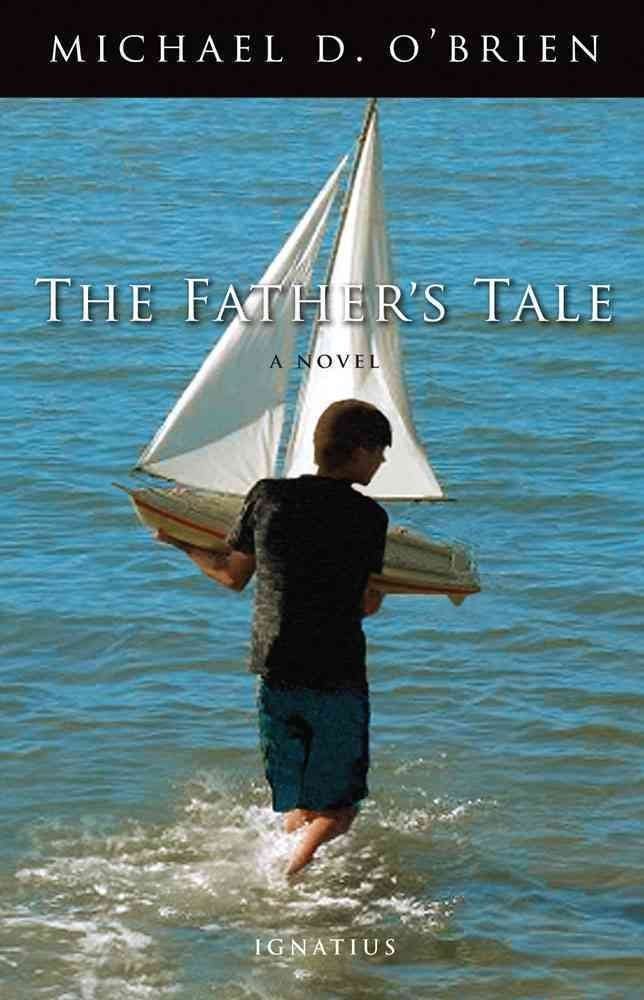
I consider myself a pretty relaxed reader. Rarely will I get angry after poring through a lousy book. If it's bad enough, I'll just set it aside and say it wasn't my cup of tea. That being said, I recently promised someone I'd read a book deemed to be a modern classic, a deep, penetrating experience along the lines of the great Russian existentialists, a tome that brings a reader on such a harrowing journey he will never be the same person again. The work was Michael O'Brien's "The Father's Tale". Coming in at an awe-inspiring 1076 pages, the tome sought to span the topics of The Parable of the Prodigal Son, Catholicism and Orthodoxy, The West and the East. Its ambitions were monumental.
For those unfamiliar with the Catholic Literary Scene, O'Brien is somewhat of a modern rock star in this niche culture. He is known for his long, ponderous works whose impact is often spoken of in the same breath as Dostoevsky and Tolstoy. Sheldon Vanauken, the author of A Severe Mercy, a Catholic staple on par with Brideshead Revisited, has sung his praises. A thoroughly devout Canadian Catholic, his works involve the struggles of faith in a rapidly deteriorating West in an unabashedly orthodox fashion. The book club “Well Read Mom”, that tends to have good literary taste, chose it as their book of the month.
I already had reservations, having read his "Father Elijah" several years back and finding the prose excessively verbose and the characters unbelievable. It's only saving grace was two excellent scenes that elevated it from dud to passable. "The Father's Tale" was written fifteen years later, so maybe he's gotten better writing chops since then. The reviews on the tab gave glowing recommendations that assured the reader this work was important. Peter Kreeft, a writer whose work I deeply respect, had this to say.
This is a magnum opus in quality as well as quantity. All of O'Brien's large and human soul is in this book as in none of his shorter ones: father, Catholic, Russophile, Canadian, personalist, artist, storyteller, romantic. There is not one boring or superfluous page. When you finish The Father's Tale you will say of it what Tolkien said of The Lord of the Rings: it has one fault: it is too short. A thousand pages of Michael O'Brien is like a thousand sunrises: who's complaining?
--Peter Kreeft, Ph.D., Boston College
Having finally suffered through this travesty of a novel, I can confidently say there is no fucking way Peter Kreeft read this book and wrote that blurb with a straight face.
The tome starts in Halcyon, Canada during wintertime. The protagonist is a Russophile, middle-aged widower named Alexander Graham with two children, Jacob and Andrew. He runs a small bookstore and is an empty nester now, his children both out of the country in college. Jacob is studying in Colorado, and little is spoken of him the entire novel. Andrew, a flighty and idealistic young man, is in Oxford studying literature. Events take off when he sees two children drowning in a nearby river, leaving him alone to rescue them. Graham's heart gives out just as he gets the children to shore, causing him to black out and awaken in the hospital, becoming a minor celebrity from the rescue.
We are then introduced to Father Toby, Graham's old friend since childhood. Both of their childhoods are recounted in excruciating detail three times in the book. In one section, Alexander recounts his entire childhood to Toby in a ten-page recollection, and then Toby telling Graham his own childhood, going over the exact same details from his own perspective for another ten pages. That chapter reigns as the most tedious data dump I have ever read, especially since most of the events narrated had already been established earlier. Also, Father Toby calls Alex "Worm" endearingly for being a bookworm. Now, plenty of guys have amusing nicknames for each other, but Worm? That's not amusing. That's just vicious.
We are then introduced to Maria, an Italian immigrant. I'll let some of her dialogue speak for itself.
"Please Alex, don't drinka too much, you go for the walk and you fall down nobody see you and you freeza ta death. That's okay for you, maybe you go to heaven, but thinks da boys, thinka da people's who cry over your coffin, eh?"
![Family Guy - Speaking Italian [Translation] - YouTube](https://substackcdn.com/image/fetch/$s_!b-wj!,f_auto,q_auto:good,fl_progressive:steep/https%3A%2F%2Fsubstack-post-media.s3.amazonaws.com%2Fpublic%2Fimages%2Fdd224582-d034-4d88-8458-54fa02b67a31_480x360.jpeg "Family Guy - Speaking Italian [Translation] - YouTube")
Alex recovers from hypothermia and goes home. He is invited to the home of the widow of the children he saved through the machinations of Father Toby, trying to pry Alex from his insular ways. Afterwards, Alex learns Andrew is going to a conference with a group of mystics called the Metaphysicians. What do they believe? What is their motivation? Who knows? The book never explains. All we know is a German guy named Bloch in in charge and they're incredibly powerful. It goes so far as to imply later in the book that they had moles in Canada's Embassy, leaving him to be stranded in Siberia when they can't find documentation regarding his entry into Russia.
This goes into my main gripe with the book. Andrew, who should be the focal point of the story, is simply a MacGuffin. Little, if anything, is given about the young man's motivations. Andrew's main purpose in the novel is to force Alex to travel to Russia to experience personally what he once only read in books. There's a three hundred page span where he's barely mentioned at all.
The book really starts at page 200 as Alex travels to Oxford to get clues to where his son went. There he encounters the Oxford staff, who can only give him access to Andrew's dormitory but no info to his whereabouts. He talks to Andrew's professors, who seem to be tweed wearing, pipe-smoking poets from the 1920's, time-warped to modern times. Here we're sidetracked by conversations about poets like Blake with all the depth of a guy who breezed through a Wikipedia article. No worries though, the professors assure us this is "a penetrating analysis". He finds a clue in his son's coat pocket, leading to confronting a woman who tells him there’s a conference in Scandinavia.
He travels to Scandinavia where it's a cat-and-mouse game trying to get access to the hotel over the course of hundred pages. He tries all sorts of methods to get his son's attention, only to fail and find out they now travelled to St. Petersburg. He follows them with the same count-an-mouse game for another hundred pages. During that time, he saves a prostitute and a drunkard. No, it has nothing to do with the plot, but it does eat up fifty pages. He finds out they left, again, this time to yet another conference in Siberia. Why Siberia of all places? Who knows?
After a stint on the train the tracks get sabotaged, leaving Alex to stay with two priests, one Orthodox and one Catholic, in a remote village. As with every character, we get their life story, which also doubles to talk about every event in Russia in the past century with all the depth and nuance as a summary of Spark's Notes. It's largely a ploy by the author to talk about the differences between Catholicism and Orthodoxy, none of which was particularly noteworthy. It all came across very heavy-handed.
He boards the train after the tracks are repaired and meets a middle-aged doctor named Irina. She's a widow. When they arrive, the two have some dinner before going off on their way. Later that night, Alex is robbed and beaten half to death, waking up to find himself in the doctor Irina’s house with a head injury that will take months to recover. All his papers were stolen, and to his horror finds out that the embassy has no record of his existence. He's forced to stay for months, all attempts to talk with the outside world being stymied. There's a romance that goes nowhere, along with some cringe inducing dialogue that works because Alex is a pretty cringe guy. While an agnostic, Irina is still in love with her devoutly religious deceased husband. We are treated to reading some of her husband's letters, which seem very suspiciously like the author's personal commentary. Now, a normal writer might indulge himself with a few pages to use as a soapbox. Not Michael O' Brien. The reader is privileged to scour through 21 PAGES of letters that are thinly veiled screeds regarding the culture of the West versus the East. I admit I skimmed this portion. It was just too much.
About four-hundred pages pass here. Then Irina is tasked lecture at a nearby University leaving Alex, now recovered. to do some exploring. He gets lost and stumbles into a secret Russian research facility. He is captured and transported to a black-ops site because fuck it, at page 900 this is a spy novel now. They think he's an American spy by the name of Bell and believe the entire story of a lost son is a lazy cover. Now we have menacing Russian interrogators, torture, lying, and misdirection as they try to pry out a confession. Failing that, he is put on a train to be shipped to their chief torturer. At transport near the border, the train is attacked by Chinese troops because.... who the hell knows, and he is sent to China.
Now, I'm no expert on international relations, but attacking a military train and slaughtering its surrendering soldiers seems to be something a little more than a misunderstanding. In any case, instead of going to war, the Chinese and Russians exchange strongly worded letters for a while.
Now the Chinese are interrogating him to extract information about the secret Russian base. They have no luck. Alex is then helped by staff who are part of the Underground Church in China. There seems no real point to their existence, and little explanation of how so many underground Christians infiltrated such high levels of the security apparatus, nor what their ultimate goals were. They were just thrown in. The Americans end up being the ones to save and fly him home, as the Canadian government was content to throw him to the wolves. This isn't an isolated incident. Michael O'Brien seems to really, really, hate the Canadian government. I can't blame him. At page 1025 he finally gets home, where he is again a minor celebrity as his story spreads. Here we find out that Andrew escaped the cult, Jacob got married, and he is pursued a romance with the widow whose children's life he saved.
I might have gotten some plot points mixed up, but I don’t care. I’m not reading it again. Mark Twain once accused James Fennimore Cooper of scoring 114 literary offenses out of 115. If Twain read "The Father's Tale", he would have had to catalogue hundreds more once unknown to him. I have never read a book with the redundancy, blatant soapboxing, and over-explaining as in this novel. And then there's the pacing, my word the pacing. Upwards of four-hundred pages pass with nothing happening, then several cataclysmic events happen within fifty pages. It's like he knew the book was becoming a bloated mess and decided to wrap it up. With a good editor this could have been cut by 400 pages and become a readable but thoroughly mediocre book. Regardless of editing, there was no masterwork in these pages to be extracted.
Catholics have been spoiled by the literary masterworks of the 20th century. Whether it's the fantasy masterpiece that is Lord of the Rings, the Southern Gothic tales of Flannery O'Connor, the dense and profound works of Walker Percy, or the tight narration of Graham Green, there's been something for every taste. It's logical this sphere wants to keep the trend going, to find the next great writer in modern times. On its face, O'Brien would seem to be that guy. He's pious, he's orthodox, he writes long works, and he discusses big topics. There's one glaring problem. He's not a good writer.
His piety constantly gets in the way of telling the story. While I have reservations with writers who think every protagonist needs to be a degenerate scumbag to be interesting, there's this overarching need for Alex to be the opposite. While the book is fine with portraying him as a bumbling fool, it always assures the reader of his inner virtue. When he incidentally walks into a co-ed nudist spa, he walks out. In order to assure the reader understands how awful it was, there is a two-page rant about how the virtue of modesty is long in the modern world. Even as a Catholic, the constant moralizing is exhausting. His only real moral failing the entire book was flirting with a young woman on the train, which was largely a misdirection used by the author to mask the actual love interest, Irina. This was one of two scenes that were done very well, the other when Irina’s sons find their deceased father's letters inside a model sailboat he made before dying. Credit where it's due there.
He wants to tackle great issues, but it's apparent when he's bitten off more than he can chew. You can name drop Dostoevsky, Chekhov, and Gogol all day, but if you can't expand on their thought in any meaningful way it’s pointless. I didn't read one passage that gave an interesting, unique take on the Russian spirit from American eyes. What I read was an author desperately trying to be profound, which never ends with anything worth saying. Last, you don't have to bludgeon the reader. Try a little bit of nuance and ambiguity. Most of this book reads like an overzealous medieval inquisitor was looking over Michael O'Brien's shoulder, poring through the lines for possible heresies.
In desperation for the next great thing, many works are given undeserved praise. In niche circles, there's that desperation to find someone in their ranks to fill that role. Orthodox Catholics want to find the next Evelyn Waugh or Walker Percy. Unfortunately, I don't know if he exists yet. If "The Father's Tale" is the best the sphere has to offer, he absolutely doesn't. Instead of elevating subpar works, perhaps it would be better to widen the net and see who else is out there. It's better that than praise lousy books for those dipping their toes in, inquiring about the next big thing. It isn't just a Catholic thing either. Established tastemakers have destroyed their social capital by elevating bad literature to the extent once renowned awards mean nothing.
Now Newpub is rising, with talented authors getting mainstream attention through untraditional channels. While many works are excellent, we're still waiting for that next great novel, the masterwork everyone needs to read to be part of the conversation, the words that fully speak of the current age. As exciting as it is, there’s a risk of getting ahead of ourselves. Even as the general public warms up to nontraditional publishing, we can’t recommend slop just because one of our guys wrote it. Newpub has shown remarkable honesty here, and if anything the niche is overly harsh to writers. This quality control and patience will pay dividends. Keep reading, keep being engaged and when the next great novel comes, we’ll be ready.
Thank you for reading Social Matter. If you enjoyed this article, please share and subscribe. If you’re Michael O’Brien, if it’s any consolation, I like some of your iconography.
Strangers and Sojourners was, in my opinion, O'Brien's best work. The reflective, sombre narration of Anne's life is O'Brien at his best. The best parts of the Father's Tale are those parts, even though they drag on for too long.
Good Catholic novelists like O'Connor, Greene, and Waugh understand that ambiguity, ugliness, and doubt are necessary catalysts in the souls of their protagonists. I think Eugene Vodolazkin gets this, and from what I've heard so does John Fosse, if we're looking for contemporary Catholic masterpieces.
I wish Ignatius and Sophia Press would publish more fiction—but I realize this would probably only result in more books with highly convicted characters and dull plotlines veneered over soapboxing.