


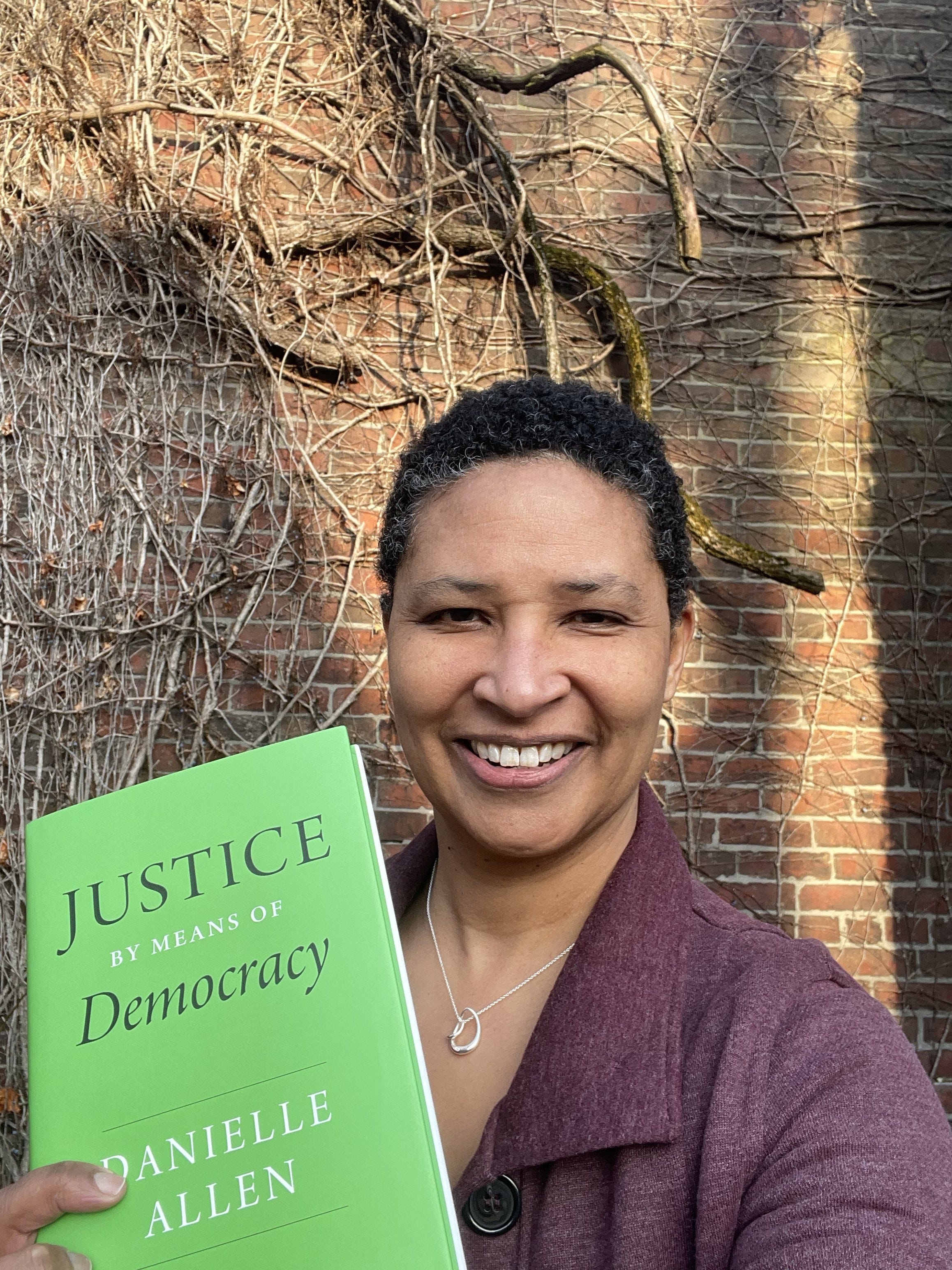
I just listened to the debate between Professor Allen and Curtis Yarvin. While I am profoundly disappointed he didn’t arrive in a tank, he couldn’t have asked for a better opponent. This isn’t because she made her points well. She was a weak opponent, but that’s not why either. She was reasonably well versed, educated by all the right people, reciting the sacred bromides of her profession expected of her. However, there seemed to be little curiosity in her mind, and the lack of complexity and nuance in her arguments made her appear only slightly above average intelligence. In other words, a midwit.
It’s hard to tell if she ever had any encounter with dissident thought in her life. She didn’t seem to bother reading any of Yarvin’s work, depending on mainstream narratives for what his ideas were. She also had an impenetrable focus on abstract concepts of Democracy, Equality, and Pluralism that sounded more like a mission statement than an argument.
There were countless more educated people with a wider breadth of historical knowledge at Harvard. They could have easily pulled another professor who could cite countless political philosophy books that would put Yarvin’s incessant citations of obscure works to shame. They wouldn’t have been a proper opponent for him though. A person of that affluence and knowledge would have to deal with massive cognitive dissonance, the deep recognition that underneath the platitudes of the University he was defending were intentions and outcomes in extreme deviation from the words coming out of his mouth.
You didn’t see that with Professor Allen. This woman believed, with every fiber of her being, in the words she spoke. When she accused Yarvin of advocating for a racial hierarchy (bait he smartly did not take), it was not inflamed rhetoric to cause a rise. She truly believed it. When she constantly said “equality”, it was with the same passion a religious zealot would say “Allah”. The crime-stop mechanism in her head to avoid uncomfortable thoughts was top-tier through the debate. When she stated everyone had moral equality and a challenge came from Yarvin in the form of “when in the evolution of Homo Sapiens does everyone reach moral equality?”, it was like she didn’t hear the question. When he asked why thinkers of earlier times have been banished from University discourse even though their thoughts were never shown wrong, she mentioned Harvard’s commitment to pluralism again like an incantation. When he noted that the quest for Truth was not a Darwinian mechanism of having the best argument but ended with the ideas that could get grants climbing to the top, she resorted to her mission statement script and the rigors of science, only adding that more work needs to be done.
Probably the most notorious example was how the two people talked over each other in regards to what the word Democracy meant. While Yarvin may have an overly pessimistic opinion of Democratic institutions, in Professor Allen’s mind Democracy, Goodness, and Truth were practically truisms. The term is practically an omnipotent deity into itself. The election of Donald Trump couldn’t be because of Democracy, because that was a bad outcome. The courts blocking Trump is Democracy, because that’s a good outcome. Yarvin poked at her again when he said her definition of democracy sounds more like an oligarchic system of prestige and got another word-salad in reply.
Yarvin’s common attack was to express the disconnect between the abstractions she focused on and reality, and it’s shocking how badly she failed. Not once did she mention real examples of how Harvard helped human flourishing even after Yarvin excoriated her University with its terrible past failures. I was originally surprised at this, but it makes sense given her embrace of the cause, with several generations of activist ancestors she looks back on with pride. A zealot is not interested in messy realities, but utopian visions. Like a monk who renounces the world for the sake of God, this midwit Academic renounced the world for the sake of her University.
I ended up liking Professor Allen. For all her faults, she was sincere. In this irony filled world of disingenuous grifters, obtuse moralizers, and annoying panderers, it’s refreshing to see someone who truly believes in something. That’s why, for all her flaws, they couldn’t have picked anyone better. No one else could so zealously defend all the contradictions of the current order, laying bare the mindset of our supposed elite. Yarvin could have attacked more aggressively, and at times he was being far too cute (the debate should have been at least two hours), but what he did was sufficient. He showed current elite order has left the realm of the earth to drift in clouds where their contemplations don’t have to worry about the messy realities of their actual outcomes.
That being said, it also makes her a deeply dangerous individual. She is not the type who will pivot when a policy she advocates ends in disaster, nor is she one to question the University as they deploy brainwashed fanatics into the general population. The nation could crumble following her advice and she would still have the conviction of a street preacher.
Overall, she is the embodiment of Eric Hoffer’s True Believer, and her fate is to be the sentry of a time that has already passed. As Eric Hoffer once wrote: “In times of change, learners inherit the earth, while the learned find themselves beautifully equipped to deal with a world that no longer exists.” If you read Harvard Magazine’s report on the debate, is clear that Ms. Allen and the University as a whole are not learners, but preachers of a faith the world has already passed by.
Thank you for reading Social Matter. If you enjoyed this article, please subscribe and share.
Solid writing style and tone, no vitriol.
A fairly accurate assessment of the “aesthetic” that she presented… Indeed, her blank stares into the audience, her refusal to face Yarvin or even look him in the eyes as he spoke… it all felt almost “uncanny valley”.
However, I would pushback that she is a true believer in a world that has already passed by. No, SHE IS the power structure, SHE is the member of the ruling class in this conversation, not Yarvin, and he knows that.
It’s half of the point he makes all the time in Gray Mirror. Why else would he say the NYT is a main node of the Cathedral? Because the NYT has power. Harvard has power. You, me, and metaphorically, Yarvin, are the ones writing on a social media app about “big ideas”. She is getting paid hundreds of thousands of dollars (base pay) to spout platitudes. Who is really in power? Trump threatening their grants? Do we believe that will stop Harvard…?
Anyway I agree with your overall assessment of her and most of her cluelessness, but let us not misinterpret the power dynamic here. Yarvin is sharp enough to know better.