


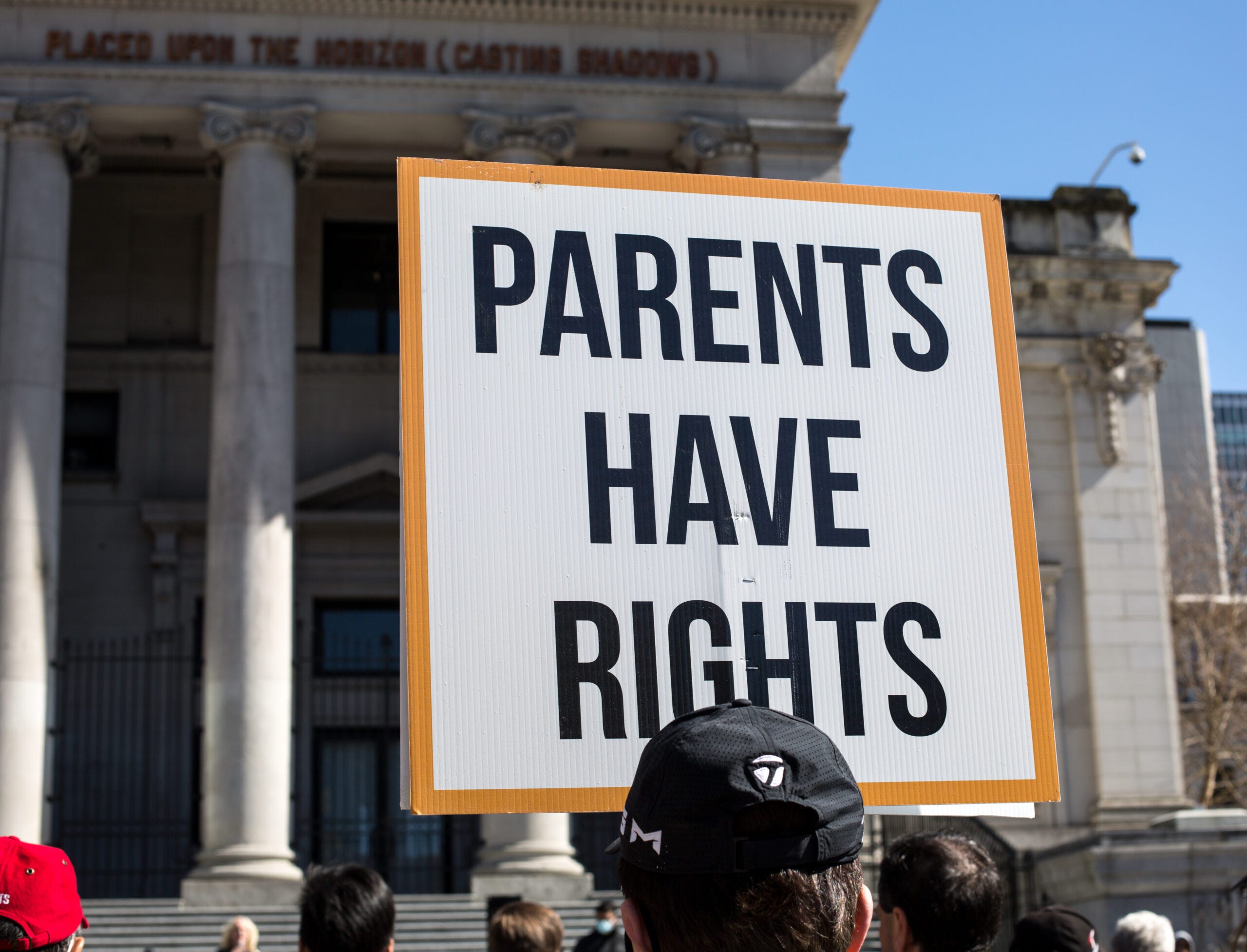
Even in this age of flattening, there are several layers of hierarchy in a functioning state. Across the ocean, the multi-nation European Union has powers vested to its domain. Individual countries are beholden to those mandates and create mandates of their own. The local provinces enforce the State’s mandates, and creates ordinances to their community. The individual is subject to all these laws, but also has personal rights regarding self-autonomy. While the family in times past was understood as a distinct social unit, modernity has largely eliminated that role, preferring to treat each person as an individual instead of a kin group member.
Of course, human beings are not born completely independent adults, and the time and care involved in raising children is arduous. While the parent has an interest in seeing his family line continued, the State also has an interest in the child’s development, as one day he will be an adult and a member of larger society. The State wants to ensure the child has the education to be a productive member, has similar values to others, and an understanding of the social order and his role in it.
As technology proliferates, wealth increases, and governments become more sprawling and complex, the State’s intrusion into domestic life has dramatically increased. Compulsory schooling is, at civilizational levels, a very new thing. Child welfare agencies are only possible because of the vast resources at the state’s disposal. This increased complexity, in conjunction with the dissolution of organic bonds, has made the state, for all its vast resources, far more brittle. Educational requirements are understood not so much for creating productive citizens, but ensuring the children are indoctrinated into the modern and impersonal cultural apparatus.
While The United States has actually increased parental authority in recent years with push-back on mandatory educational, health, and disciplinary laws, much of Europe has followed a different path. Family life is continually becoming more constrained, with both hard and soft power making it difficult to avoid the State imposing its value system on the children. The modern idea of children’s rights supersedes the assumption the parent knows what’s best for his own child.

While the steelman argument for government intervention is that it’s designed only to ensure the child is healthy and gets a reasonable education, the truth is it’s to ensure that the child submits to the secular ethics of the state. One such example is the case of parents who refused to have their child participate in mandatory sexual education classes that they felt were deeply immoral. The priests of the European High Court, after ritually slaughtering a goat and observing its entrails, unsurprisingly came down on the side of the government.
The Court had previously found that the German system of compulsory elementary school attendance, while home education was generally excluded, aimed at ensuring the integration of children into society with a view to avoiding the emergence of parallel societies. Those considerations were in line with the Court’s case-law on the importance of pluralism for democracy.
You might be confused how these states importing masses from the most culturally differentiated societies on the planet helps them ensure a cohesive society, or how how enforcing a strict, singular educational system encourages pluralism. Yet they will say this with a straight face while arguing Germany’s homeschooling ban does not break the European Convention of Human Rights. Western Society likes to pontificate on objective moral frameworks to work under, that the concept of Human Rights has some meaning outside the societal context where it is employed. Anyone who makes even a cursory analysis will realize the modern conception of universal rights is very recent and based on cultural assumptions that don’t transfer to other places. More and more of the time, the idea of Human Rights is simply a catch-all for any new social upheaval those in power want to enforce. As Alastair Macintyre famously quipped:
From this it does not of course follow that there are no natural or human rights; it only follows that no one could have known that there were. And this at least raises certain questions. But we do not need to be distracted into answering them, for the truth is plain: there are no such rights, and belief in them is one with belief in witches and in unicorns.
Whether we are talking about human rights, minority rights, children’s rights, or any other subset, the same problem remains. It lies in the realm of sentiment more than any cohesive abstract theory. It doesn’t follow that all rights are meaningless, however. Every society has an idea of rights procured to its citizens, many of them legally enforced. With those rights are implied obligations, though those aren’t talked about much anymore. While the European courts want to look at human rights as an objective universal, they are simply stating that the citizens of the wider European Union don’t have the right to separate children from state-mandated education for religious reasons. The parent’s right to raise their child in a certain tradition is aggressively curtailed. A person’s rights are entirely a construct of the community they live in, not a metaphysical entity.
The tension between the family unit and general society has always been there, and the delineation of where the parent’s authority ends and the State’s authority starts has never been static. It has run the gambit from the parent' having totalitarian authority over the household to the parent being little more than a resource provider as the child is raised by the state. Both have their philosophical assumptions, and both extremes come to conclusions abhorrent to modern ears.
All Rights, No Obligations
The anarchist Murray Rothbard likely has the most hardline attitude regarding obligatory parental involvement mandated by society. None. In his controversial essay, Children and Rights, he stated:
Applying our theory to parents and children, this means that a parent does not have the right to aggress against his children, but also that the parent should not have a legal obligation to feed, clothe, or educate his children, since such obligations would entail positive acts coerced upon the parent and depriving the parent of his rights. The parent therefore may not murder or mutilate his child, and the law properly outlaws a parent from doing so. But the parent should have the legal right not to feed the child, i.e., to allow it to die. The law, therefore, may not properly compel the parent to feed a child or to keep it alive.
Rothbard argued that until the child had agency to leave the house (through growing up or running away), the parents had total dominion over the life of the child. Rothbard isn’t concerned about the extremes of such statements, such as this necessarily entailing the ability to sell one’s own children. He embraces it and considers it a moral good.
Now if a parent may own his child (within the framework of non-aggression and runaway freedom), then he may also transfer that ownership to someone else. He may give the child out for adoption, or he may sell the rights to the child in a voluntary contract. In short, we must face the fact that the purely free society will have a flourishing free market in children.
To those wondering, no, Murray Rothbard did not have children.
While this sounds monstrous to modern ears, in ancient times it wasn’t uncommon. Often the patriarch had control over matters of life and death, and full mastery over those in his household. In harsher, less socially intertwined times, the business of a man’s household was solely his business.
This is quite liberating for the parent, as he has total control over the domestic household. They can decide whether one’s child is worthy of their time and support at any point and remove it at will. The parent’s autonomy is absolute and unquestioned, and the child only has a say through showing self-agency by removing himself from the household.
While an extreme example, society has to grapple with the application of a parent’s will on a child. At what point is a punishment extreme and abusive? Many countries ban corporal punishment entirely. Many go as far as to say banning their children from social media is abusive. There’s the question of whether a parent can let a child run feral and give him zero education or whether the State can intervene. At what point are we dealing with parental abuse? At what point are we dealing with parental neglect?
No Rights, All Obligations
When Careerflex became an ex-pat in Sweden, he knew there would be a culture clash. He never thought it would culminate in his entire family fleeing the country as the Swedish equivalent to Child Protective Services came to take away his children. Their family ran amuck of the aggressively egalitarian and conformist nature of Sweden, and his child’s innocent faux pas were seen as a menace to their quiet society. They also have a far different notion of parent’s relations to children, as Nordic countries are extremely restrictive of parenting outside of very rigid norms.
This was the context for the publication of Bergström’s Divorcing With Children. Addressing the new “parental teams”, Bergström advises parents to give up the idea that they have a basic “right” to care for or control their children. Rather, parenthood is about obligations.
This mindset is due to their individualistic attitude, where natural hierarchies such as Church, family, or other organizations are seen as oppressive constructs that inhibit people from living as they see fit. The parent is not the authority over the child, but the caretaker at the mercy of the State’s whims. The Swedish ideal of freedom is an individual free from constraint, which paradoxically conflicts with the American conception of freedom that includes these natural bonds. As the American expats realized:
In the Swedish mind, the ideal is to isolate individual people from each other via the government.
Swedes and Americans---as cultures--- value freedom. But how they conceptualize it and engineer freedom are quite different.
In the Swedish mentality, no person should be able to exercise dominion or control over another person. This extends even to the parent-child relationship. It especially applies to married or romantic relationships.
The means by which Sweden has engineered their version of freedom is to have the government deeply involved in an individual’s life from cradle to the grave. Sort of an omnipresent genderless parent to which a person can always turn. And this frees them from burdening and being burdened by family and friends.

In the American mindset, the enemy of individual freedom is the State, while the family, community, religious congregation, and others are the means to enforce virtuous behavior and cooperation. In other models, freedom is imposed by the opposite, diluting common familial, religious, and local bonds through State action. The State sees itself as the active caretaker of its citizens freedoms that ensure no citizen is conscripted into unwanted bonds, no matter what they are. The child is more the ward of the State than the parents, as the parents in this framework has no right to impose its worldview or code of ethics. Of course, this fanatical level of egalitarianism requires a powerful state to mandate, and there’s still the contradiction of the state mandating its own views of individualism on the general population.
Because of this conception of rights, the State has final say regarding every aspect of raising and rearing children. The parents have no rights in this moral framework, and are more unpaid caretakers of the next generation than anything organic. This is not going away, as Sweden is doubling down on such policies as children in unmarried families skyrocket and the two-house model of childrearing continues unabated. The question remains, though, whether anyone will be willing to have kids in such an environment.
You Get the Society You Tolerate
While it’s easy to point and sputter at the excesses of both sides and it’s easy to contemplate the happy medium that is ideal for a functioning society, it doesn’t accomplish much. When dealing with the levels of rights and obligations, it runs the gamut of total autonomy to slavery, with justifications for both. Most people would blanch at the thought that their neighbor has the right to kill his six-year-old son if he became a nuisance, or could put their newborn daughter in the elements to freeze to death. They would justifiably be appalled if a child was beaten by a drunken father or allowed to run feral in tattered clothes around town. It is not only a travesty on a child, but the wider community, as such bad behavior begets more of the same, the same way as when one couple divorces it spreads like wildfire. There has to be a line that can’t be crossed, and social norms that can be enforced. On the other side, taking a child away because the family does not believe in new secular fads, does light corporal punishment, or has specific political beliefs the bureaucrats don’t like is also a travesty and terrorizes even those who are more “normal”.
As an American, my traditions give large latitude to the family. I’ve seen kids whose dad relied on the belt far too often, kids who came to school in tattered clothes, and a good share of nut-jobs mothers. Even with these tragic circumstances, barring one I knew involving sexual abuse, the kid was better off with the parent. Without even getting into the details of the horrific foster care system, a sub-par parent is better than a stranger. Still, the parent’s will can’t be absolute, and a parent’s rights must be curtailed by certain obligations due to bringing a helpless human being into the world.
I will argue that giving this wide latitude is likely best for stability, as models like Sweden, regardless of your views of it morally, is very unstable long-term. It relies on a very top-heavy bureaucracy and secretive channels to operate. While it leaves many parents in terror now, once the welfare state cannot support itself, the existing social structure will come tumbling down. Also, an all encompassing State looking over every parent’s shoulder is a fertility death trap for a nation with already far below replacement reproduction.
You can argue about the ethics of parent’s right, children’s right, and the rights of the State to your heart’s content, but such moral arguments doesn’t tell what the status-quo will be, but power. For parents who tolerate an intrusive state, they will get more of it. For those who look the other way at a kid getting beaten, they will get more of that too. Cohesive communities in the last century have been effective at self-policing, which has been a blessing and a curse. There’s the neighbor who sounds the alarm when he thinks a kid is being starved, and there’s the ninny who freaks out because a nine-year-old is biking around town alone. The overprotective shrew has helped murder classic Americana, but the concerned citizen reasonably looking out for others keeps everyone honest.

As zero-tolerance policies in education, psychology, and other fields have terrorized many innocent parents and an influx of childless adults want a hand in how other people’s children are being raised, the ratchet is always moving towards more control, more suspicion, more obligations without associated rights. As demographics change, and there are more childless voters, this will only accelerate. The voting booth won’t give a reprieve, but only parents who refuse to comply and are willing to fight to maintain their sphere of control. It means keeping self-policing norms without ceding power to neurotic busybodies and fighting an encroaching bureaucracy to allow your child to flourish.
Thank you for reading Social Matter. If you enjoyed this article, please share and subscribe. I’m paywalling an article a month, so if you enjoy this Substack, please consider becoming a paid subscriber.
Part of the problem is that the legal framework has shifted to “best interests of the child” rather than parental rights. So basically it becomes a factual dispute over what is the best decision, and it’s just a matter of convenience and resources that the parents make day to day decisions.
It's a shame that the first few times the courts assumed the right to separate fathers from children all his neighbors and family men didn't drag his out and hang the judge and others, killing anyone that gets in the way. {Calling the police station and telling them that it would a shame to leave their children fatherless and their wives with them, so Stay the F- away from us and leave the judge and other hanging for 24 hours or we'll burn your station down and kill everyone in it.'
I'm pretty sure Natural law would make it legal - you took my children and I kill until there returned.
Die screaming!
--
That sound nearly perfect - but it would sound even better with the squeak of hanging corpses swinging in the wind. That would sound much better!