


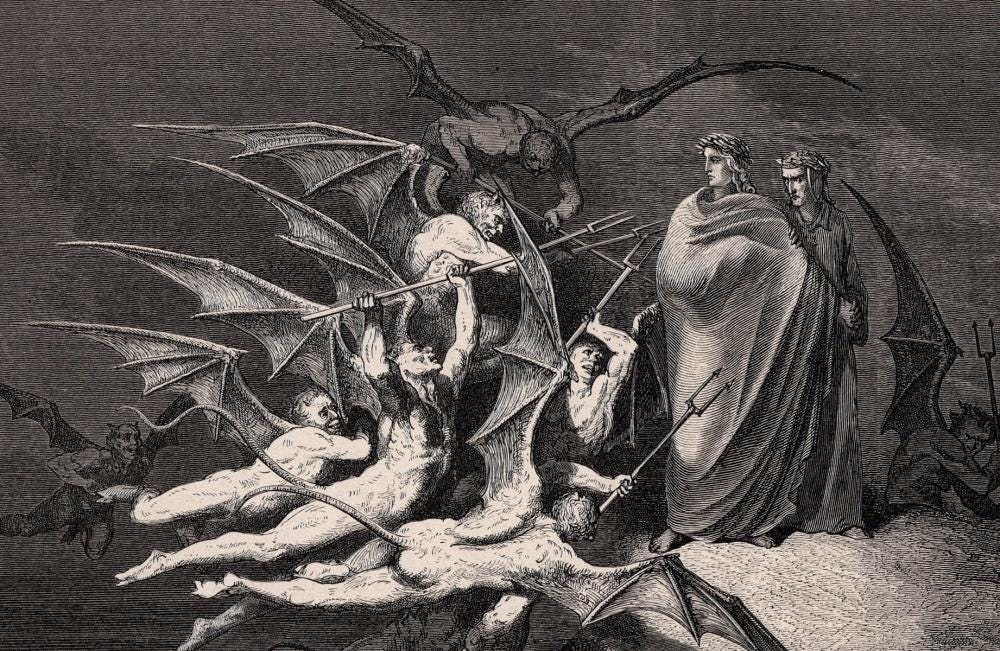
Back in college, I was friends with what seemed to be the ideal couple. She was small and kindly but with a mild neurotic streak that her muscular boyfriend easily countered with a smile and teasingly tossing her over his shoulder. Unfortunately, they broke up, and I assumed it was typical young lovebird drama. The reality turned out to be far darker.
The man’s mother was a hyper-pious Catholic who despised the girl, going as far as telling him that “the devil brought you two together”. The man, while outwardly happy and secure, was weak in keeping his mother’s outbursts in check. Needless to say, she had no intention of spending the rest of her life with an unhinged mother-in-law and broke off the relationship. The fact that the woman ranting and raving about demons was a devouring mother was not lost on me.
Whether or not one is in a religious community, everyone has a story. Maybe it was the erratic street-corner preacher shouting at bystanders to repent and escape the devil’s grasp, or the self-righteous churchgoer who is all too willing to relegate everything he dislikes as “a tool of the devil”. There is the “satanic panic” regarding role-playing games, day-care centers (some of which was true), and rock-and-roll. Such hysterics over time led the general population to roll their eyes and scoff when old scratch was mentioned.
Yet there is still that doubt lying in even our secular times, that modern psychiatry more explains away than explains problems of living, that there is a manifestation of malice and cruelty wafting through society, a certain spirit that emanates time and time again that scientific manuals can’t quantify. One can speak to his heart’s content about chemical imbalances, DSM-V classifications, and standards of care, but such cold, clinical words can’t penetrate the language of the spirit.
We have been a materialist culture for several generations, and the march of science continues to relegate religious thinking to empty individual pieties. Psychiatry explained mental illness, psychology healed without using the language of a priest. After the social and religious revolutions of the 1960’s, even the Catholic Church seemed to cede most of its territory to psychology. Demonic possession was relegated to mental illness that could be helped with a mix of medication and talk therapy. The exorcist, likely the most unscientific of all professions, became a dying breed, with only 12 in the United States in the 1980’s. It was a near certainty they would cease to exist within the next couple of decades. Yet underneath the seeming victory of secular thought, a spiritual emptiness took hold, along with the realization that material philosophy did nothing to explain the strangeness of existence. Now there are now 150 exorcists in the United States, and they can’t keep up with demand.
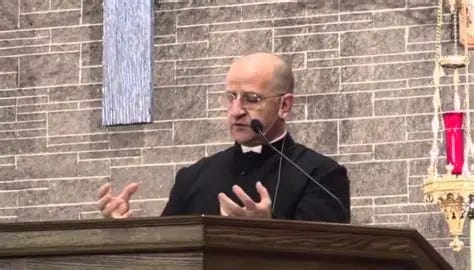
Father Chad Ripperger, an exorcist and minor celebrity in the trad-Catholic sphere, recently went on the Tucker Carlson Podcast. There he discussed his experiences as an exorcist, how demons operated, and the foibles us mere mortals do to invite their presence. What’s interesting about his appearance is his indifference to whether anyone believed him. While his worldview was completely foreign to the average man, and he had no intention to debate the logic of an exorcist in the modern day, taking the need as a given. Because of his attitude, a fully secular man will probably see a kook discussing shapeshifting and dialoguing with diabolical beings. Some more religious will be fascinated by his stories and explanations, glad that such spiritual matter can be discussed openly. Other religious will wonder why an exorcist makes podcast rounds like a celebrity and question whether discussing demons to the general public is a good idea. Both religious sides have a point.
Melody Lyons wrote on the spiritual pitfalls of contemplating the demonic, arguing such actions will cause nothing but misery. It is akin to forbidden knowledge, divination that can only spiritually damage one listening.
I had no warning that I was going to be instructed by the tongues of liars and thieves. I had not given consent. It was a violation. Keep the hell away from me! This was not profanity when I said it, but a literal command to the most popular exorcist in the world from the middle of my kitchen. Since then, I have seen Father’s content pop up seemingly everywhere, and it is often and increasingly objectionable as he offhandedly recalls the words of demonic encounters and places the burden of such knowledge upon the little ones of Jesus’ flock.
Others argue that such knowledge is necessary to survive without falling to naivete.
The fact is this - although Scripture tells us to be ‘like little children’ this does not mean we are to be enfeebled as little children. Especially in the modern age, with devilish lawlessness running riot, we have our tools and weapons, the Sacraments, Guardian Angels, the Rosary, and, crucially, His Holy Spirit to equip us for spiritual battle because there are not enough Father Ripperger’s to go around and this is something he clearly recognizes which is why he teaches us and educates us in these things. This is part of why I respect him.
When one talks of the heat of evaporation in different compounds, this is detached, outside of oneself. Contemplating the demonic is another matter, and rests on actively contemplating a malignant, wholly inhuman force. As seen by how it drives some to hysterics, taking the form of demons while railing against them, it’s a valid point that some people aren’t equipped for such contemplation. It doesn’t affect only the individual either, as irresponsible talk of the demonic brings all religious practice into question. Maybe accessing knowledge of the demonic is questioned for a reason, for the same reason books were once banned.
Of course, all this talk of forbidden knowledge, possession, and spiritual infiltration is a far cry from the triumphalism of Western materialist ideology. While all the words are in English, the connotations of the words described might as well belong to two different civilizations. Skeptics will question whether the speaker truly believes his own words.
While only God knows Father Ripperger’s heart, Let’s take at face-value he is sincere in what he says, that he really experiences what he says. He really believes he talks to demons, he really believes he casts them out, and he really feels he has been under demonic attack. It would be unfair to lump Ripperger in with this crowd. He is calm, detached, and often quite funny in his interviews. His definition of demons and his encounters are complex and esoteric, and whether or not you believe they exist, such beings make rational sense within his theological framework.
Unlike the shrill mother or the rabid street preachers, his thought is deeper and more layered. He’s also willing to discuss other factors at play that give a better explanation and cure to a malady than immediately assuming demonic possession. If one listens to the interview, he doesn’t even dismiss non-supernatural explanations. He knows you don’t need to talk of demons when someone has serious hangups about trust because of being sexually abused as a child. While few adults, thankfully, have what would be considered a full demonic experience, they have enough empathy to understand the struggles that creates.
The ways of the scientific mind through the last few centuries have put emphasis on the objective, to witness something that can be witnessed by any third party in a reproducible setup. Such a mindset has brought about the revolutions of physics, biology, and ecology that we take for granted. Yet it would be wrong to allocate everything to clinical objectivity. A classic thought experiment is whether an infinitely powerful computer existing outside the cosmos can predict with clockmaker’s accuracy the entire lifetime of the universe. In the time of Newtonian physics, this would seem to be a given. In the new age of quantum mechanics and modern experiments that show a strange non-locality, this isn’t as cut and dry.
Objectivity has also been made synonymous with reason, that unless something can be demonstrated to an outsider at will, it belongs to the realm of sentiment. Testing the velocity of a particle is part of the scientific process, while intuitions are not trustworthy without hard data to back them up. When Father Ripperger discusses types of demons like Lilith and Loki, commiserating how their presence torments a man, there is an implicit understanding, an instinct, but nothing that can be relegated to objective analysis. After all, aren’t these matters subject to cultural prejudices and social stigmas? Yes, of course, but does that discount individual experience. Does that nullify his mental model of the world?

Ripperger: So supernatural is those things which are above anything that is created, and that pertains to God. Whereas preternatural comes from the Latin word praeter natura, which means aside from nature. So that would be things that are above what we experience as human beings in this world, but it's not supernatural because it's not God. It's kind of in that in-between state, which is what the demons are. But they're still considered natural in the sense of they have a specific nature that God created them with. They're created beings and that they actually have a natural law. They have all that, they're structured to think in certain patterns in certain ways. So it's kind of a middle tier, but it's preternatural. Supernatural would be something like being able to suspend the laws of nature. So demons can't cause miracles, for example, but they can cause things that to us as human beings are outside our normal experience. And so it looks miraculous, but it's actually not. Something that they can do on their own.
From a purely materialist perspective, this will sound like total balderdash, but is it balderdash to a person who has experienced a dark presence, a malignant voice in their psyche that seems to stem from nowhere? The materialist may talk of chemical imbalances driving these sensations, but that just begs the question of how a chemical reaction can emit a non-material output. One’s own consciousness stands as a refutation, and the idea of consciousness being an emergent property of molecular complexity serves more to obfuscate than edify. That being said, overt superstition obfuscates as well, and Ripperger says some pretty wild stuff in which some pushback is justified.
An individual is still an individual, who has subjective experiences no one else can fully understand. A brain scan might pinpoint general emotions, but the experience remains hidden to everyone but the subject. An exorcism requires this kind of encounter, as there is no process or procedure, no specific rite that can with certainty cast out the demon. It depends on the subjects using these tools. It’s also why exorcisms are as contrary to science as one can be. Instead of objectivity, is it subjective to its core, an encounter of two souls, with maybe a demon lurking inside. It’s why the personal virtue of the exorcist is considered important, why his connection to the divine is necessary for being able to bestow deliverance.
In the realm of humans understanding the world, there’s a place for metaphor, for the fuzzy details that fit in no theoretical framework. A physicist can pontificate on the properties of matter, but such theoretical knowledge will not get him far against a professional tennis player’s instincts built over a decade of hard practice. You can prattle off stats to your heart’s content on how to raise the perfect child but you’ll be useless compared to the hard-boiled father who sacrificed and suffered to raise his own six children. Theories, at their core, are just models, and every model hits the wall of reality. This goes for the minutiae of theology as well as the frontiers of scientific research.
At its core, this is the distinction between the spiritual and material. The material is, by its very nature, lifeless. It can see atoms in powerful microscopes, observe cells reproduce, and tell what wavelength makes the color red. It can’t, however, speak objectivity on experiencing "red”, stubbing one’s foot on that bunch of atoms called a rock, or pinpoint when a mass of cells becomes something more and can experience the world. The sensation doesn’t exist in a certain time or place. No one can point and say this is where the experience of “red” lies. In the spiritual realm, the words to explain what an encounter with the divine entails will seem like straw compared to the encounter itself.
Yet the spiritual and material are intertwined in countless ways. One would have to be mad to be unable to map hunger to lack of physical nourishment or a brain injury to limiting cognitive abilities. There will be those who argue the panic over devils will keep those who need mental health care from getting their needs met, while others will accuse the medical establishment of wanting to numb their patient’s mind instead of handling a real spiritual crisis more in line with the faculties of a priest.
Since the time of Plato with his theory of forms, philosophy has tried to understand the interaction of ideas on the physical plane. Some consider the entire material plane an illusion, maya, while others believe only what can be measured is real. Wittgenstein argued such questions were simply problems of language. Such ideas have been discussed for millennia and will probably be discussed until man takes his last breath.
This isn’t to argue Chad Ripperger is correct. Even many who like him think he’s a mixed bag. Still, he represents the hard extremes and conflicts in such modes of thought that have no conclusive answer, and likely never will. There are those obsessively beholden to hyper-rationalist scientism and those who get a little nutty with superstitions. Both are immensely dangerous.

On Angels
While there is the demonic, one must not forget about the angelic. One of my old classmates became a priest after the usual conflicts between wanting to be married and raise a family and his higher spiritual purpose. When we worked together in the fields during the summer, the farmer looked over to him and said, “that guy’s just different.” And different he was. I still see my work partner throwing hay bales on those humid summer days and getting into antics at school, even after he entered the clergy and has become a local legend with stories of miraculous conversions and healings. While I have witnessed none of them, I have no doubt of his sincerity, nor of the many who swear he healed them. In another example, an extended family member who almost died in a routine c-section miraculously stabilized after her priest administered the Anointing of the Sick.
Can I prove that these are real miracles? Of course not. But believing the subjective experiences of fellow human beings is hardly irrational either, and neither is believing in phenomena outside our technological trappings to observe. As the levers of truth-telling our institutions once wielded rust out, other modes of thought are escaping. Such new interest in the preternatural can be seen as a longing for a re-enchantment.
Yet in our world there is much more talk of the demonic than the angelic, of Lovecraftian horrors than guardian angels. Perhaps it is because we live in a world festering with devilry, perhaps we can no longer see the angelic if we tried, our minds hopelessly mired in cynicism and despair. Yet there are miracles all around us for those willing to see.
As Dreaming of the Rood stated:
In this fallen reality we have built, the Lord has not been quick to drive out demonic beings nor ghostly beings nor still odd beings, for it is these oddities and terrors that often remind the world how much we require a deliverer.
Thank you for reading Social Matter. If you enjoyed this article, please like and subscribe. I am inserting more and more paid content as my list grows, so please consider becoming a paid subscriber.
I used to think that the idea of demons was ridiculous. But seeing the absolute savagery and anger in the world has made me reconsider. I even see it in myself on the rare occasions I completely lose my temper and go on an unhinged rant about something. It's like the demons are just hanging around, looking for an opening, and when they see one, they take control. Later, when you rationally look back on it, you wonder what "possessed" you to act so irrationally and over-the-top.
I've been seeing the resurgence in demon talk (among those who are psychologically close to the idea that we are not bodies) as a sign of increasing awareness that our political environment is developing into a real culture that emphasizes fear, guilt, judgment, division, punishment and war. As millions of minds settle into sides inside guilt-projecting narratives, designed (it seems) by the most damaged psyches; we feel the evil separateness of it, and the looming danger, whether physical (like assassinations, professional expulsions, wars of choice) or mental (judgment and exclusion).
Note that the culture itself is invisible, like demons are invisible, because it lives in minds. But we see the effects through actions that try to make them "real."
It's a long way out from hell. We would be hopelessly trapped in our guilt projecting, safety-constructing insanities, but there was a perfect master who showed us the way. Some say he was God, some say he demonstrated the way back to God (--not through sacrifice, but through demonstration that nothing here can hurt the real you).
"Such ideas [of the choice between materialism and spiritualism] have been discussed for millennia and will probably be discussed until man takes his last breath." This is true, because the internal war between love and fear--and all its external offspring through every social unit--will continue until everyone in their innocence has chosen love together; and after that, humans (and demons) will be no more.
"By this they will know you're my disciples, if you love one another."