


Note: This article has spoilers to the movie “Margin Call”.
The financial sector is an opaque, confusing mass of regulations and indecipherable math to a majority of the population, including those working in it. There’s a sense that their outputs of complicated monetary products, rapid fire trading, and insane levels of abstraction have formed a world unto itself, their numbers and models subsuming the reality it’s supposed to analyze. The strategies concocted in high-rising steel monoliths in New York are terrifying to your average American, but most are willing to look the other way if they can buy cheap stuff.
The 2008 crisis was a harrowing look behind the curtain of how these operations run, showcasing layers of systemic failure that ballooned into a full meltdown, culminating in the entire financial sector begging the federal government for a bailout. The core of the collapse, bankruptcies from failing mortgages placed in packages with gold standard ratings, showed an enclosed system that went along with decisions that denied logic through sheer inertia. The money was too good to stay on the sidelines.
I rarely rewatch movies, but one film regarding the 2008 financial crisis I come back to again and again is Margin Call.
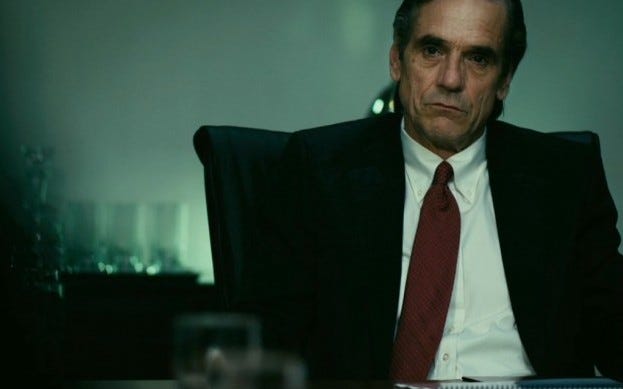
To call Margin Call a movie is almost a misnomer, as it operates more like a stage play. The set pieces are sparse, most of the action takes place in meetings, and the hum of air conditioners is the soundtrack. It begins with mass layoffs at a financial firm, with one of the chief risk management guys given the boot. He gives a USB drive to low-level quant Peter Sullivan before he leaves. Sullivan finishes the work and sounds the alarm of imminent financial meltdown, haplessly spilling the news to increasingly ruthless sharks in the corporate hierarchy. This culminates in the executive board room where the visibly shaken and out-of-his-depth analyst confesses impending doom to CEO John Tuld, portrayed brilliantly by Jeremy Irons.
The entire movie is phenomenal, but the final board room meeting sticks out as a masterpiece of writing. You can watch it a dozen times and find something new. Mr. Tuld is a killer, his iron will and instincts sharpened by suffering through countless crisis and bouncing back, beaten up but alive. Regardless of your opinion of his ethics, the scene is a seminar on what real leadership looks like. How to take charge, how to be disarming, how to get the information you need, and how to convince the skeptical to follow orders.
While many commentaries and synopsis of “Margin Call” portray some characters as clear villains, the movie avoids it. Like most good art, it lets the character motivations in a morally murky situation drive the story. Peter Sullivan is too pure for this world, an honest man who cares about doing his job without regard to its political ramifications. The others are not as clean, and it’s clear from their conversations everyone knew something was amuck, but feared pulling back on another helping from the gravy train. Some hid their incompetence up to the breaking point, some went along for the generous paychecks, and some simply loved the game. In context, it made sense that the alarm was never raised. Every other corporation was doing it, and pulling back would put them at an insurmountable disadvantage. They knew deep down it couldn’t last, and Tuld set works in motion that left everyone else holding the bag.
It would be easy to dismiss Tuld as a Machiavellian scumbag. He did screw over firms that trusted him, send the world economy spiraling, and strongarm employees to breach their sense of ethics. From the perspective of Tuld though, he had a simple choice. Would he let his company go bankrupt along with everyone else, or survive? After all, the economy was going to crash. It was inevitable. If he didn’t screw others, rest assured they would screw him. This was a zero-sum situation, and in such environments the only option is to win. Like he told his subordinate Sam at the end of the film:
So you think we might have put a few people out of business today. That it’s all for naught. You’ve been doing that every day for almost forty years, Sam. And if this is all for naught, then so is everything out there. [points to the skyline of New York City] It’s just money; it’s made up. Pieces of paper with pictures on it so we don’t have to kill each other just to get something to eat.
It’s not wrong. And it’s certainly no different today than it’s ever been. 1637, 1797, 1819, 37, 57, 84, 1901, 07, 29, 1937, 1974, 1987 —Jesus, didn’t that fucker fuck me up good—92, 97, and whatever we want to call this. It’s all just the same thing over and over; we can’t help ourselves. And you and I can’t control it or stop it, or even slow it, or even ever-so-slightly alter it. We just react. And we make a lot of money if we get it right. And we get left by the side of the road if we get it wrong.
And there have always been and there always will be the same percentage of winners and losers, happy fuckers and sad suckers, fat cats and starving dogs in this world. Yeah, there may be more of us today than there’s ever been, but the percentages—they stay exactly the same.
While this may seem myopic and cynical, in his world he’s absolutely right. It IS just numbers, a useful fiction that allows the world to function without deteriorating into barbarism. The numbers only care for history in terms of making a monetary decision. There is no care for peoples, creeds, lands, or culture. They’re just symbols, abstractions running through increasingly complex models. These models have become so opaque even their architects have given up understanding what makes them tick. The interactions of countless algorithms in an ecosystem of overwhelming data, winning a few cents a trade over trillions of daily transactions give no sense of an underlying order decipherable by man. In this miasma of information, someone needs to make the hard choices, and John Tuld rose to the challenge.
Archetypes like Tuld have existed throughout history. For those born of nobility, they played diplomatic and military games to increase their lands and power. To those born in a lowly station, they are the types who would form a band and travel the world looking for riches. They are the ruthless tacticians and commanders that every army wants on their side. Every one of them has a loyalty. For some this may be lineage, for others faith, and others culture and people. They are real, tangible things, not mass fictions.
Tuld’s only loyalty is to the company, and the company’s survival depends on one thing, line-go-up. He knows every employee will leave the minute another firm offers a larger paycheck, so he only wins compliance through being able to pay the most, hence the massive bonuses he gave to convince traders to destroy their business relationships. In this mercenary world, he’s not loyal to his employees because they are not loyal to him. It’s just the nature of the game. If he kept on the chaff, it would only serve to harm the company’s future prospects.
The focus on monetary profit above all else spreads far beyond financial firms. This sort of toxic mindset can be seen in economy obsessed think tanks, when President Trump brags about GDP growing, or contemplating how much money a college degree makes like it’s all the matters. Over decades we have seen countless businesses swallowed by corporate juggernauts, most of them with powerful financial instruments at their disposal. Corporate culture has become a homogenized hellscape of taboos determined to erase all unique identity, forcing every employee to work like a deracinated unit.
Countless complaints have been made about private equity eating away at industries, sucking the life out of healthy local businesses and leaving a husk of their former selves. Whatever they can do to squeeze a little more efficiency and monetary gain will be used, secondary effects be damned. While repulsive to the common man, such an idea of profits above all has often been mandated by the courts. Take the Michigan Supreme Court Ruling in Dodge vs. Ford that ruled Henry Ford was obligated to make a profit before the well-being of his workers and customers.
A business corporation is organized and carried on primarily for the profit of the stockholders. The powers of the directors are to be employed for that end. The discretion of directors is to be exercised in the choice of men to attain that end and does not extend to a change in the end itself, to the reduction of profits or to the nondistribution of profits among stockholders in order to devote them to other purposes.
It should be noted that the Supreme Court has shifted to a softer stance recently. In Health and Human Services vs. Hobby Lobby, the Supreme Court ruled:
Modern corporate law does not require for-profit corporations to pursue profit at the expense of everything else, and many do not.
In modernity, there is some space to move here, but even a businessman who wants to be more than a profit machine hits another snag, the 1964 Civil Rights Act. CRA Title VII states:
It shall be an unlawful employment practice for an employer -
(1) to fail or refuse to hire or to discharge any individual, or otherwise to discriminate against any individual with respect to his compensation, terms, conditions, or privileges of employment, because of such individual’s race, color, religion, sex, or national origin; or
(2) to limit, segregate, or classify his employees or applicants for employment in any way which would deprive or tend to deprive any individual of employment opportunities or otherwise adversely affect his status as an employee, because of such individual’s race, color, religion, sex, or national origin.
There’s plenty of smug grandstanding about the “accomplishment” of this bill from both Republicans and Democrats. When this was written, it seemed a goodwill measure to ensure minorities wrongly persecuted got a fair shake, whether they were Jewish, black, female, etc. As everyone in this space knows, it soon became holy writ that surpassed even the Constitution in our legal framework. It also destroyed freedom of association. The workplace could no longer be an organic outcropping of men from a similar culture working together to better their lot, but a faceless machine that mandates nothing about the person’s worth can be calculated outside of how much money he makes for the company. If you want more than a measly 15 employees, you have to play ball. It destroyed their ability to hire, and fire, based on anything but line-go-up.
Want to start a Catholic covenant community? Illegal.
Want to start an all-male gaming company? Illegal.
Want to start a trades company exclusively for people of Polish heritage? Illegal
Want your factory to only employ residents of a local town? Illegal.
Want to hire only Americans? SpaceX got sued for that.
Want your large corporation to donate exclusively to right-wing causes? Not illegal, but it doesn’t matter. Have fun getting sued to oblivion.
The all-spanning tentacles of Human Resources has been given authoritarian power over companies to comply with the Civil Rights Act’s unwritten mandates, and woe to the corporation who has to deal with a wrongful termination suit from a minority. Protecting the company from the shifting sands of the government’s regulatory apparatus has made HR go above and beyond the letter of the law the squelch any smell of noncompliance.
The right, with its emphasis on the nebulous term “meritocracy”, has only made things worse. The idea that merit doesn’t stem from anything other than a test score and credentialing apparatuses hasn’t created a more efficient, dynamic workforce. It’s created a more sterile one. An applicant who doesn’t have the highest test score but stems from the same cultural background as the others has merit, but it isn’t considered such. While you can argue that no one should be discriminated against based on immutable characteristics, this is an impossibility. Intelligence, for instance, is largely an immutable characteristic. It also goes against how humans naturally organize. Even if your employment criteria isn’t a hard line requiring a certain ethnicity or creed, but a softer form of considering them among other skills, you’ll get destroyed.
There is a French term, called Noblesse Oblige, that signifies the responsibility of those in higher stations to watch after the well-being of subordinates. It’s the baron who treats his peasants respectfully, building churches and introducing technologies to facilitate their labor. It’s the owner of a car dealership who supports the local little league team. It’s the King who sells some of his riches to buy food during a famine. There’s an understanding that the obligation to raise up those under you not only is good morals, but loyalties also extend one’s own power.
With the rise of mass financialization, the ability to suck up smaller firms, and the legal minefield of modern business, our world has been sucked of fundamental ways leaders in time past have built loyalty for his underlings. There’s no easy way to foster a higher calling than simple monetary reward. In the name of equality and business, the government has actively worked to destroy any semblance of outside loyalties in the office. You can go to Church, but don’t you dare lead your organization in prayer. You can hang out with whoever you want at the bar, but your team has to be sufficiently diverse. At its core, it’s the “freedom” of a slave.
Some might contend that while the business world is like this, you can do what you want with your own money. Yet one’s work environment is where most relationships are made outside the home, and the primary location of group action. By removing the ability to coordinate in these spaces, any mission outside of immediate profit becomes impossible, and the idea you can one day sell your company and spend the buyout on your pet causes is thin gruel. It creates a harsh division in one’s life where there should be symbiosis.
We can’t get carried away and assume reinstating freedom of association will make every CEO act in the interests of general society. The types whose only goal is personal power will always be with us, but at least other forms of business structures will be possible. We could get back to more meaningful ways of seeing if someone is a best fit, an expanded view of the company mission that goes beyond banal platitudes. Everyone who feels like a drone would love a true sense of belonging that doesn’t involve an empty mantra of your boring co-workers being “family”.
Americans, both left and right, can wail and moan to their heart’s content about people like John Tuld, yet our legal system has mandated that the ideal businessman is this wolf in a suit. He has no outside loyalties to the company, no priorities that can’t be easily monetized. He’s the perfect capitalist, and is rewarded for it. Changing this will require changes that will make both capitalists and progressives scream bloody murder. One of the most devilish lies of the modern era is that you can separate your work from your personal life. This isn’t true, as can be seen in the bizarre corporatization of all parts of our lives. Failure to change things will make the poisonous banality of office life expand into every facet of existence, until one’s entire life has the same sterility as a modern meeting room.
Thank you for reading Social Matter. If you enjoyed this article, please subscribe and share. Paid subscriptions are also always appreciated.
This ruthless flattening of all relationships into cold number-go-up optimization is one aspect of the "Machine" that Paul Kingsnorth is warning about.
Outstanding writing as usual! Noblesse Oblige oddly enough was a concept my mother always discussed with me growing up and this article really drives the point home perfectly in that modern corporate business models simply don’t allow this to be practiced meaningfully anymore. My grandfather and his business were the model my mother used to talk about noblesse oblige. He was a successful businessman in our small town and owned the first ford dealership then later the Chrysler dealership. He had employees that worked for him for decades. Were his employees perfect? No, but as long as they were loyal to him they always had a job and if they got in a spot of trouble he would help out. One employee was a wonderful man but you knew at least once every couple months he would be too hungover to come to work, he never caught any grief and it was quietly ignored because when he was there he would do anything my grandfather asked and he never drank on the job. You would get nitpicked and shitcanned in any modern work environment for that now because they don’t care about how loyal you are only that you filled out the required form for the day off. The people that worked there were like family members who watched me grow up from birth. Eventually after my grandfather passed away and all the small town dealerships were mostly just forced out of business by the drive to consolidate the dealership system by the car companies into larger regional dealerships. I’ll never forget that feeling of seeing people be under the wing of what would have been the small town American version of the local lord and seeing these men and women work for a single person their entire adult lives and getting to know their children and grand-children all because one person felt a duty and responsibility for those that worked under him. At some point I know those folks could have struck out somewhere and could have been paid a little bit more but I know that they didn’t because they knew that no matter what happened in their life no other employer would have their back like my grandfather and that’s something that’s hard to quantify in a corporate benefits package.