



There are a lot of public goods you support, but don’t want in your neighborhood. There are also a multitude of public non-goods that you want to keep far away as possible. While you will rarely find anyone who supports a blanket ban of pig farms or waste treatment facilities, they’re not something you want to see or smell walking outside your front door. The classic acronym, NIMBY (Not in my back yard), fits this mindset perfectly. It’s the mantra of residents who want to maintain a certain atmosphere to their locale that extends beyond their own property lines.
The NIMBY principle applies to stores, industry, family residential areas, apartment complexes, etc. Hence why there are zoning boards that are tasked with finding reasonable ways to compromise with the locals. They may not leave them satisfied, but at least not angry enough to riot. Complexities emerge as the county, the state, and the federal government get involved in town planning, all with their own interests. Often, as a consequence of overwhelming legal and financial power, the larger entities will push around the small ones in its jurisdiction. Still, when push comes to shove, there’s usually a desire to find amicable ways to move forward. Scorched earth tactics are messy, and even from a simple business perspective can cause unforeseen consequences.
While the local townships have limited power, they still have leverage, and the people elected to these planning boards can have a significant impact in ensuring their constituent’s interests are met. On the flip side these admins, usually of modest means, are also very susceptible to indirect bribery, intimidation, and personal power trips.
The following is a tale of powerful forces with strong economic incentives descending on a small farming township to change the landscape permanently, converting a large portion from agriculture to a high-tech industry employed by outsiders, and the efforts of local activists to stop it.
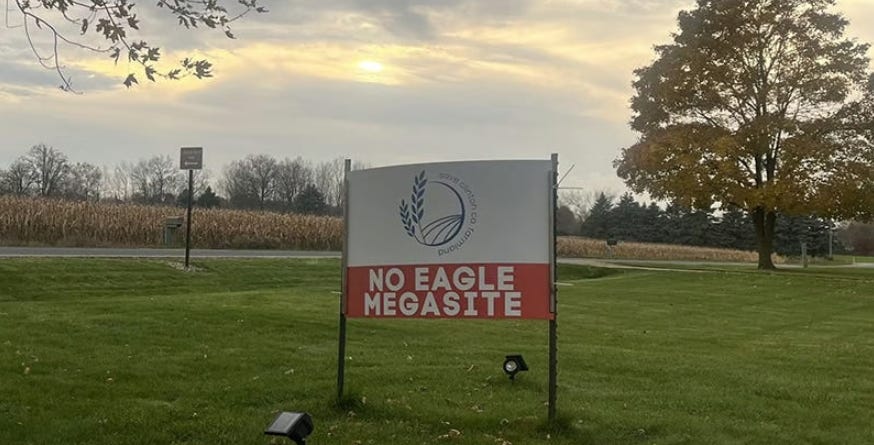
The Eagle Megasite
In 2009, in the town of Eagle located in Mid-Michigan, a local man named Dave Morris died. A legend of farming in the area, he was the recipient of multiple awards for his work in agriculture and his vast philanthropic outreach to the farming community. Going far beyond caring for his own land, he was a staunch advocate of creating opportunities for the next generation of farmers.
Four years earlier, as infirmary hit him, he gifted his farmland of about 1000 acres to Michigan State University. Michigan State began as a land-grant agricultural college in the 1800’s, the first in the nation. As time passed, the number of disciplines drastically increased, but during much of his life the University still clung to its roots of having a top-tier agricultural program. He requested the University keep it as farmland for at least 25 years, and trusted his legacy would be in good hands. For over a decade the land was leased out to local farmers, and the proceeds sent to support the University and a retirement house per Morris’ request.
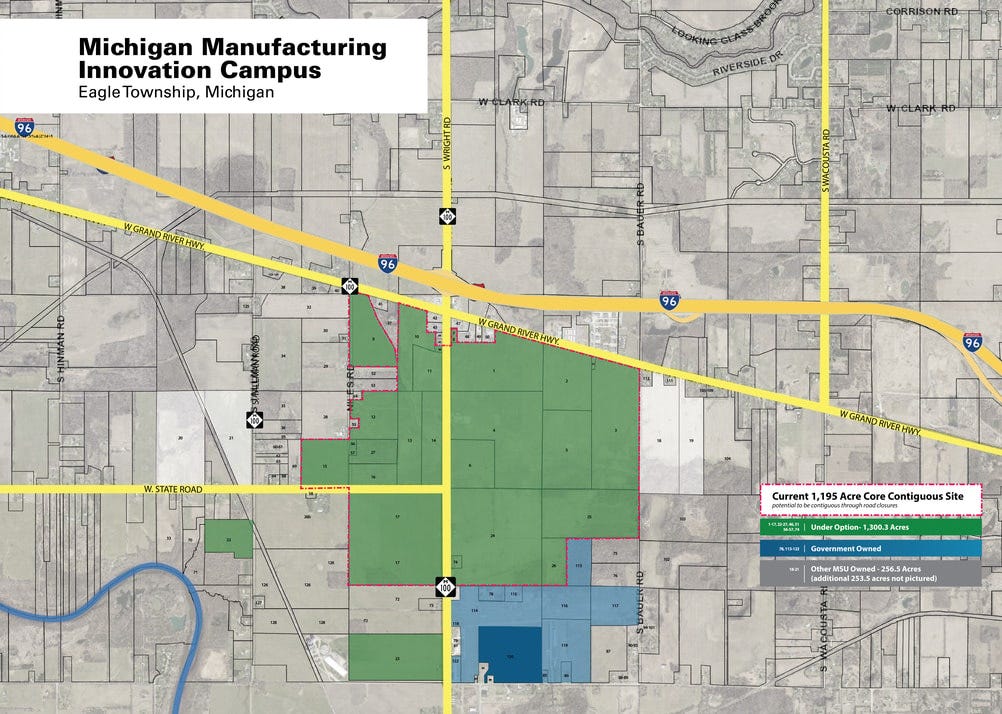
During the last few years, the state of Michigan has been aggressively pursuing high-tech companies, especially in building automotive and chip manufacturing facilities with a voracious appetite for land, electricity, and water. The land, close to a local highway and tied together, was seen as a prime area to source these up-and-coming plants. The Lansing Economic Area Partnership (LEAP), seeing that few parties would have to be paid off, saw this as an opportunity to get industry in the area and began work with Eagle Township to rezone the land for industrial use. They reached out to the Eagle township supervisor, who agreed to sign a non-disclosure agreement to review the plans. The University that owned most of the required land was fully on board, regardless of the agreement of maintaining the land solely for farming for at least 25 years.
To say the locals were upset would be an understatement.
Opposition is organizing against an effort to develop a 1,400-acre mega site that business leaders envision as a multi-billion dollar high-tech campus in rural Eagle Township.
Residents living near the site in Clinton County are preparing to share their concerns and vision for the land, which state officials and local business leaders are marketing to microchip and electric battery makers as well as similar large-scale companies.1
Rumors spread that a Chinese battery manufacturer was interested, and the idea of a foreign entity owning a large chunk of land in the area put everyone on guard. As secrecy was maintained between all parties, so did the idea that the plans coming to fruition would irreparably damage the wider community. Tensions rose, and Michigan State University was compelled to write a letter expressing their viewpoint.
In this spirit of transparent communication, I want to address recent concerns that some in the agricultural community have raised regarding David Morris’ bequest of property in Eagle Township.
“In 2005, Mr. Morris made the decision to donate a significant land holding that he and his wife farmed to Michigan State University. His expressed expectation was that the land would eventually be sold and that 55% of the proceeds from the sale would fund four endowments within the College of Agriculture and Natural Resources and therefore benefit agricultural research, education and outreach in perpetuity. Mr. Morris was clear in his wish that this gift to MSU would support the college’s causes closest to his heart, and we will honor that wish. The remaining 45% of the funds will benefit Clark Retirement Community in Grand Rapids, as Mr. Morris stipulated.”
I know that some people are deeply disappointed that Betty and David Morris’ property may no longer be used as farmland should MSU sell it. It is painful to see the landscape of our daily lives change, and productive farmland is precious to our communities, our producers and the consumers who rely on the fruits of our farmers’ labors.
But as a public servant and an esteemed leader among his peers, Mr. Morris’ vision was for the land’s sale to benefit his beloved agricultural community by funding education, research and outreach.2
From the viewpoint of the University, the gift was established to fund the University departments and support the retirement home. Their mission is not to actually maintain farmland. Unsurprisingly, the residents of the area didn’t see things this way. You can sense the contempt for the locals shown by the letter. The talk of “seeing the landscape of our daily lives change” comes across as disingenuous and patronizing. Also note nowhere in the letter did it say how this would directly benefit the wider community. It would fund the University’s agriculture program, but the original mission of the University to find best practices for agriculture and to maintain a rural community has taken a back seat. Universities don’t see agriculture as a sexy field anymore, and focus elsewhere.
The statement with the Lansing Area Economic Partnership’s CEO wasn’t much better, though they at least tried to extoll some economic benefits.
“Lansing Area Economic Partnership won a $250,000 state grant last year to prep the site.
“The impact of that huge employment growth here would dramatically help small main street businesses in our community who rely on customers,” Trezise said. “It would refill empty schools with families. And, of course, would have a dramatic impact on everyone’s tax base.”3
He said nothing about employment opportunities to the locals in the area, but importing new locals to work the factory, and stressing how these new locals would bring money with them. Note the statement about filling empty schools with families (I know this area, the schools are not empty).
What wasn’t considered was they would likely have a significantly different cultural outlook than the current residents, and the CEO was more or less expressing as a positive what these residents, whose lineage often lived in the land for several generations, feared. And he couldn’t help but express some contempt of his own.
Trezise is sympathetic to “backyard feelings,” but he believes a mega site will secure Michigan’s future.
“That conversation is about balancing a profound greater good versus a few people and their backyards. That doesn’t diminish or even criticize their viewpoints,” he said. “It’s just that we also do have a right, as a society and community, to talk about all of it.”
Now, mind you, in principle he has a point. There are “common good” needs that require sacrifice, but there also needs to be respect and negotiation with people these decisions affect the most, something the LEAP planners seemed to ignore.
Many of the concerns were environmental also. These sorts of large plants need a massive amount of water to function and chip manufacturers have potential to contaminate the local supply. Even with these concerns, LEAP had not intention of doing environmental impact studies to ensure the land, and water, would not be contaminated with massive industry.
No environmental impact reporting planned
Despite being within a stone's throw of the Grand River and a critical part of the Lake Erie watershed, LEAP has indicated no intention of performing environmental impact studies (EIS). They only promise to "follow all current" substandard regulations–regulations guided by the captured EGLE.
…..
In 2021, the average daily water intake of semiconductor plants worldwide was over 11 million gallons. According to scientific research, and to observations about existing semiconductor operations, these facilities can drain local water supplies, forcing communities to ship in water for municipal use.4
Whatever money made would not be shared with the wider community. Whatever employment would not benefit the locals There was no talk of trainings, partnerships, or express donations to the extended area to make the deal go down smoother. The mindset of the people pushing the project was an assumption the locals would eat the shit sandwich and like it. Unsurprisingly, the secrecy on top of the back-handed diplomacy didn’t quell fears from the residents, who saw all loss and no gain from the deal. During this time, the county, working with the township council, decided to continue with preliminary analysis of the rezoning.
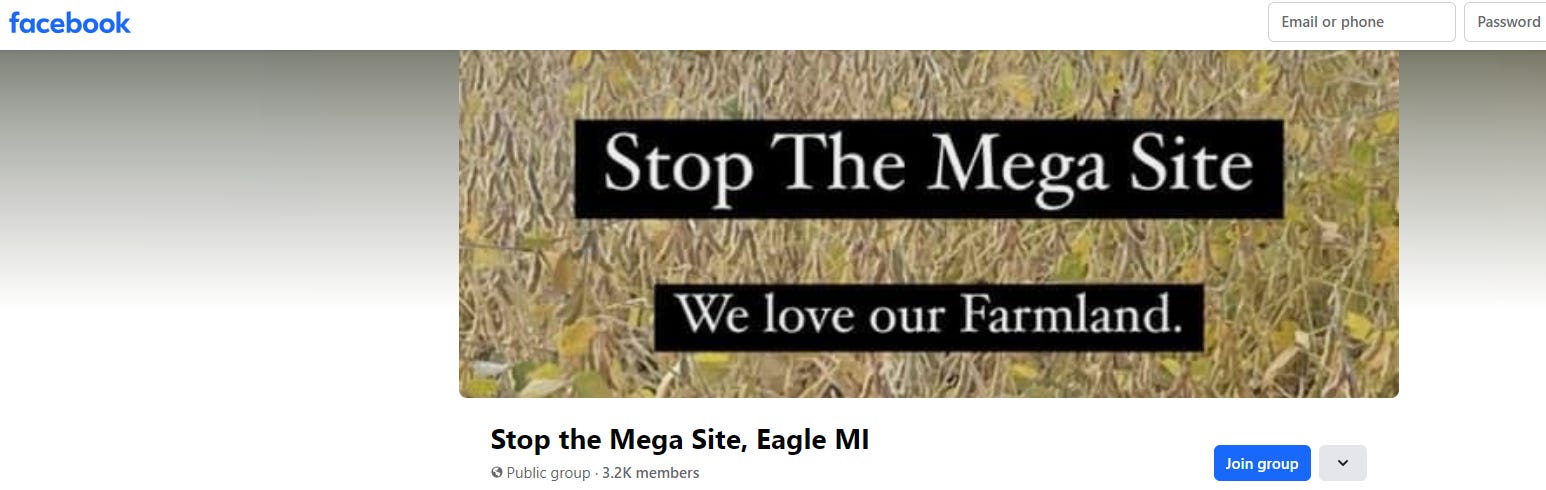
Political action came from an unlikely initial source, a local grandma in her 60’s who had a friend help her open up a Facebook group called “Stop the Mega Site, Eagle MI”, which brought publicity to the issue and enabled local activism. She would post local topics, places to organize, and new updates, becoming a crucial center of contact for the political battle ahead. She started a petition drive that quickly amassed over a thousand signatures. The word spread. Soon, word of the megasite plans spread far outside the area, attracting the attention of conservative lawfare nonprofit Mackinac Center for Public Policy (MCPP). The MCPP requested through the Freedom of Information Act for the original donation agreement between Morris and the University.
The university complied by giving the MCPP a heavily redacted document that lacked key details.
MSU responded by producing some of the requested records on February 28, 2023. The university did not provide the original agreement, as requested, and only released portions of an amendment to the original agreement. The key agreement was almost entirely redacted, making it impossible to know the terms of the land donation agreement.
The university claimed it was using an exemption that allows private information and material related to the university’s security to be redacted. But the privacy exemption is highly unlikely to apply to all the redacted information. And MSU may have failed to fulfill its obligation to separate exempt information from non-exempt information. The Mackinac Center contacted MSU’s FOIA office to discuss the records in an effort to avoid legal action, but never received a response.
“This case represents yet another example of Michigan’s lack of transparency,” said Steve Delie, director of transparency and open government at the Mackinac Center for Public Policy. “The Eagle Township megasite has been the source of major media attention, but details on the project are sorely lacking. Michigan’s citizens deserve to know the details of how the underlying land came to be in MSU possession, and MSU needs to be held accountable for relying on improper redactions to withhold key information.”5
Seeing what they saw as intrusion on the local community and lack of transparency, the firm sued Michigan State University.
Local residents also played hardball, planning a recall campaign for Township Supervisor who signed the non-disclosure agreements for lack of transparency. They quickly amassed 600 recall signatures (this is a very small township) and forced an election during November of 2023. LEAP made advertisements to support the current township supervisor, but any semblance of trust was gone. It got worse as it was uncovered the Township supervisor was using her personal email and business email for correspondence instead of official channels.
The FOIA also revealed the extent of secrecy surrounding the project, as we learned that Schafer was using her private cell phone and personal email accounts, including a personal AOL account and a GMAIL account linked to her company, Countryside Accounting, for communications with MEDC and LEAP.
Current Township Supervisor Troy Stroud has requested documents and communications from Schafer, as they are considered the property of Eagle Township. However, Schafer’s incomplete response to Stroud included printed emails with no printed attachments from the emails out of her personal accounts.
…….
LEAP directs communications to be done through Schafer’s personal cell phone.
The use of Schafer’s private cell phone, in addition to her personal email accounts, raises concerns about the potential evasion of FOIA requests that appears to be happening by both Schafer and the partners involved with the megasite.
In a communication from LEAP President and CEO Bob Trezise on March 24, 2022 to LEAP COO Keith Lambert, he says, “Keith. Use please Patti’s cell phone to text her messages. She say (sic) this will be more efficient for her. Thanks.”6
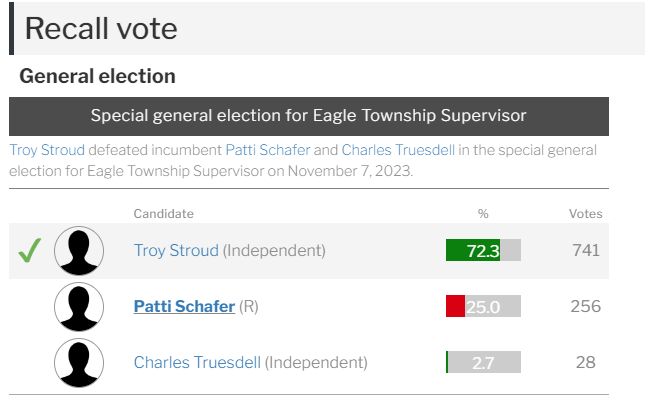
The recall election came, and it was a bloodbath. The incumbent only managed 25% of the vote and was removed from office. In 2024, during the master planning session managed the township, all references to a megasite disappeared while making plans to strengthen the current zoning.
A 217-page master plan draft for Eagle Township does not include any proposals for a manufacturing site on farmland, Michigan Farm News has learned.
The announcement comes after Eagle Township and state officials welcomed a high-tech manufacturing site in 2023, one called the Michigan Manufacturing Innovation Campus (MMIC) by the Lansing Economic Area Partnership (LEAP). News of the proposed development upset locals, especially when plans were to convert area farmer Dave Morris’ farmland.
Eagle Township eventually recalled its supervisor, held input sessions in February, and recently released a master plan draft. It’s a plan that would keep the community’s character in check and create the township’s first-ever zoning ordinance, Eagle Township Supervisor Troy Stroud told Michigan Farm News.7
In the aftermath, the township council got a black eye, the local grandma got Citizen of the Year, and industrial rezoning has been put on permanent hiatus. This isn’t to say the threat is gone. Michigan State University still owns the land and the Michigan Government is still aggressively planning new industrial development. This saga also isn’t an isolated incident, and several other similar stories have happened across the state, like this one only an hour away in Big Rapids.
Residents of a west Michigan township voted Tuesday to recall five remaining members of the township board for their approval of tax abatements for a Chinese-owned company tied to a new electric vehicle battery plant.
Residents in Green Charter Township, near Big Rapids, tossed the board members after months of mounting controversy relating to the battery plant deal and the Chinese connections of Gotion, Inc.8
The story is ubiquitous in the state, and the same tactics are used, with the same results.
The Art of the Deal
The shocking part of this saga, outside the unprofessionalism of LEAP and the local township council, was how no one made a reasonable effort to quell the fears of the residents. The entire attitude of these people was that they would do what they wanted, and the local residents would just have to deal with it. Even waiting a few years for the 25 year plan to end would have given them more rapport, and the fact they tried to break a promise of a man who gave them such a massive gift would strike anyone as unethical, especially rural folk.
It seemed to come as a real shock when they fought back and crushed their plans, but it shouldn’t have. There was no upside to the locals. This is a plant that would probably bring in close to a 100 million in investments, and I could not find one instance where they offered a sweetheart deal to the wider community. A simple pledge that incoming business would be obligated to do something like hire a couple hundred locals from the small towns, fund some land development and agricultural training, give college scholarships to recent area grads, or donate a sum of money to rural schools would have come across as a rounding error in total development costs.
While there would still be many who would not want the deal under any condition, others would roll the dice with increased educational and town infrastructure funding. If they actually made an attempt to quell their legitimate environmental fears instead of hiding all the details under NDA’s they assumed would never see the time of day, they would have had a fighting chance. Many, many people live in rural areas now to escape the ceaseless degeneration of society, and this sort of hostility and secrecy just warrants the idea that powerful forces are out to destroy them.
For now, the locals have successfully repelled the attempts of outside influence in dramatically changing the landscape, but the land is still in Michigan State University’s control, and while buying the land outright would be a good move, the prospects of massive income from manufacturing, and likely animosity about the backlash, will likely make the University unwilling to bargain.
This fiasco started because of a kind old man who wanted to support farming and gave the land to an institution he trusted. While we don’t know how he personally would have reacted, his children considered it a damning betrayal of their father. If there’s a moral to this story, it’s to be careful who you trust with your estate, to never stop fighting for what’s important, and never get old grandmas with lots of time on their hands angry.
Thank you for reading. If you enjoyed this article, please consider subscribing and sharing. Your support is greatly appreciated.
https://www.lansingstatejournal.com/story/news/local/2023/02/01/eagle-township-mega-site-clinton-county-high-tech-jobs-farmland-preservation-battery-plant/69859428007/
https://eaglemimegasite.wixsite.com/stop/post/1-31-23-msu-responds-sale-of-morris-farmland-to-benefit-generations-of-michigan-growers-mfn
https://www.mlive.com/public-interest/2023/02/at-what-cost-michigan-communities-fight-mega-sites-despite-promise-of-jobs.html
https://edraofmi.org/eagle
https://www.mackinac.org/blog/2023/mackinac-center-sues-michigan-state-for-redacting-info-about-megasite
https://www.michigannewssource.com/2024/02/exclusive-behind-the-shadowy-development-of-a-michigan-megasite-part-iii/
https://www.michiganfarmnews.com/eagle-township-moves-away-from-mega-site-plans
https://www.bridgemi.com/business-watch/5-michigan-township-officials-recalled-chinese-owned-gotion-project
Trust rule number 1 - don't leave anything to universities.
I know where they're sending the next batch of 2,000 Haitian "migrants".