


Watching movies was a staple of my past life. Once I could come home from a 10-hour day of work and chill the rest of the night if I wanted. I had my one-bedroom apartment on the second story, right outside being a pond and the small fountain the ducks liked to congregate on. I would close the blinds, make it as dark as possible, and pop in a DVD. Weekends were also far more flexible, as every other Saturday I would go to the theatre with my buddies and sit in those red theatre seats. Sometimes the listings were weak, but we made the most of it, going to B-Dubs afterwards and either rehashing quotable dialogue or ruthlessly lambasting it over beers.
Married life changed that, especially with kids. I was able to get back to my past nostalgia this week when the rest of the fam was across the state visiting relatives at Grandma’s during the week, with me stuck finishing a project for work. Friday evening, 7:43 P.M. came, and I could call it a wrap. Driving home, I debated going home and immediately to bed after a brutal slog. On the way home, I remember an AMC theatre on a slight detour, and the temptation to relive a staple of my past bachelorhood was too much. I drove in, not even knowing a single movie currently released.
The Jack Quaid movie Novocaine was showing, and perusing the movie poster and a quick look at Rotten Tomatoes made me think it was the clear winner, especially given the other option was Snow White. As I passed to the counter to buy my ticket another poster, written entirely in Korean, piqued my interest. I pointed to it and asked him if it was in English. He told me it was subtitled and it was featured because there was a local Korean community that they catered to. I looked online and found nothing. I never saw another smash piece of Korean media, Squid Game, though I heard all the rave reviews. Maybe there was something to Korean media, a renaissance forming. I could be at the cutting edge of the next big movie. I took my chances, knowing nothing about what I was to be subjected to.
************ SPOILERS ***********
The movie opens in a suburban area somewhere in the American Northeast. The camera moves into one of the houses, where several Korean families are laughing and joking about their escapades in the United States. Through the dialogue, we learn it is twenty years from the ascent of a Trumpish type figure and America has drastically curtailed immigration to the extent that only ten thousand are admitted a year, the elite of the elite. It’s also noted de-facto martial law was instituted to deport 50 million people, with the country only recently going back to any sort of normalcy. The writers must have anticipated Trump was going to win or at least saw which way the winds were blowing. These expats were from this “Best of the Best” cohort, all of them being seminal researchers in Sociology, Physics, and Biology.
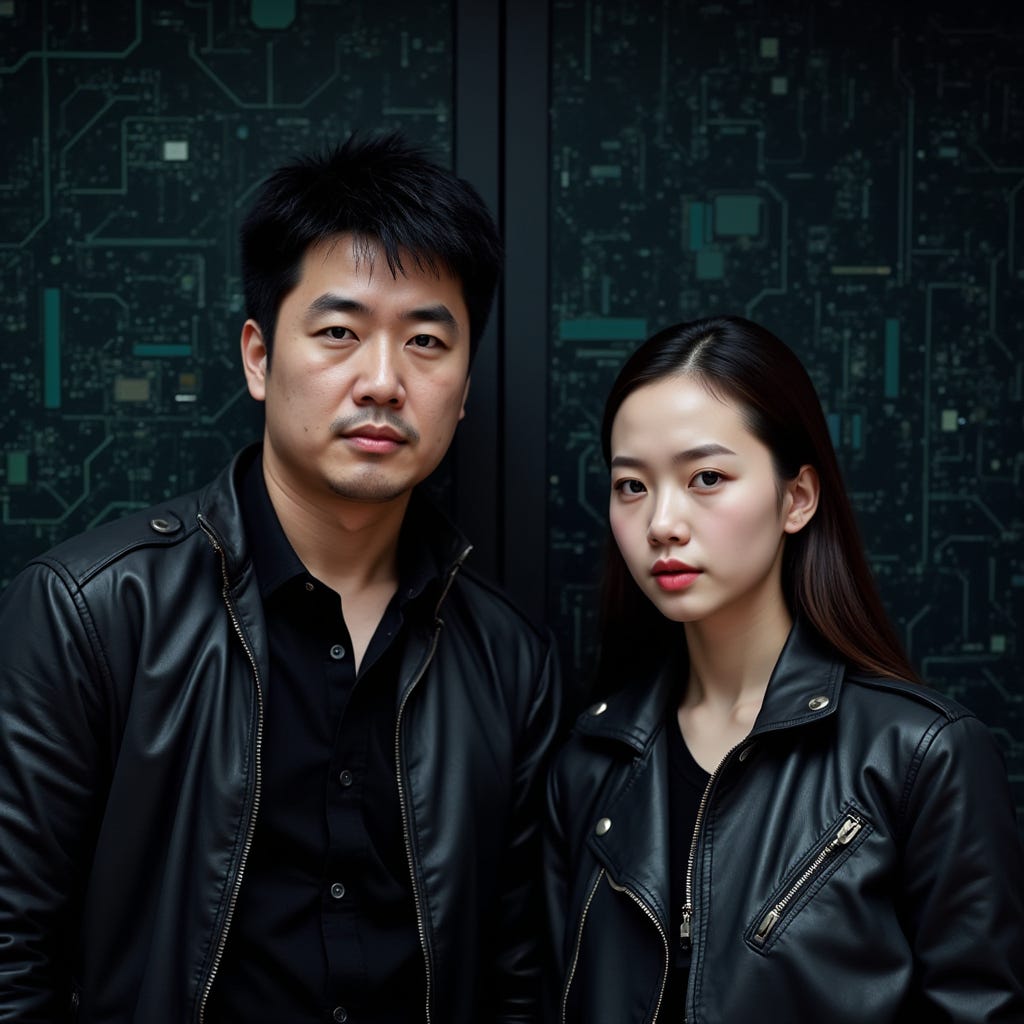
We meet the main characters, Ji-Hoon and Soo-Jin Yoo. It’s a going away party, and couple are tasked by the government to research the growing cohort of White Extremism, requiring them to move. I rolled my eyes upon the realization this was going to be a Korean “fuck America” movie, but thought some mild amusement could be gained if it went totally over the top. I stayed in my seat.
We next see them with their moving van to a small podunk village in the Midwest, a Sonnenrad flag proudly waving in the main street. I about bellowed out loud at this point, wondering what based-world America they were dropped into. Seeing this, of course, made the two nervous. The white townspeople stared at them as they drove by, putting them on guard and contemplating leaving. They parked their moving van and started getting their furniture inside, a crowd forming to study the new arrivals.
A massive, burly man in a vest with the United States flag walks over, making the husband instinctually come between the stranger and his wife. Instead of a conflict, the man introduces himself as Carl and offers to help them move. The two decline, but he insists, with a few more men coming over. They relent, and the crew makes short work of the move. They assumed there was a catch, or maybe a veiled threat to leave, but instead the men wave and walk off, muttering something about telling Sally to give them a welcome party.
They try to set up the house, only to constantly hear the doorbell ring with someone else introducing themselves. Getting annoyed, they soon ignore it altogether. We fast forward to a week later, as the couple is getting their instructions from an undisclosed federal agency. They were tasked with creating a psychological profile of key players in a White Nationalist group called New Dawn. They were warned while on the outside they were friendly and rarely used overt violence, they were a deeply dangerous and adept organization.
“This isn’t your average Atomwaffen or Neo-Nazi outfit.” their stern, world-weary boss explains.
An inside plant gives them an invitation to a video room with some of the members, who immediately chuckle at their brazen non-whiteness and mutter, “Chinks” to each other. Whether the incorrect slur was supposed to be ironic or if they were uninformed is never revealed, but it was pretty funny. Kyle, their secret informant, convinced the crew to be polite and not to boot them from the server. They gave some snarky comments about flat faces to the couple, where Ji-Hoon, in anger, retorts about needing sunglasses because of how pale everyone in the room was. Soo-Jin shrinks in horror as she thinks they just failed entirely, only be met with guffaws from the ring-leader of the cell, laughing and responding, “I like you, you’re racist too!”
The scene transitions to a high-school football game, at least that’s what they were going for. It looked like something more out of The Road Warrior than anything. Soo-Jin is on the phone with her mom, having another bitter conversation before she hangs up in disgust. Ji-Hoon is watching in bemusement at the barbarism of this small town until an older man approaches him introduces himself as Kevin Hart. He explains he’s a professor at a local university, then waxes nostalgia while watching his son play linebacker as he was an all-state player in his youth. Ji-Hoon is exasperated such an educated man has such fond memories, leading him to question his arrogance. They build rapport, the professor asking if he plays Ghess. Ji-Hoon responds he was once a nationally ranked Go player, leading to plans to play each-other in both games.
The couple gets pulled in. Instead of disinterested parties looking in, both become much more active in the online extremist group they are studying. It escalates when, on vacation, they are accosted by a black man on the subway in New York. Both of them reacted by blowing off steam online with 13-do-50 type memes. It’s pretty funny seeing recognizable 4-chan memes on their screens. Even in the distant future, the green-texts live on.
Things progress, and soon they are outright shitposting. They imply to each other it’s ironic, but it doesn’t feel that way to the audience. Throughout he’s digesting memes and talking points of the group, many true, many very biased but with a kernel of truth, giving detailed notes and psychological profiles as he goes. He starts to realize the crew are not crazy, racist bumpkins. They are intelligent and ideologically sound, as much as he finds their views appalling at this point.
We see the mental model of Soo-Jin morph first. As her fights with family and the emotional distance of their previous ex-pat community expands, she becomes self-conscious of her appearance, adding digital filters smooth some of her starker racial features. As she builds rapport with the women in the group, all rabid Aryan pro-natalists with several kids, she questions her own life.
We see time pass in a clever way, with every month starting with a scene of Soo-Jin opening the bottle containing her birth control pills, with every month seeing her hesitation grow, until in the last few months there’s only the unopened bottle as she gets ready for the day. We see the Go board prominently on the dining room table disappear, and replaced with a chess board. As time progresses, the artwork in their living room is also updated.
Their research falls to the wayside as they dive deeper and deeper, sharing hard-core white supremacist memes with no sense of irony, caught up with fitting into the club. Their usual analytical minds get turned off in the rush, leading them to believe and repost the most obvious falsehoods imaginable without blinking. Soon they are spending almost all of their time online, both heavily filtering their faces to fit in. The movie, cleverly, doesn’t tell you whether they’ve really bought into the cult or playing them all for fools.
The climax comes when they are invited to speak at the New Dawn conference, where they would be introduced to some other top dogs in the organization. They’ve earned the organization’s trust and are now cryptically offering a “life-changing opportunity”. Ji-Hoon speaks, giving a sycophantic story of their first impressions, and how the community changed their ideas on race, concluded to rousing applause. Afterwards, a muscular, 6’ 5” man named Hans approaches them and asks to speak privately. From memory it went something like:
Hans -“Wonderful speech, it really put together everything we strive for. I want to express my gratitude for all you’ve done for us and keeping an open mind. I do have to be honest with you. I consider you a friend, but will never consider you one of my people. You can understand why, right?”
Ji-Hoon - “Yeah, well, some things are immutable.”
Hans - “In this day and age, not as much as you think. You see, there’s a project in the works, a blueprint for the future. We tried the multiculturalism thing, didn’t really work. Even if you embrace our values, embrace our culture, there’s still that otherness. Not happening again. We used to have some assimilation, but it wasn’ enough, everyone knows they are outsider, even generations later. Things are changing. Now, we might be able to reach Total Assimilation. We can have a single culture, a white culture again. People like you can truly be one of us. Is this something you are willing to entertain?
We don’t see the answer, but pan to several months later, with a white man and woman who have suspicious similarities to the two main characters are in the hospital, laughing and congratulating each other over tears as their first child is born. The camera pans to the baby, complete with blue eyes and blonde hair, and the movie goes to credits.
Yeah, the ending really goes off the rails.
Overall, the movie gives a fascinating study to the nature of identity, and the extent that peers affect one’s outlook. The commentary on internet culture was something to ponder, especially in our highly online culture. At what point does posting funny memes ironically, or jokingly escalating rhetoric, create a brainworm that slowly changes your views? What was once a silly past-time to waste some time becomes a wholly new identity, and you are posting half-truths and believing total bullshit others spew out without a second thought. Before you know it, you’re spending hours posting nonsense just for a laugh. As one gets more cloistered with extreme elements of society, the easier it is to get taken for a ride. One’s views can change with the right influence and cease to be recognizable, even to yourself.
If you ignore some hilariously misinformed ideas about American culture, taking a while to really get going, and the ludicrous ending, it’s a fun two hours. I give it 4/5 stars. If you watched this movie, let me know your thoughts in the comments.
Thank you for reading Social Matter. If you enjoyed this article, please subscribe and share.
You made this up lol
Haven’t seen the movie yet, but the comments Hans makes to the couple—about how the can never really be fully integrated despite their cultural efforts and genuine commitments, sounds exactly like something one of my Korean (not Korean-American, btw) friends told me back around 2011.
I was asking him if a white person were born in Korea, only spoke the language, did the mandatory military service, etc, would the white dude be accepted as Korean? My friend, a chud but a sharp one, said no way, they have to be of the same race to count.
Blew my sweet little college-educated mind at the time but was the first time I realized that white Americans were pretty out of line with most cultures’ take on race.