



And now for something completely different, The Pillar recently reported an incident last year regarding some seminarians on retreat.
Clergy in the Archdiocese of Denver are divided over the handling of a controversial “blood oath” ceremony involving a vice rector and seminarians during a ski trip last year.
A group of seminarians studying at Denver’s St. John Vianney Theological Seminary were taken on the trip in January 2024 by then-vice rector of the seminary, Fr. John Nepil, during which they were woken in the middle of the night and invited individually to swear a “blood oath” in a ceremony involving a dagger and a man in a yeti costume.
During the bizarre ceremony, video of which was sent to The Pillar by multiple sources in the archdiocese, seminarians were told to scream as if in pain before returning with a bloodied cloth wrapped around their hand and their mouths taped shut, to a room where others waited for their turn to be brought in.
I was confused when I first read this, then laughed. The absurdity is just delicious. While the silly “blood oath” is over the top for a seminary, it’s clear what the priest was going for, having a surreal story they’ll remember for the rest of their lives that would make everyone else think they went mad. Really, their biggest mistake was recording it. Never record a prank like this. Even if it’s innocuous, it loses its aura. Let the memories speak for themselves.
Many have participated in outrageous antics like this, especially as young men. In some college fraternities this would be known as “Tuesday”. During another era he might have gotten instruction to tone it down a little or look the other way and everyone would consider the incident closed, but not this age. In the hyper-moralistic outrage machine of Catholic social media, the faithful are practically falling over themselves condemning it. The accusations range from accusations of blasphemy to grooming to violent hazing.
Chris Jackson amusingly described it thus:
Apparently, part of that preparation now includes acting out a scene from Eyes Wide Shut: Catholic Edition at a ski resort owned by a devout Catholic with a flair for cosplay and bear fluids.
Former vice rector Fr. John Nepil, formator, professor, and (allegedly) moral compass, organized a 2024 ski trip that included a charming little ritual involving daggers, fake blood, and secret society LARPing. Because obviously, what seminarians need isn’t the Spiritual Exercises, it’s Fear Factor with clerical faculties.
To their defense, the Church has been inundated with countless abuse stories, with the McCarrick scandal still fresh in people’s minds. Many ad-hoc secret organizations within the clergy, like the St. Gallen Mafia, have used their connections and influence to make sure their men reach power to shape the Church in their image. There have also been several scandals where founders of various orders were sexual deviants. On the surface, this sounds like more of the same corruption Catholics are sick of.
What’s odd though, is the utter disbelief in the comments, largely from men who should get it. They utterly dismiss the idea that this was just a silly stunt. Have none of these guys gone hiking in the woods with their buddies and pulled a ludicrous prank? Have none of them done some stupid shenanigans while out partying on Saturday night? Does no one remember coach crushing them during summer’s “Hell Week” to transform them into a focused, disciplined team?
When one thinks of your typical initiation, there’s always a ceremony, its publicity dependent on how socially acceptable and elitist it is. This stems from the openness of a Christian Baptism all the way to the strict secrecy of Skull and Bones. There are different levels of ritual, stemming from everything being done according to the rubrics to completing winging it on an adventure that no one knows the outcome of.
Today, there is a deep-seated animosity in the common man when he sees compatriots participating in shadowy machinations in darkly lit rooms or bizarre stunts like the Yeti Incident. There’s the implied assumption they are up to no good and are hiding their ambitions and goals from the population at large. A lot of this has to do with classic Fraternal orders falling away and the general isolation of modern man. There’s no frame of reference anymore. While the common man’s public rationalization is altruistic, wanting to clamp down on hazing, sexual abuse, and cult manipulation, their actual reason is much more fundamental. They fear them.
Power is Built on Conspiracy
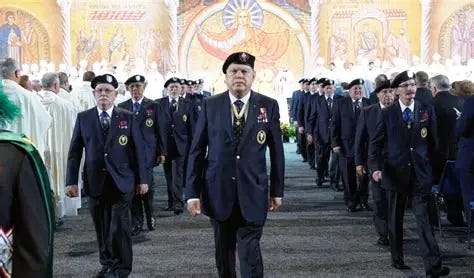
In modern times, any sort of rituals, especially secret ones, are looked at with suspicion. They see it as initiation to a cult that wants conformity before independence, molding the acolyte for its cause. Such suspicion can sometimes be alleviated through wholesome community outreach, like the Knights of Columbus. They famously take part in secretive rites of initiation and select ridiculous titles and militia-style uniforms for themselves while helping old church ladies. If this innocuous group met every other week to work on secret projects they never divulged, skittish Church ladies would be raising alarm bells.
It’s not without justification, as those who work their plans in secret are likely conspiring against current power structures and ways of life. These groups cross the political spectrum. Radical terrorist organizations have elaborate demands of initiates to prove they were serious. A classic example were the Weathermen, who famously demanded mass orgies and criminal acts of its adherents to prove their loyalty to the cause. The KKK had a more formal hierarchy and rituals with a similar goal of using intimidation and terroristic tactics where political power was not sufficient. Such ideological radicals can easy snowball into a powerful political force, which is why intelligence agencies focus so much energy on infiltrating and destroying them before they’re capable of mass disruption.
It’s not only the lower classes, as it’s also a means for political elites to discuss matters outside the purview of the general public, like the infamous Bohemian grove. Rest assured, there are countless secret clubs, whose name will never be known by the common man, filled with rich and powerful elites who conspire to bring their ideas to fruition behind closed doors. These are where public kayfabe is whisked aside and the real business of rulership can be discussed.
There’s an implied set of rules in democracies that everything has to be discussed out and hashed out in the open, that making plans for political gain and creating exclusive organizations outside the eye of the general public goes against democratic principles. The common man assumes the aspirations of a tightly knit unit with more loyalty to their in-group than general society is a betrayal of what makes our republic work. They understand that hundred fanatics for a cause are a force that can easily overpower three thousand milquetoast and unorganized men regardless of the ballot box. According to the mythology of open discourse, it’s not playing fairly.
Yet there’s a reason every professional military in the world subjects its recruits to grueling physical and mental labor, bringing them to the edge of their resolve and then through it. It’s to break them down to form them as a new, cohesive unit with strong loyalties and emotional bonds to his new compatriots. The same strategy is used in rites of passage used to test a boy for manhood, whether it is surviving in the woods or killing a wild animal. It’s used in Fraternities with crazy and embarrassing instructions for its initiates to follow during Rush Week. In the end, a soldier will jump on a grenade to save a man whose name he didn’t know two months ago, a man in a tribe becomes an equal to his once elders, and a member of Phi Sigma Cappa can immediately have comradery with another fraternal brother he never met before.
Simply put, it works, allowing one to craft a network on like-minded people who can coordinate and exert their will, whether for good or ill.
Brotherhood is Built on Conspiracy
Regardless of one’s opinion of The Catholic Church, becoming a priest is one of the most radical decisions one can take. One takes a vow of poverty and are at the mercy of one’s Bishop, who are often lousy shepherds. Many seem to assume the primary purpose of Seminary is to educate and spiritually form the seminarians. While this is important, it also gives comradery that will encourage a man to persevere when his prayers feel stale, his duties overbearing, his daily life suffocating. During those dark times, he will have those happy memories of late nights with his fellow seminarians, the hilarious tomfoolery they pulled on one another, the defeats and joys they shared. There comes resolve stemming from refusing to let them down. When everything else fails, he has his duty to the brotherhood to fall back on. As Father John Nepil once wrote.
The pressing issue for the Church in this moment of history is how it will creatively mediate the power of cross through new concrete forms of communion. Sadly, priests are the first to say they don’t need it, “and besides we are really busy.” Most priests I have met who have left the priesthood were isolated and didn’t pray; all of them lacked vulnerability in prayer and in relationships. But for some reason few have realized that the grave privation of constancy in relationships, at the source of so much destruction. Unless our relationships are consistent, deep trust cannot emerge and vulnerability becomes impossible. Vulnerability does not exist on its own; it is always the fruit of commitment.
If you want to see anger, ask a priest about fellow clergy who left. Their sense of betrayal is unfathomable when dealing with a man who reneged on a lifelong oath, when a fellow brother they spilled their guts out for, went to bat for, that knows things no one else in the world knows, walks away.
You’ll see similar dynamics in any brotherhood. The experiences, conflicts, struggles, victories, and defeats are irreplaceable, forming the core or one’s identity. The more intense the formation, the more one’s mind gravitates to those tumultuous times. The more all-encompassing the commitment, the more zeal is unleashed to succeed. Secrets are uncovered that every member will go to the grave never mentioning to another soul. There’s an urge in every man’s psyche to not only belong, but feel like he earned it, that it wasn’t just given for existing, for saying the right things, for checking the right boxes.
Such basic wants are manipulated, of course. There are cult figures who prey on this need. Sexual abusers famously use organization with strict loyalty to feed their base appetites. Hazing can get out of control. Yet in the moral terror to stop such deplorable behavior, culture has eschewed every such fraternal structure as intrinsically corrupt. Fraternities are now considered the arena of dumb, low-status idiots with universities tightening their clamps more and more. Chat rooms full of shit-posters are constantly being infiltrated. Fewer young people are playing sports. While such downturns mean fewer coaches can abuse athletes, fewer fraternities can haze new recruits, and fewer young men are moving to political extremism, it’s hardly a victory when that means the ability to build any true comradery at all becomes impossible. When every interaction has to be approved by an all-encompassing leviathan, they learn to stop trying. You can pat yourself on the back for stopping an imagined groomer all you want, but the cost is a generation of listless, demoralized, apathetic men. Congratulations.
Worse, by constricting such rituals, you’re obstructing a necessary ingredient in creating the next generation of true leaders. Ask yourself whether a smart but mischievous man who spent his youth getting into crazy adventures with his friends or your average College Republicans president has more potential.


Ask yourself if the bookish and shy student who wants good marks from his instructor or a world-conscious, energetic, adventurous man who may have slacked on studies off and on would be a better pastor. What type is needed in our time? Sure, a young man who spends hours in the chapel reciting rosaries will likely be a holy and dignified man. He certainly gives Trads more ease, but that’s not the only type, nor the only way.
As much as the left is accused of schoolmarm behavior, old-line conservatives tend to be just as bad. Even sadder, many of these types have happy memories of playing countless pranks and stunts in their youth, likely rewarded with opportunities from their connections and friendships that have lasted decades, then condemn the same behavior in the next generation. Those who didn’t often have a gnawing suspicion they missed out. Much of the millennial striver class is pondering whether those countless hours doing the “right” things made them miss out on the things that matter.
Yes, excessive hazing is bad. Yes, some evil people will use their charisma to nefarious ends. This has been true throughout history. However, ask yourself if outrage at harmless shenanigans directed at pastors who have a solid track record is productive. Do you want to subject the next generation of leaders to the same stifling conformity you were subjected to? Do you want a virtuous man to be able to break the rules when necessary? Do you want a world where a man knows he has a cadre that has his back? Do you want strong, cohesive fraternities willing to do what’s necessary, regardless of social approval?
Then let them cook.
Thank you for reading Social Matter. If you enjoyed this article, please consider subscribing and sharing. If you don’t want to be attacked by a yeti, become a paid subscriber.
Good piece Mr Schmidt,
I admit I expect more from priests than I expect from myself, and I don’t share your “harmless shenanigans” estimate of the situation. I have priest friends who are also raising their eyebrows at this story.
However, I agree that the priesthood is a brotherhood in Christ before anything else. Fraternity is a delicate thing, and it’s under attack in all modes of modern life, as you describe.
In defense of yeti blood oaths, not so much.
In defense of strong bonds between fishers of men? Absolutely.
My college sports team used to go camping by a river each year. One year a dude got blackout drunk and we painted his foot black with a sharpie. When he woke up we told him he got a disease from the river, he freaked out and tried to fight everyone. It was hilarious.
To this day, the team designates a ‘black foot’ at each annual camping trip. I feel bad for those criticizing the yeti ritual. I’m sorry yall never had fun