


In the Amazon Series “The Man in the High Castle” where the Axis powers won World War II and carved up the United States, an ex-pat moving to the Nazi Sector is given a tour by the wife of a prominent official. The ex-pat is awed by the cleanliness and peacefulness on this side, a place where crime and filth have simply vanished under a ruthless authoritarian regime. She is told that “nobody locks their doors here.” The scene is a classic rhetorical tactic, designed to cause unease at ostensibly “good” things like an orderly society and questioning the means of achieving it.
In a similar fashion, the world of Gattaca is a clean and stable techno-utopia. Genetic diseases have disappeared, the social order is largely bereft of violence, people go into space with the nonchalance of a business meeting, and everyone is high-trust and high-IQ. The future society formed by total devotion to improving the human genome, with everyone using in-vitro fertilization and gene editing to ensure the best genetics move forward. Natural children, therefore, are subject to heavy discrimination.
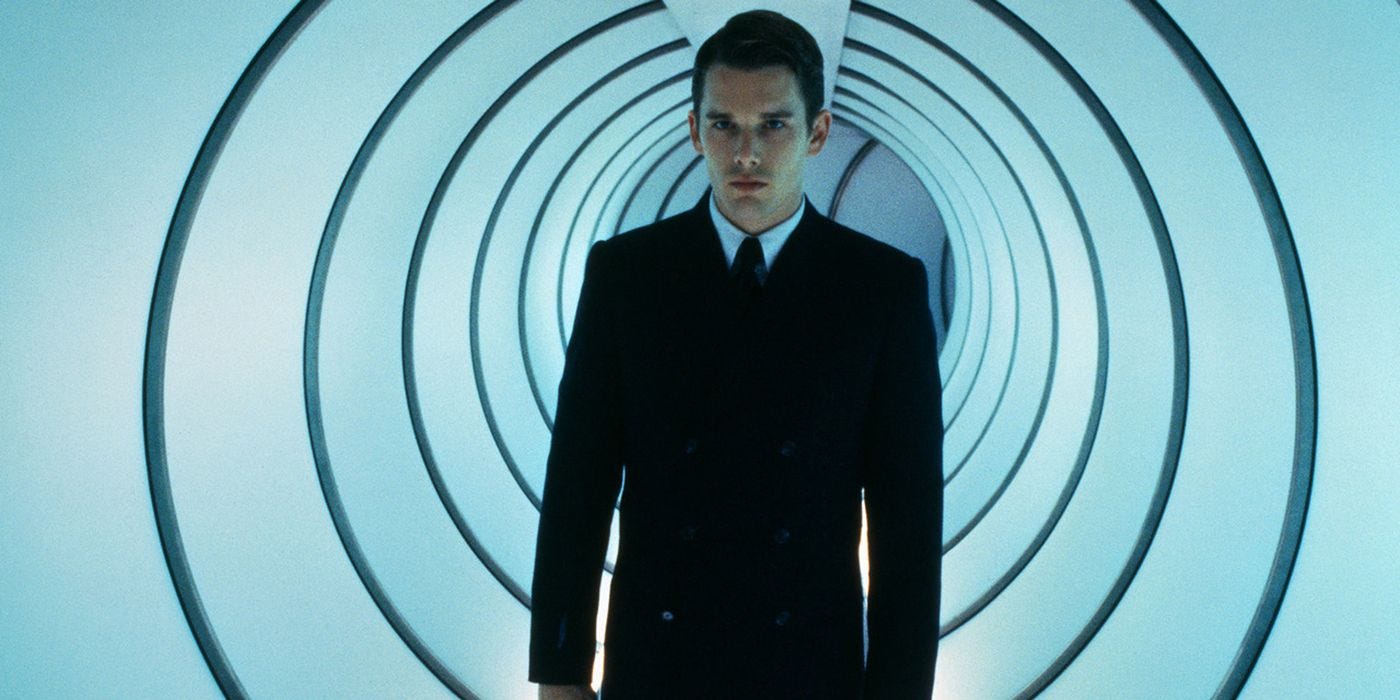
Enter Vincent Freeman (this film is anything but subtle), a “God-child” conceived by a tryst in the back of a car, and therefore doomed to be a member of the underclass with a genetic heart condition. From his early years, he has had a fascination with space. When told the only way he will see the inside of a spaceship is to clean it, decides to make a deal with the underworld, buying the identity of a genetically perfect but crippled man who gave up on life. Through this new identity, he gets employed at a top tier aerospace firm called Gattaca. When there’s a murder in the facility, he is at risk of being found out by private investigators and having his dreams of entering space dashed. Through pure force of will and a doctor who looked the other way at his fraud, he attains his dream of entering space.
“Gattaca” was a childhood favorite of mine. Like many older millennials though, I started to form a more critical eye about the moral framework of many of these childhood favorites. Many movies I originally enjoyed can’t stand anymore. I once loved “American Beauty”, and now would give full-throated support to burning every copy of that atrocity. It’s both frustrating and liberating to look at media and immediately see the subtle and not-so-subtle ways you are being manipulated. Upon rewatching Gattaca, its morality is far more gray than my original memory.
While the movie is uplifting, in the end, Vincent will be nothing but trouble. His heart condition was real, and he had no business going into space on a long mission. The other passengers will likely have to deal with a corpse, be short-staffed for the mission to Titan, and even with his very real contributions at Gattaca, will end up being a net negative. His “screw-you, I’m going into space” mindset was anti-social, a monomaniacal want to exploit the techno-society that kept him down to experience something most citizens, even in this time, never did.
Of course, the movie is from the perspective of Vincent, and is bereft of questioning the moral choices of the protagonist. It’s an ambitious man rebelling against an inhuman system that is cold and bereft of humanity. They operate under an assumption of genetic determinism while ignoring unpleasant confounding factors that complicate their vast but sterile world. He doesn’t have the power to overthrow it, but he can thwart it enough to fulfill his dreams. In short, it’s a beautifully constructed work of propaganda.
A lot of its emotional weight depends on the audience’s already latent distaste for eugenics. It doesn’t make an effective case for why in-vitro fertilization and genetic modification is a moral failing. While I have a philosophical, moral, and technological aversion to IVF, the movie assumes the audience in already on board that this is a negative while never grappling with the questions it raises. In our more secular age, this sort of gene selection is viewed more and more positively.
This has led some dissidents to consider the movie a sort of Rorschach test. Can you see through the tear-jerking music, gorgeous scenery, and uplifting story to see the narcissism of a man who is willing to live a totally fraudulent life, put innocent people at risk, and likely will cause massive financial harm to fulfill a personal dream? Can you see how detrimental a world of Vincent Freemans would be? Can you get past the “eugenics bad” brainwashing to realize that these people live in a Utopia?

It stands to reason why they think this way. Everything is managed well, everything looks elegant, and everyone is trusting. Contrast this with our current world, an age of anarcho-tyranny where addicts shoot up in the streets and DEI policies make everyone’s boss a nitwit with an axe to grind. Regardless of background, everyone is assumed to have the capacity to be a rocket scientist, and countless hours are wasted to keep this myth alive. It’s obvious why a purely predictable techno-polis with clear rules, expectations, and understanding of genetic limitations feels like a godsend. Watching this movie in the 2020’s hits far different than the 1990’s.
Of course, this society is also one that is steadily losing its humanity. Every decision is through metrics and Vincent, though he shows extreme competence, is shrugged off because of a sub-optimal genetic profile. It’s orderly, but also bereft of exceptions for factors not quantified. Most of all, it ignores the core purpose of a society, to give its inhabitants a sense of place and belonging. Vincent’s immutable qualities, his genes, doom him from attaining this from the start.
The movie implies there is a large black-market consisting of people who fell through the cracks of the more visible aspects of society. Whether through a disappointing genetic profile or simply a case of having no place for their aspirations, underneath the veneer is an angry underclass formed through a rigid ideology that will eventually tear it apart.
Contrary to the world we live in today, where every rule seems to have an exception that allows a guy with thirty arrests to walk free and certain interests can act in ways that would jail the rest of the population, the world of Gattaca has no such exceptions. Both structures create a resentful underclass, one that can’t stand the chaos and arbitrariness, and one that has skills and ambitions but doesn’t fit into an easily quantifiable mold. While you can point to Vincent’s fraud and deceit, one has to ask if he owes anything to a social structure that refuses to recognize his potential. Many are just as unhappy and unfulfilled as he is, and one can’t fault a guy who says “fuck it” and gets his. No matter how aesthetically pleasing a place it, is has to have meaning for those living in it.
Regardless of the technological or material advancement of a society, people will be destroyers if it doesn’t fulfill human wants. There will always be out-groups, but if a cultural elite has no mechanism for good actors to rise up, their resentment will go towards destructive ends or get exploited by others. Even the most utopian world will be resented if it fails to instill meaning. In Gattaca, going to space became a mundane matter, but to Vincent it was a life quest, and you need people like this. There’s always the tug-of-war between individual ambition and group cohesion. There a Faustian, reckless ambition that pushes forward and creates chaos but also new opportunity. There’s he cool, controlled planning that creates the predictability necessary for hundreds of millions to live in peace. Both need to be balanced.
In the future, maybe the world of Gattaca will realize the limitations of genetic determinism, just like our current society is beginning to realize the intrinsic constraints of one’s genetic code. A future Gattaca world might understand that exceptions will not bring chaos when done prudently, just like our society is realizing countless exceptions make said exception the rule. While most genetic profiles will make a future rocket scientist unlikely, it doesn’t stand to reason they can’t bring value in other surprising ways that should be nurtured. Our world, and the world of Gattaca, have no sense of this dynamicism by veering in opposite directions. The balance has been lost.
If they can’t achieve that balance again, then maybe they deserve to fall.
Thank you for reading Social Matter. If you liked this article, please subscribe and share. For full access to articles, please consider becoming a paid subscriber.
Was forced to watch this in 10th grade Biology class to immunize us against the evils of Eugenics. I distinctly remember it having the opposite effect on me.
Communism, Fascism, even our current Neoliberal “Meritocracy” treat both the individual and society as one would an animal and its herd; something to be managed, trained, bred, or even culled.
And like in animal husbandry, these various political economies, which certainly includes capitalism in all of its forms, treat people according to the perceived economic or monetary worth, not as people who are of intrinsic worth because they are people. Moreover, the way this economic value is determined is always decided by an elite who derive personal profit, power, and even status by their decisions on what and who is worthy of existence.