



In our present age, few concepts have come into focus more than the nature of power. Most have a general, naive view of the matter, referring to hierarchies in the form of org charts, chains of command, and the legal letter of the law. Modernity has shown power to be far more complicated, especially in liberal democracies where the most affluent men hide their influence in the shadows. Much of the crisis of modern life is the realization that no one knows who is in charge, and therefore no one knows who to petition for redress of grievances. It’s a mentally taxing system that feeds paranoia and fosters distrust. Much of the grass-roots right-wing projects in the last decade have been to reestablish power residing in a visible body again instead of a disorganized mass of nodes and interests. They want to know who’s actually in charge.
Wielding power in the background has been a feature in varying degrees in every great civilization, however. One reads countless stories of this phenomenon, whether it be the conniving eunuchs of Chinese empires, the Praetorian Guard of Roman times, or the corrupt Vizier whispering poison into the Sultan’s ear. While often having a negative connotation, there are many positive narratives as well. It could be the queen who tries to regulate the king’s harsh edicts or the trusted, saintly man who convinces a tyrant of the error of his ways. Power has never been a simple thing, and there have always been a multitude of ways to attain it, visible or not.
Early in my career, many offices had Admin Assistants to deal with the mundane aspects of work. In olden times they were called Secretaries, but this title is passé now in corporate America. Since it made no sense for engineers to have to waste precious hours filling out forms, making travel requests, and other annoying tasks, they had someone on board to take care of those details so they could focus on their core job. These Admins were mostly women, as is the case in my example, a kind old grandma who was inexplicably a huge World of Warcraft fan.

She filled supply shelves with a smile on her face, did the annoying tedious tasks we didn’t want to be bothered with, and could even dish out some amusing banter. More importantly though, she knew how to work the bureaucracy. There were some people you talked to, and some people you went around. You approached some with a gentle touch, and another you played hardball with. Whenever a request came through with petty pushback, whether it be a dumb power struggle over a meeting room or complaints about a requested hotel being too expensive, she could smooth it out. While at the bottom of the totem pole, she knew how to get things done, and kept the organization running smoothly. She had little official power on paper, but could accomplish things even management struggled with.
Of course, when layoffs came, secretaries like the kindly grandma were the first to go. Because their value was not easily put into a spreadsheet, they were seen as unnecessary costs. The Vice President, of course, kept his though. When she left, things got more complicated. Frustrated engineers would now spend an infuriating afternoon trying to get their simple request through the labyrinthine process, and good luck getting support. Put a help ticket out, and someone on the other side of the ocean might get to you in a few days. You can just twiddle your thumbs until then. In the corporate world, this is known as “efficiency”. Those old ladies might not have been able to code, but they were critical nonetheless. Morale and productivity dropped when they left.
While my workplace had this positive example, I can’t say as much for the local parish secretaries. As everyone who goes to a church knows, the secretary is the backbone that keeps things running. She is the first person one reaches before talking to the pastor, often keeping his phone number hidden away like it’s a state secret. You have to go through her. If you want anything done, she is the point of contact. She is a necessary buffer, as there is always a Ned Flanders type that will incessantly bug the pastor about trivial matters, and he needs a someone to filter people. Also, pastors are often terrible administrators and don’t have the wherewithal to deal with church maintenance, scheduling, and event planning. They want to simply focus on preaching and counseling. This dynamic lets her wield incredible power.
In the right hands they are a boon, a critical part of church organization, but this position also attracts a truly contemptible archetype. The pay is peanuts, so other intangible benefits are pursued. They are the ones who love power, but not the responsibility associated with it. They like to push people around and show favoritism, but need plausible deniability. They want to follow their ideological ends but need a facade to hide behind. Because they serve as the first line of contact, they are in a unique position to frame things in their interest. They tend to be very progressive, far more than the average parishioner.
In my years, I have seen what seemed to be coincidences turn into clear patterns. In my twenties, a Catholic youth group meet at a local church every Tuesday. We had the support of the local priest, cleaned up after ourselves, did not conflict with anything else, and had essentially no footprint on Church operations. After a couple years, we were told we could not use the space anymore. The youth group leader didn’t give details, but only vague statements regarding issues with the administration. It ended up being the church secretary had an axe to grind against us for being overly conservative and put machinations in motion to get us out. She, along with another lady in the admin, also gutted the Catechism classes to make them more inclusive. Later, a homeschool coop had a similar thing happen. There were plenty of classrooms, as their parish school closed down, but then were, again, removed under nebulous pretenses. Like before, the church secretary had a hand in it.
What was shocking wasn’t just their brazenness, but the obsequiousness of the other staff. These women were literally at the bottom of the hierarchy, and yet continued to get their way, like they were running things. I don’t know whether they found the files of where the dead bodies were buried or simply were the only ones around who knew the system, but the amount of soft power they wielded was insane.
In the last six months, this phenomenon has become even more personal. My family, along with some others, have been trying to rejuvenate the parish that was geriatric until a few years ago. Young families have been streaming in because the priest is solidly orthodox, some unfortunately refugees from other parishes the archdiocese laid the hammer down on. With time, it has gone from an older, more moderate parish to becoming younger and more traditionally minded. Because of the initiative in the archdiocese to close down parishes, it’s been imperative to grow the Church very quickly to avoid the chopping block. Couples’ events are being planned, family potlucks happen frequently in the parish hall, and signs of life are showing.
This should be good news, but isn’t to everybody. Specifically, our Church secretary does not like the changes, or us. One of the first events we wanted to do was an “All Saint’s Day” party. When we spoke to the secretary for planning, she asked why it wasn’t a Halloween party. We replied that while there would be games, we wanted to avoid making it secular. She scoffed and responded, “well, I guess that’s more important than FUN.”
Luckily, we have good rapport with the Priest and some long-standing congregants given carte blanche to do whatever they wanted. Now, if anything, there is almost too much going on. The once empty halls have now been used to house relics of Saints to venerate, host an Epiphany party, have a family potluck, and more along the way. And no, our Church Secretary does not like this. On two separate occasions we asked her to put an event in the Church bulletin. Both times she “forgot”. She did, however, remember to post a “Meet Santa” notice for a local Boy Scout Troop that has no association with the parish but somehow uses the hall for free.
Other branches of the parish, such as the “Planning Committee”, wasn’t much better. They were still talking over the details of monthly Eucharistic adoration for children on Fridays, which essentially boils down ensuring the Priest is available, making a flyer, and opening the Church. They started the initiative six months ago and were still planning. And don’t get me started on the “Finance” guy. When we asked about the possibility for some of the music teacher moms in the parish to teach in one of their empty rooms, he stated they could, in return for paying a fee of 30% of their income from such lessons. What a deal. The do-nothingness of the official bodies and the passive-aggressive nature of the secretary continues to be exhausting.
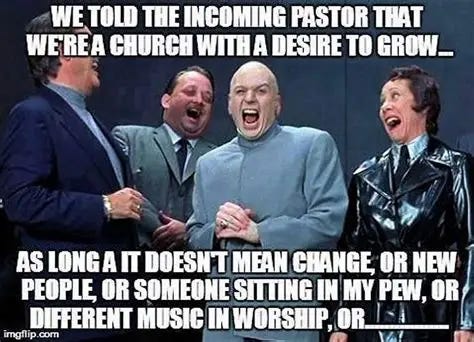
Maybe my personal experience is flawed, and I got the 0.1 percent of church secretaries that are awful. Maybe, but what I can’t get out of my mind is how much damage these seemingly innocuous positions can do, and it’s not just church organizations. Passive-aggressively not doing your job, subverting requests to your own ends, and other Machiavellian machinations demoralizes and exhausts people who want to make a difference in every organization and leaves an opening for ambitious subversives to get their own people in and destroy it from the inside. The concept of good faith interaction is lost on these people. Another aspect is how they use their seeming vulnerability to their advantage. If you rail against an old lady working in a Church, there’s no way to come out looking like the good guy, and she knows it.
In essence, the rogue church secretary is the personification of the maladies of the impenetrable bureaucracy that has its own interests. While Trump was technically the executive, his first term shows in savage detail how much power an executive has without willing foot soldiers. It’s a complicated issue, since to restore proper order, you can’t have this sort of maneuvering to circumvent clear tasks, but she creates enough plausible deniability to make one look like a bully when calling out her behavior. The ideal would be to simply fire her, but that would be mean and hapless parishioners don’t have that power. Luckily, if she can use soft power, so can we.
Some parish veterans who like the new direction have slowly, quietly, taken on new responsibilities. One even can plan events herself and only has to check the calendar to ensure no conflicts. “Forgetting” to add things to the Bulletin are being circumvented by printing our own flyers and inserting them before mass. The secretary declared a soft war, and she will get what she wants.
This new mindset is a full 180 from my earlier experiences and is an indicator of how sick of the status quo people are. Twenty years ago, most people would have shrugged and just said that’s how things are or tried to work within the system. Now people are willing to create their own systems within systems. While once people would bash their heads going through countless committees of all talk and no action, parishioners are realizing they can just do things. They’re realizing the “position” and “proper procedure” they felt chained to was just a mirage, that polite deferments to corrupt or useless staff are a crutch to be discarded. There’s the realization that if those with responsibilities don’t do their job, someone else can.
Many on the right love the idea of a final battle where the enemy is publicly defeated and everyone celebrates victory. True victory conditions in “soft coups” are much more mundane. The enemy is never defeated, just sidelined. There’s no final battle, just a slow pivot to the new way of doing things. Many opponents will still, on paper, have the same position, but the meaning will entirely change. This has been the modus operandi of the social revolutions of the last sixty years, and those of us of a more traditional bent need to be comfortable with this. Quiet restorations are still restorations. Quiet victories are still victories. Quiet progress is still progress. Instead of prepping the great confrontation, but we need to be preparing for countless small skirmishes, gaining a bit of ground every time, grinding away at the forces of complacency and slow decline.
Victory will be a slow crawl through the institutions, something impossible when things ran well. Now the wheels are coming off, and people are looking for competent people who are able to do what people in official positions are now incapable or unwilling to do. Whether it’s your tiny parish or the massive government machine, there’s a place to start. Get things working again, invite your friends, and take back your agency. Dare that decrepit old woman to stop you. Laugh when someone says that’s not how things are done. In times of bureaucratic malaise and weaponized incompetence, be the one to rip the red tape.
Thank you for reading Social Matter. If you liked this article, please consider sharing and subscribing. If you’re interested in being a paid subscriber, get in touch with my secretary.
>There’s the realization that if those with responsibilities don’t do their job, someone else can.
Sometimes. Maybe. The problem is that what you're doing is inherently, and unavoidably, subversive. You certainly can "just do things" within an existing institution/organization, but only to a certain point. Beyond that, you're no longer really acting as part of the institution/organization anymore.
In many circumstances, this is fine. I have a long-standing (though good-natured!) disagreement with one of my relatives about reforming/improving government agencies that runs along these lines. His position is that if you try to change an agency too quickly, you wind up alienating people critical to the agency's operations, making it even less efficient and effective than it already his. The point is a valid one, it must be said. But my position is that a lot of agencies are doing things that are net negatives for society, so making them less efficient/effective is no bad thing.
But now you're talking about the church. The Roman Catholic Church, no less. I'm a magisterial Protestant myself (Presbyterian), but I have enough respect for church tradition and authority to recognize that there are plenty of things that can only happen under the auspices of church authority. The Sacraments are an obvious example, but the whole panoply of church discipleship and discipline is very much in view. Like it or not, this woman is part of how your church operates. If you work around her, rather than with/through her, you're ultimately working around the church rather than with/through it.
You have fundamentally misdiagnosed the problem here. It's not the secretary. Not really. Your archetypical "church secretary" takes many forms, obviously. But the real problem here is not that people with soft power are abusing it. It's that the people with "hard," i.e., explicit, formal, hierarchical authority, are asleep at the switch. All of the institutional/organizational power this woman has over you is, in effect, borrowed/delegated from your parish priest. If he isn't satisfied with her performance, he has the ability to do something about it.
After all, there is an obvious solution to this problem: your priest, who presumably has more-or-less unilateral hiring/firing authority over parish staff, can tell this woman to cut out the passive-aggressive bullshit on pain of getting fired.
That he hasn't, and almost certainly won't, tells you most of what you need to know about the situation here. Indeed, you hint at it yourself towards the beginning of the post
>Young families have been streaming in because the priest is solidly orthodox, some unfortunately refugees from other parishes the archdiocese laid the hammer down on.
The real problem here isn't that this progressive harridan is a progressive harridan, though that's obviously not great. Her power isn't really soft at all. It's hard power, though it's borrowed from men higher up the hierarchy. The real problem is that the bishop/archbishop/whoever would take her side in any dispute with your parish priest. Which both you and your priest are presumably aware of.
Ultimately, those invested with hard power are either too afraid/lazy to wield that power for your good and the good of the church, or they are actively, whether covertly or overtly, using that power against you. Your troubles with the church secretary are just secondary-order effects caused by the real elephant in the room: most of the men holding formal leadership positions in the Roman Catholic Church (Just like most other institutions and organizations these days! Including most Protestant denominations!) are cowards.
I wonder to what degree secretaries should just be wives? Like, I made a note joking about how I would hire my wife to be my secretary in order to have an affair with her; but considering how historical this trope is, I wonder if your secretary should actually be your own wife, lest you be tempted. I was also thinking about the "work wife" phenomenon, and honestly if you don't count sleep, you spend more time at work then you do at home. I know the husband being a breadwinner and the wife being a homemaker is trad, but the trad before that was the husband working in the fields right outside your own house while the wife milks the cows and takes care of the chickens.