


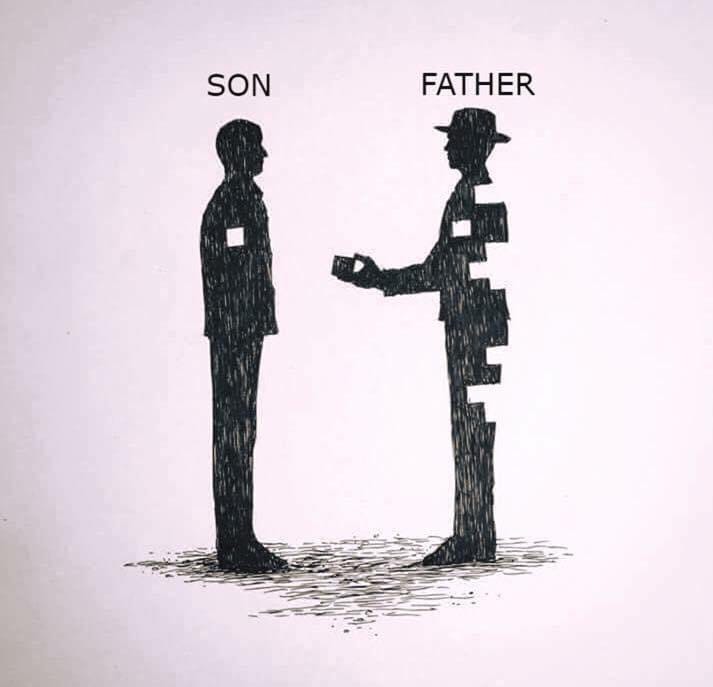
In the finale of Rome, Lucius Vorenus comes home after being mortally wounded in a skirmish. Like most relationships in home, his family issues were… extensive. His attempts at keeping the family together after his wife’s tragic death failed, and the culminating despairing father gave up and took a distant military post. His friend Pullo explains how the man should have died days ago but held on through force of will to visit his broken family. In his death bed, Lucius comes to the realization that they don’t want to see them. Instead of collapsing into despair, he simply exclaims, “I still love them.” The children finally relent to see their dying father one last time and they reconcile before he passes on.
The scene has always stuck with me. Even after his children seemed to disown him to the very end, there was no anger in his voice. He did what he had to do, and was at peace even in failure. It encompassed every parent’s worst fear in a poignant and all-too-real way, especially in this era of alienation between parents and their children.
One aspect of the culture war I’ve had the luck to never experience is the “man up” pastor. I’ve never been scolded on the pulpit for not doing enough housework, for ignoring the kids, or for working too much. On the domestic side, of course, everyone those conversations, and in general society there is a clear template for what is considered fatherly duties when any need for a dad is admitted at all. It goes without saying these have duties become nebulous and restricted, leaving modern dads at a crisis as to what being a father even means.
In earlier times, a poor father would work himself to the bone so his son could inherit a prosperous farm. He would not be playing catch, but working with his children in the fields showing the skills they would need to survive. Oftentimes he would be gruff and harsh, as the children would be entering a world far more unforgiving than their father’s stern words. Behind every correction though, was the knowledge that keeping a child soft and coddled would mean death.
If one was from a more prosperous background, the father would be the one working through his network to find a suitable trade or alliance. He would send his child off with a relative or ally to stay and train under another house. The father understood childhood ended quickly, and had the resolve to ensure his child would not spend time where he should be learning and achieving something doting around the household. The household became wealthy through the efforts of countless ancestors, and only eternal diligence would keep it that way.
Probably most importantly, marriage prospects had to be arranged with the father’s approval. Often the father would have a strong hand on who his child married, if he didn't choose the spouse outright. The father would be responsible for family alliances and the continued security of the family name. In short, picking the next generation’s political and social alliances through marriage fell to the father, though it goes without saying the child had say in the matter as well.
You see some of this today, but in different forms. The father is often researching the best sports coaches to give his child an edge, or maybe the better school. While he is often not involved as much in the day-to-day tasks of education, he has a keen eye on the macro level skills the child is earning and their future work prospects. He does home improvement projects around the house. He is present at the dinner table. He takes everyone to Church. He still gives “the talk” about girls to his sons while the mother gives “the talk” to his daughters. One can see how these old responsibilities have faded away or been diluted.
Most fathers work for a corporation, and the vast majority have no small business for their kids to inherit. The best they can do is save money, which is no small thing, but not a legacy. Even if there is a business, it is considered immoral and unseemly to pressure a child to keep it running, and general culture sees such transfers as uncouth, a sort of nepotism. Dads can teach practical trades, but it’s increasingly seen as “free labor”, a chore instead of a rite of passage. It’s seen as an imposition to demand one’s child goes to religious services after a certain age, and making a child learn the father’s trade is seen as narcissistic, an unwillingness to let their child be their own person. And heaven help you if you disapprove of who the child brings home.
If one looks at the role of “good fathers” in general consciousness, ignoring the majority who sees the role as that of a buffoon or a faulty mother, all the activities are focused on giving a happy childhood to his children. He plays video games with him. He helps with his schoolwork. He encourages the child’s new hobbies. He accepts whatever girl he brings home. Everything is built around spending time doing what the child wants and accepting the child’s decisions. Dad is a cheerleader whose primary goal is to build up his children’s self-esteem. The only time it is acceptable to force your child to do anything is modern, socially acceptable disciplines, like making him do homework or punishing him for anti-social behavior. And even this is limited.
The man who want to be a “good father” more than anything are most susceptible to making themselves pitiable in front their children. They are the ones with no backbone, who try to be a friend, and who are eager for their children’s approval. With the terrifying specter of alienation either by divorce or estrangement when the child reaches adulthood always a possibility, his only strategy is to please everyone. He wants to know he is “doing a good job”, that he is “putting his family first”.
Often it’s a sort of desperation, as he hates his job but accepts it to put bread on the table. His dreams have passed away in middle age, and he copes about his loss in social contacts by doubling down on the household. It’s a desperate grasp for a thread of identity that unravels due to too much strain, and his children can smell the weakness.
Times past has many stories of the distant father, the drunken father, the controlling father. All of them fell to some sort of insecurity and rightly became despised. Yet the new father that is supposed to replace these archetypes, “the cheerleader dad”, is just as scorned when kids enter adulthood. It’s no wonder why. He is superfluous, a non-entity, a limp rag who didn't give his children anything but vibes. There is a reason male cheerleaders are not respected, so it’s no wonder why it turns out this way.
There’s nothing wrong with being supportive of your child’s interests, nor is there anything wrong with being kind and supportive. Aloof fathers are just as toxic as needy fathers, and foster just as little respect. That’s not our core responsibility though. While a mother’s primary role is to keep a child safe and secure, a father’s role is to ensure the child is equipped to enter to world and thrive, and that requires effort beyond “fun” activities.
He knows when to let go and let the child become an adult, and also knows the child is part of a legacy that is bigger than him, spanning a vast chain of fathers through the ages who worked themselves to the bone so the family may survive and thrive. Your child is no more exempt from caring for this natural gift than you were, and it entails responsibilities. This requires direction, and while such direction can devolve into unhealthy domineering, it needs to be there. The father, most of all, needs to instill a sense of who they are. “I just want my child to be happy” is the mantra of a worm, not a man. It’s the dirilection of responsibility and conflict in the hope that things just work out.
Modernity has tried to make the father superfluous, and they have done an astounding job. While the mother has seen this same corrosion in her relationship to her children, the father is seen as the bigger threat. In the quest for creating the perfect individualistic, de-racinated consumer, the father is seen as the impediment in creating a world bereft of natural hierarchies and responsibilities. The father, as head of the household, is the prime recipient of such attacks.
Instilling virtue, discipline, and a sense of place will leave a stronger legacy than a thousand “fun” excursions. Carrying the family honor forward is the greatest gift a man can bestow. The neediness, lack of backbone, and need of affirmation is the end state of a man who wants to be accepted but no longer knows what he is supposed to do. A good father knows that sticking to his guns may cause friction. He knows that directing his child away from a spiritually vacuous existence will likely cause anger. He knows that standing by his principles may mean, especially in this age, complete loss of contact.
In few eras has it been harder to be a good father. The social contract now demands the father waive all his rights in return for delegating his old responsibilities to the State, except financial responsibilities of course. He is to stand aside as his child is inoculated into the new therapeutic culture that emphasizes self-actualization over natural bonds. The father is to raise the child, feed the child, encourage the child, but never insinuate a child’s own responsibilities or family honor he is tasked to maintain. This isn’t to say the child is a slave to his father’s desires, as a mature man knows there are many paths to a good life. The child is not just an independent, autonomous, person without deep, inherited responsibilities either. The father needs to keep this balance, even when general society screams about the backwardness of his ways.
He’ll do it anyways, because anything else but doing his duty is impossible to fathom. The most terrifying prospect is losing access to one’s children, but even worse is the existence where every action is a desperate bid to avoid such a possibility. Much of the time, his role as father will get everyone angry, and his moral compass will be the the only guide. The responsibility goes further than one’s immediate family, but those in your line who lived before and for those you want to live after. It’s the understanding you may be hated for doing the right thing, and no one will be giving you a pat on the back for being a “good father”.
Still, no matter the ups and downs of the relationships, no matter the pain, the frustrations, the tears, the thankless labor, and all the stupid mistakes, he’ll still love them.
Happy Father’s Day