


Marriage is a tradeoff. For men, it is a vow to devote your time and resources to your wife and future children in return for a family dynasty you can call your own. While not as strong as the maternal instinct, most men want to be fathers, and this compact ensures their progeny has the stability to flourish.
This means most of your income and time goes to support people other than yourself. Where you might have put extra money away for an early retirement, or maybe earned less working a more interesting job, it’s not feasible anymore. Your earnings need to support a home that is more than a bachelor pad. You need to keep up with the rising cost of food and education, and unexpected expenses quickly burn a hole in your pocket. The double responsibility of work and home have an impact on one’s social life as well. Even if you’re available, during those infant years you’re likely too tired to want to hang out.
While there are many influencers online pontificating on their child-free lifestyle, bragging about being able to sleep in as long as they want, go to restaurants whenever they want, go to foreign countries whenever they want, most are mundane people. There are outliers having wild adventures and building business empires impossible to achieve with modern domestic expectations, but that’s not the norm. There’s nothing wrong with pursuing a unique life that doesn’t entail marriage. For most though, raising the next generation will be their lasting impact on the world. This isn’t to say married men lose all ability to pursue an exciting life. Most men have ambitions outside the household sphere and would go mad living a purely domestic life. Opportunities are available, though time and resources are sparser.
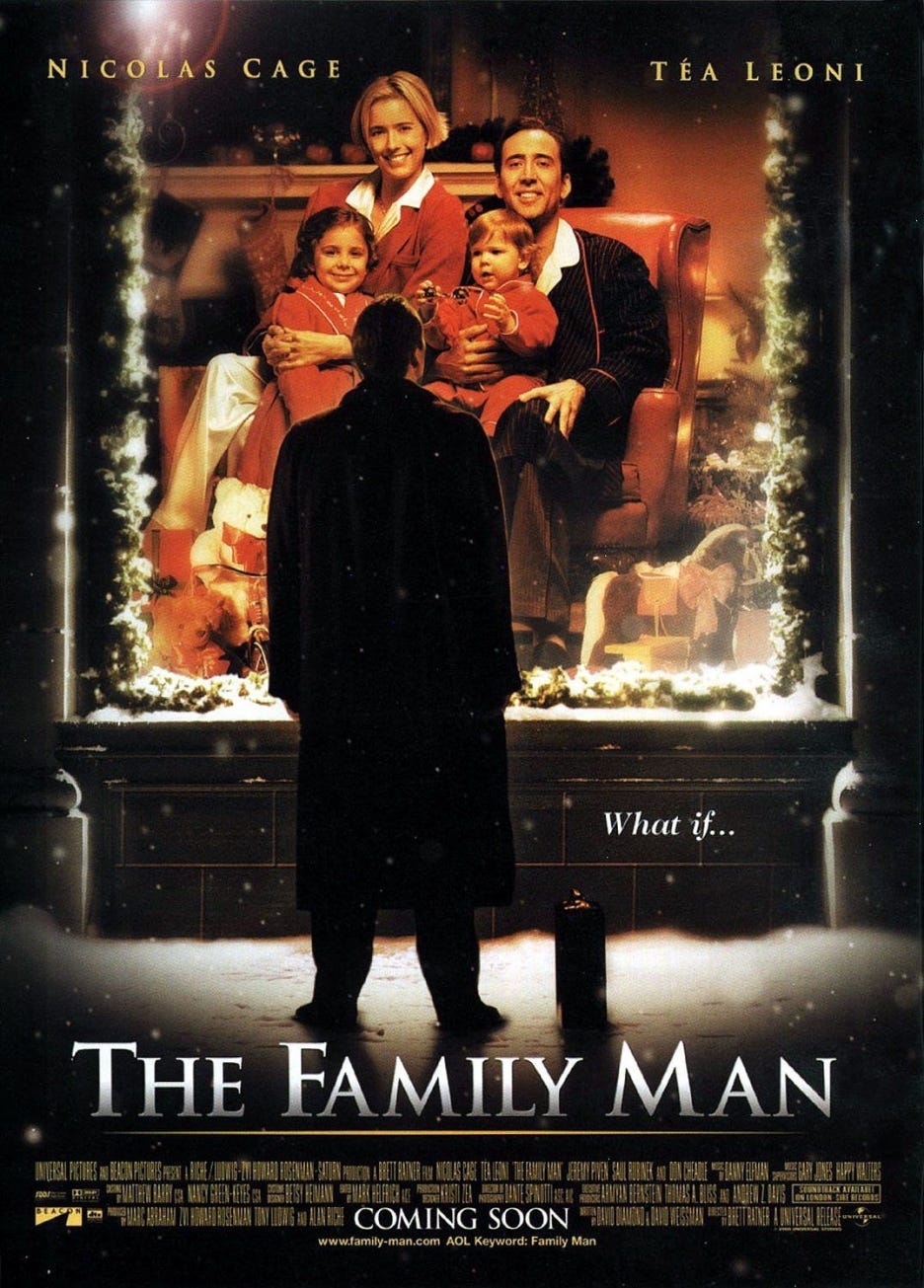
Countless media has been produced dealing with the tension of domestic tranquility versus the drive for glory, most of the time ending with the man realizing how much more fruitful hanging out with his wife and kids are than his wider ambitions. Movies, like “The Family Man” starring Nicholas Cage, preach the message that being a regular old suburban dad is better than being a single, high-power executive. It’s encouraging the mundane life over the exciting, familiarity over the unique. In the choice of a fulfilling career versus being there for the family, it teaches every good man chooses family. “The Family Man” is a film many middle aged dads pull out during those days of drab conformity to tell themselves they made the right choice. It’s never convincing.
This is what happens when you have a family. You sacrifice. [Pause] You sacrifice a lot. [Long pause] It’s gonna be in your best interest to stay away from me for the next couple days.
-Justin Halpern, relating his father selling his 1967 Two-Door Mercury Cougar in “Shit my Dad Says”
This isn’t a character flaw, or a dig on marital life. Any man who doesn’t sometimes lament for his freer younger days never had the vigor of youth flow through him. He also understands you put away meaningless nomadism for long-term goals. What’s ignored in these binaries is a man’s role in the larger community. Fraternities weren’t just to drink beer and have a good time, but to build alliances, rapport, and a shared vision to the future their children would inherit. Business relationships aren’t just socializing; they are gateways that open a wider world to one’s children. While they do not directly correlate to household duties, they watered the soil and planted the seeds in the fields their progeny would inherit. They built friendships and alliances that would pass through the generations. In the most extreme cases, they formed the comradery necessary for organized violence. These public duties, duties his wife will never understand1, and modern culture dismisses as selfish, create friction regarding how a “good” man ought to live. They are seen as in conflict but remain inseparable obligations.
For many modern men, however, there is no conflict. They have no ambition outside of the white picket fence. Work is just an inconvenience one suffers through to get to his true purpose, showering love and emotional support to his family. The most he does in the public sphere is watching the big game with his friends, after he puts the kids to bed of course. In work life he is willing to suffer humiliations, degrading conditions, and boring tasks, treating it more like a necessary evil than an aspect of life under his control. These types tend to keep their heads down and do their work. They are nervous to look elsewhere, the thought of switching jobs creating incredible anxiety. Because of this reticence, they accept lousy pay and staying still in the org chart for the mirage of stability. The bosses know they aren’t going anywhere, and will accept what they get. Don’t fret about not living to your potential, they say, sacrifice for the family.
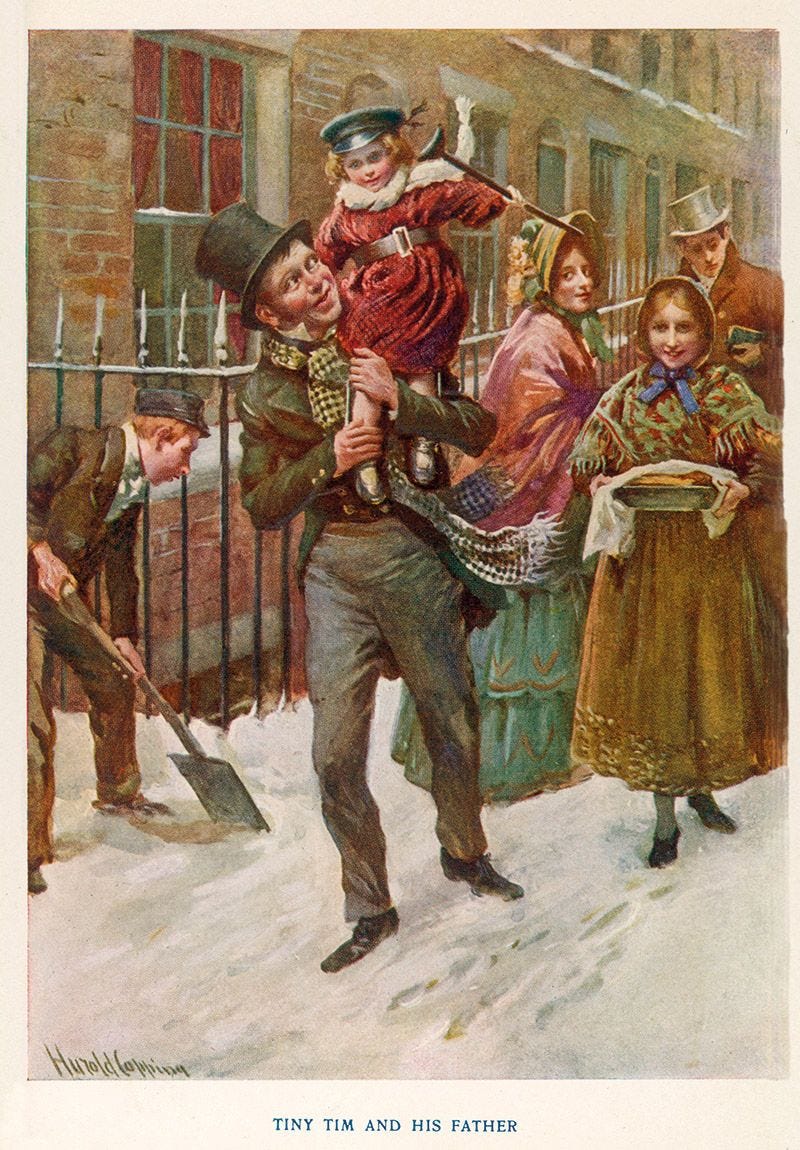
Every year during this time I either read “A Christmas Carol” or watch the George C. Scott movie based on it. While the main focus is on Scrooge’s Dark Night of the Soul, I’ve taken more of an interest in the character is Bob Cratchit, likely due to me being in a similar stage of life. Bob is a benevolent man, showering all available time and attention to his adored wife and kids. He is happy, present, content, with the sole ambition of making his dear ones feel loved and cared for. He is, as us moderns would say, a Wifeguy.
A lot of online personalities who are immature and lack life experience, would call this weakness and yearn for the days when dad would work, go to the bar, then come home late at night. The only attention he would give to his children is to punish them for screwing up. Of course, such a patriarch, built from the worst rhetoric of feminism, has been an exception and not a life goal for a decent man. For most of history in the anglosphere, the father has been present to care for his children outside of their simple monetary needs. He would also train the sons in his trade and show how to run a household of his own. If he didn’t have the trade skills necessary, when he came of age, he sent him to someone who did.
As everyone knows, Bob’s work life is far less jovial. He is relentlessly abused by Ebenezer Scrooge, who denies even basic warmth while doing the old miser’s bookkeeping. While confident and joyful when near his family, Bob is shown to be deferential, timid, and scared next to the powerful presence of Scrooge. This could be respected if Scrooge paid well, taking his lumps to build a solid monetary foundation of his own, but he didn’t.
“There’s another fellow,” muttered Scrooge; who overheard him: “my clerk, with fifteen shillings a week, and a wife and family, talking about a merry Christmas. I’ll retire to Bedlam.”
Bob Cratchit was a skilled tradesman, and fifteen shillings was a very low wage for the work he did. He was not general labor and had valuable skills in the market. Yet day after day he tolerated Scrooge’s cruelty. It’s even worse when it’s clear his family was on the edge of poverty, yet he couldn’t find the courage to either ask for more money or go elsewhere. Bob’s wife can’t help but show her justified disdain for Bob’s employer.
Scrooge bent before the Ghost’s rebuke, and trembling cast his eyes upon the ground. But he raised them speedily, on hearing his own name.
“Mr. Scrooge!” said Bob; “I’ll give you Mr. Scrooge, the Founder of the Feast!”
“The Founder of the Feast indeed!” cried Mrs. Cratchit, reddening. “I wish I had him here. I’d give him a piece of my mind to feast upon, and I hope he’d have a good appetite for it.”
“My dear,” said Bob, “the children! Christmas Day.”
“It should be Christmas Day, I am sure,” said she, “on which one drinks the health of such an odious, stingy, hard, unfeeling man as Mr. Scrooge. You know he is, Robert! Nobody knows it better than you do, poor fellow!”
“My dear,” was Bob’s mild answer, “Christmas Day.”
“I’ll drink his health for your sake and the Day’s,” said Mrs. Cratchit, “not for his. Long life to him! A merry Christmas and a happy new year! He’ll be very merry and very happy, I have no doubt!”
His weakness of not asserting himself in work life not only damaged him, but the family as a whole. One also sees this in his other negotiations, where Mr. Cratchit proudly tell his son of an apprenticeship he found.
After it had passed away, they were ten times merrier than before, from the mere relief of Scrooge the Baleful being done with. Bob Cratchit told them how he had a situation in his eye for Master Peter, which would bring in, if obtained, full five-and-sixpence weekly. The two young Cratchits laughed tremendously at the idea of Peter’s being a man of business; and Peter himself looked thoughtfully at the fire from between his collars, as if he were deliberating what particular investments he should favour when he came into the receipt of that bewildering income.
In the movie, Scrooge shakes his head at how little the young man will make. According to Gemini, five and sixpence was a very low wage for an apprentice, who would usually get eight shillings. Charles Dickens knew this when writing the book. Well-meaning Cratchit set up his son to earn less than he deserved, an in turn was training his son to accept less than his skills demanded. One gets the impression most businessmen saw Bob as somewhat of a joke.
We can compare how Bob approaches family with Scrooge’s parents, who never had a word a dialogue but through their actions showed their priorities. In Scrooge’s vision with The Ghost of Christmas Past, we read of Scrooge being the only one left at the boarding school while all the other children went home to their parents.
The jocund travellers came on; and as they came, Scrooge knew and named them every one. Why was he rejoiced beyond all bounds to see them! Why did his cold eye glisten, and his heart leap up as they went past! Why was he filled with gladness when he heard them give each other Merry Christmas, as they parted at cross-roads and bye-ways, for their several homes! What was merry Christmas to Scrooge? Out upon merry Christmas! What good had it ever done to him?
“The school is not quite deserted,” said the Ghost. “A solitary child, neglected by his friends, is left there still.”
Scrooge said he knew it. And he sobbed.
While Bob has eschewed the prospects of business success for being totally present, Scrooge’s parents have taken the opposite direction, focusing on his education while being cold and emotionally distant, forming their son into the successful but cruel businessman who made money but nothing truly enduring.
In the choice between Scrooge’s dad and Bob, Bob is the clear winner, but it doesn’t need to be so rigid. A father’s core responsibility is ensuring his children can survive in the world that keeps turning after they pass on. This requires both an emotionally stable household and connections, relationships, and a keen sense of the world outside the family sphere. While Bob is trying to manage that with his son’s apprenticeship, he could accomplish much more. This requires a stronger, more demanding outside persona. He has to be just as full of energy and present outside the household as inside. He has to be seen as a man who demands respect, not an acquiescent mouse.
Countless millennials have told their stories of being latchkey kids who dealt with distant parents who neither gave emotional support nor prepared them for the world. They told themselves they would never be like that, and vowed to always be totally present with their family. Others tell of their well-meaning boomer parents who were present but gave the world’s worst advice on how to navigate adulthood. Their parents assumed that the culture that existed in their twenties was still the norm. There was a lack of engagement with modernity that caught them flat-footed and unable to assist their struggling adult parents. In other words, they were weak parents. This is an all-too-common experience of previous generations, but that doesn’t mean going full wifeguy is the only remedy.
While it’s usually bad advice to say you can have your cake and eat it too, it’s the case here. Not only is a life outside the home reasonable, it’s necessary. The spheres of work and fraternal social groups aren’t vices keeping you away from the family, but an integral part of protecting them. No man is an island, and no family is either. The father needs to understand where the winds are blowing and react. As the son ages into adulthood, the father has an obligation to initiate him into the relationships he has maintained since he was an infant.
Don’t let the internet, the media, or your wife guilt trip you for having dinner with a business associate, going to a men’s group, catching up with a colleague, or expanding your skill set. These are a part of your wider obligations, just as important as tucking in the kids at night. While it needs to be balanced, it’s meaningful work. Those who “keep their head down” at work and allow their outside relationships to stagnate are setting both themselves and their children up to fail.
Don’t be Scrooge’s parents, but don’t be Bob Cratchit either.
Thank you for reading Social Matter, and Merry Christmas.
Though I will say some wives practically beg their introvert husbands to leave the house.
I enjoyed the Bob Cratchit reference and the overall thrust of your piece but I would venture to say that your definition of marriage as trade-off plays into the immature voices who are sloppily confronting this problem.
Never thought about Bob Cratchit in this light before. Thanks for the analysis!