


War is hell.
In the aftermath of mass deployments during the Global War on Terror, just about everyone has listened to Middle East war stories. They’re not pleasant. Even those who never saw combat came back demoralized and angry. Two guys I knew came in thinking they were protecting the country from terrorists, true believers. They returned embittered and heartbroken, maintaining love of their people but forming a visceral hatred for Uncle Sam. I talked to a therapist who said that many of the vets weren’t shattered so much by what they saw, but the sense that their own government betrayed them, planting them in a warzone they had no business being in. Then there are those who did see combat, such as one medic colleague of mine who watched his friend get shot in the throat and bleed out before he could save him. The experience so rattled his psyche he went AWOL.
There’s clear reasons veterans get such hallowed esteem. Celebrating soldiers sacrificing their lives for the nation is an indicator of a healthy society, as no culture that denigrates the warfighter is long for this Earth. They want the valiant dead to be venerated. They want men who survive their tour of duty to be honored. Most of all, they want to ensure they’re taken care of.
Few institutions are as maligned as Veterans Affairs. You are constantly inundated with stories of how benefits were rescinded or never given in the first place. You hear outrageous stories of people who clear physical limitations from combat get a pittance and end up ignored by the system. Few stories are more well-known than the story of Tyler Ziegler. This wedding photo is recognized everywhere as a harrowing glimpse into the realities of war. After getting mauled and disfigured by a suicide bomber, he had to fight the VA as well.
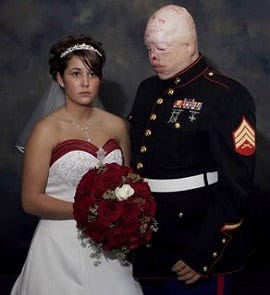
In Ziegel’s case, he spent nearly two years recovering at Brooke Army Medical Center in Texas. Once he got out of the hospital, he was unable to hold a job. He anticipated receiving a monthly VA disability check sufficient to cover his small-town lifestyle in Washington, Illinois.
Instead, he got a check for far less than expected. After pressing for answers, Ziegel finally received a letter from the VA that rated his injuries: 80 percent for facial disfigurement, 60 percent for left arm amputation, a mere 10 percent for head trauma and nothing for his left lobe brain injury, right eye blindness and jaw fracture.
He eventually got disability increased to 4000 dollars a month. Money couldn’t save his situation though. In 2013 he died of a drug overdose.
There’s another side to the VA though, soldiers gaming the VA system for non-existent maladies. The Washington Post has made extensive investigations over the last few months, publishing shocking reports of how Veterans are exploiting the system. It’s fantastic journalism, and while it’s unfortunate the articles are behind a paywall, it’s worth opening an account to get a free read. As much as I hate journalists, this series shows what’s possible when investigators aren’t partisan hacks. The articles pissed everyone off, especially the VFW and countless other veteran’s orgs calling it irresponsible and maligning. Many citizens were furious a sacred class was attacked.
The Disabled American Veterans Association stated:
That’s why we are outraged that the blatantly misleading conclusions the Post asserts could actually discourage some disabled veterans from seeking the benefits they’ve earned. Given everything we know about the importance of connecting veterans with the larger community of support, it’s irresponsible for the Post to rely on such specious and spurious analysis to support a conclusion it appears they had already reached before they began writing.
The Veterans of Foreign wars wrote:
Your article leans heavily on inflammatory anecdotes and edge cases, portraying veterans as system abusers, while ignoring the structural reality: combat wounds are not the only occupational hazards of military service. The daily grind of service — exposure to toxic environments, repeated concussions, sleep deprivation, moral injury, sexual trauma, constant stress, and grueling physical demands — leaves lasting scars. Just because a veteran wasn’t blown up by an IED doesn’t mean they aren’t disabled.
Veteran’s orgs argue that fraud cases are a miniscule portion of benefits, but the Washington Post gives clear evidence this stems from lack of effort. They don’t want to be “the bad guy”. There is still an astonishing level of low hanging fruit. For example, the article found that 5000 people with an anxiety disorder disability payout had a pilot’s license, something that usually disqualifies someone from flying.
UPDATE: An angry pilot in the comments states that anxiety disorders are not disqualifying, and flight docs tell pilots not to report VA disability status. Take of that what you will.
They aren’t finding fraud because they aren’t looking, except in brazen instances where it can’t be ignored. The clearest indicator The Washington Post was over the target wasn’t just the flak, but the inability to counter them with an argument not already answered.
Some stories were comedic in their chutzpah. There were Veterans who came in claiming to be paraplegic, then after the appointment standing up from their wheelchair in the parking lot and putting it in the trunk. You had a man pretending to be blind while consistently getting his driver’s license updated with near perfect vision. A doctor out doing errands was surprised to see a patient taking a leisurely stroll who, months before, entered his office in a wheelchair and complained of constant pain. The patient proclaimed a miracle had occurred when he was recognized. Hallelujah! Even with their total lack of opsec, it took a long time to prosecute these people.
Note all the low-hanging fruit in the article were for clear physical maladies. A much more pernicious pattern is the explosion of benefits for conditions without clear physical indicators, such as depression, PTSD, headaches, etc. The military, to their credit, has paid far more attention to emotional distress from service than times past, but in the process has opened up a gateway for people to game the system. Some disabilities, such as sleep apnea, have larger payouts than getting your ankle blown off, giving a perverse incentive to receive unnecessary payouts.
The vast majority of veterans awarded benefits for sleep apnea and prescribed treatment for it receive a disability rating of 50 percent for that condition alone, according to VA officials. In contrast, most veterans who have a leg amputated below the knee or blindness in one eye are rated at or below 40 percent.
……
“The common question I get is, ‘Is this compensable or not?’” Gurubhagavatula said, noting that some veterans ask her to test them for it. “A lot of the time they tell me, ‘I know someone who got rated for this.’”
……
“It’s the most controversial condition right now,” said Michele Colpaert, a national service officer with Disabled American Veterans, a nonprofit group chartered by Congress that helps former service members claim benefits.
“Everyone wants to file for sleep apnea.”
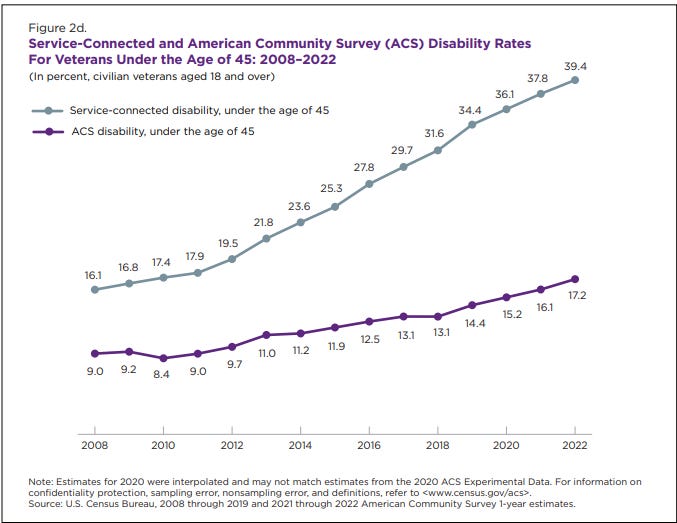
Not surprisingly, the VA has seen an explosion of disability cases, especially in young people, and shows no signs of slowing down. For those 18 to 45, the disability rate has reached a whopping 39 percent, up from 16 percent in 2008. Note this is after most Global War on Terror operations ceased. While there is a time lag between soldiers leaving the service and getting benefits, this is an astronomical rise.
The VA uses a disability rating to ascertain compensation received on a percent scale. Because of the mass bureaucracy of the VA, there is an implicit strategy of veterans requesting anything they could possibly receive. Those who know how to play the byzantine system and give the correct information in the proper format will see their requests granted. Scammers knew to get doctor’s records while on duty to bolster their case while others more deserving of attention quietly plowed through without a visit. Those who stoically suffered during service, only applying for disability when things got overwhelming afterwards, don’t have the same paper trail. Often, if they didn’t know how to play the game, the VA left them in the cold. Even with veterans who have legitimate claims, they have to act somewhat like scammers to get compensation. This is essentially acknowledged by the legal profession.
It is true that a lawyer might encourage a veteran to file broadly by making multiple claims. This response is not, as the authors crudely suggest, an attempt to “milk the system,”[8] but rather a strategy to contend with the fact that over a third of VA claims—many of them meritorious—are denied.[9]
Outside the legal realm, there are a plethora of sources available to tell you the right things to say and the right way to act, especially for unverifiable maladies like depression and PTSD. As one example, the guy running “VA Claims Insider“ details the most high-paying disabilities to apply for in a totally above board, non-scammy, just trying to give information sort of way.

He also offers “pro-tips” for what words to use for maximum compensation. For example, regarding migraines:
Pro Tip: Perhaps the single most important word that can make or break your VA rating for migraines is the word “Prostrating.” The reason it’s so important is because the 30% and 50% VA ratings criteria contain the word “Prostrating” in reference to both frequency and severity of your headaches.
If one goes to the hive of scum and villainy known as Reddit, the sub /r/VeteransBenefits gives a plethora of people trying to get as much disability as possible under incredibly dubious circumstances.
Here’s one from a guy I’m sure deserved 100% disability.
When I was knocked down from 60 to 30, I got a lawyer and called everyone I ever met in local, state and federal government. Turns out a call from a Congresswoman’s office does get some feathers ruffled.
Between that and my lawyer I got it done to 80% and left it alone until Aug 2024 when I poked the bear again, but with a lawyer holding the stick.
Got 100% without issue in 104 days.
Here’s one telling vets to declare medication isn’t helping, even if it is.
Three (and this is the part that pisses me off): Many people apparently just can’t fucking read. If the rating criteria are “panic attacks more than once a week”, but you go in there and say, “Yes the medicine they gave me helps a little, but I still have anxiety just about all the time.” All they are going to hear is that you are getting better, because YOU have not given them the QUANTIFIABLE criteria by which they can DOCUMENT that you DESERVE an increase, or to maintain your current rating.
Here’s one encouraging vets to argue they are doing worse, even if improving, to plea for an increase.
Well all three are actually true, however! We as vets need to do our homework before going for our exams: What was our last % for this condition? When was our last exam? How were we feeling then? If you are going for an increase, duh then you don’t feel better! Get with a VSO or somebody in the know, or at least Google the damn stuff. Don’t volunteer too much info to the examiner. The examiner maybe nice and friendly but they are not your buddy. Like Top used to say “LOOSE LIPS SINK TANKS”{ I was Army! }
These were found within ten minutes of perusing the subreddit. I’m sure there are thousands more blatant examples peppered throughout the group. Then you have Youtube, where countless healthy guests openly talk about getting disability and saying they deserve it, even if they never left base.
To be frank, veteran’s disability has become a massive bust out.
Some argue that one-third are denied, so there is obviously some due diligence, but the reason for this is straightforward. You need to understand the byzantine system. Many vets, likely the honest ones, are ignorant of how it works and get crushed. The most common reason for rejection is either insufficient documentation backing it up, or insufficient documentation tracing it back to their service. In other words, they didn’t have the right buzz words, authority figure, and story to back it up. While there are claims seemingly arbitrarily denied, most of these can be remedied with sufficient effort, and maybe a lawyer in tow. A lot come in thinking the VA will be on their side, only to be dealt with suspicion regarding their application. This low trust bust out makes everyone suspicious.
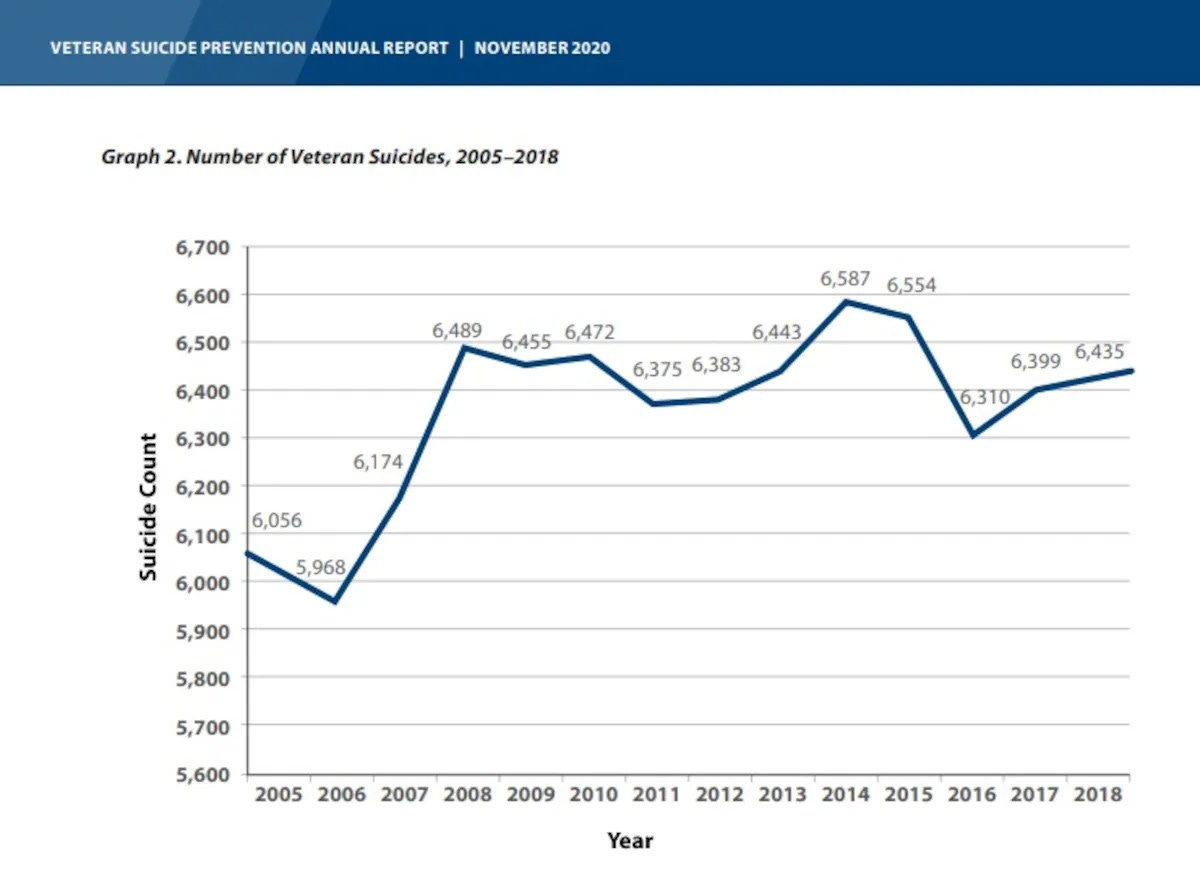
One might retort that while there might be fraud, the new emphasis on mental health is saving veterans lives, who continue to have a notoriously high level of suicides. While I wish the increased benefits decreased their suicide rate, the suicide count has stubbornly stayed at around 6500 since 2008. Even with the extensive payouts for mental health issues, their mission to drastically reduce deaths of despair has failed.
We currently have a system paying an increasing number of veterans for both physical and psychological maladies but has little to show for the massive scope creep. VA disability runs close to 200 billion in expenses, and the incredible increase in payouts has not seemed to improve the average Veteran’s life significantly. It has instead made a secondary income for a vast swath of vets who could work the system while unleashing a nightmare for vets with legitimate grievances to navigate.
As the proper buzzwords, procedures, and paperwork required for a smooth transition percolate through the internet, the bust out will only continue, especially for items like depression, where fraud is largely unprovable unless you have the guy on audio bragging about it. After all, he could be the most jovial life of the party, but that doesn’t mean he isn’t constantly tempted to blow his brains out. In the “honor system” of previous times, this would be minimized by simple civic virtue, but we don’t live in that world anymore.
The fear, of course, is that a rejection of a depression claim will doom someone who just needed a little help. I’d argue that it’s not the money that’s the issue, as it seemingly doesn’t help a lot. It might be useful to pay the bills at the first rough spot, but having no job for years is arguably one of the most effective ways to make depression and PTSD chronic. We’re stuck with a situation where money doesn’t help the fundamental issues, and an increasing number of more unscrupulous veterans are applying for disability looking for an easy life.
We are currently in a trajectory where most veterans will have some sort of disability compensation within ten years. The culture has already changed from mildly stigmatizing taking disability without clear indications of injury to being actively encouraged for anyone who feels they can get it. The honor system will further erode as veterans who don’t take disability will be seen as chumps and suckers, especially as our society degrades to a low-trust third world mindset. This will encourage even honest vets to take what they can get.
Institutions like the VA worked, to the extent they ever worked, when there was a homogenous culture of honor that eschewed handouts. As that era is in the past, with younger generations more comfortable getting handouts, the system is going to reach a breaking point. A large, impersonal bureaucracy can’t defend itself against a mass of scammers gaming the system without clear, objective standards of compensation that can’t be gamed. You can’t fake losing an arm or an MRI scan showing a traumatic brain injury, but good luck proving someone does not have tinnitus or constant headaches. Denying compensation is especially precarious when they are part of a sympathetic class.
There are solutions, but none are pleasant. You can vastly expand surveillance of those with disabilities, making random house visits, talking to neighbors, and looking at bank records. You can give more flexibility to agents in making judgement calls whether he’s really disabled. Responsibility will be moved from the bureaucracy to a single individual’s investigations. Will this eliminate fraud? Not completely, but it will scare many away from the most egregious fraud. Will it eliminate benefits for some unlucky vets who wrongly get flagged? Yes, that will happen. The question becomes how much fraud can you accept, and how much power do you give to those making judgement calls? Tradeoffs are inevitable. Sub-optimal outcomes will happen.
At another time, many men who really needed help would have the support of classic veteran’s organizations like the VFW and DAV. The VFW and American Legion are desperately trying to recruit young veterans to no avail, who have nothing in common with older generations, and the culture of hanging out in a dark bar is not intriguing to the next generation. It’s fine the new generation has other interests, but little has come out to fill this void, making today’s veterans far more isolated than their earlier counterparts.
Reading some articles regarding the VFW halls closing and the lack of classic veteran comradery, I couldn’t help but get the impression that for many in the new generation of veterans, their identity is not tied to their service to the extent of previous generations. They see it as a part of their life that is over. It was just a job they put their time in for as opposed to a life-changing experience where they showed their mettle and patriotism. While this is fine for people who left without mental or physical scars, it’s devastating for those who didn’t leave unscathed. I’m not a vet myself, so those who are vets are welcome to chime in on the current culture.
All policy has tradeoffs, and it would be wonderful to live in a world where every malady was 100% verifiable, the bureaucracy had perfect information, processes were handled the same every time, and patients were completely honest. That’s not our world though, and sympathy to those damaged by senseless military conflicts has created an opening for the lazy to get easy money and encouraged making liars of usually honest men.
A lot of this was Uncle Sam’s doing. By exploiting young, patriotic men and putting them in a useless meat grinder, the anger and sense of betrayal helped form a culture of taking whatever wasn’t nailed down. When the government treats people like expendable garbage, the government shouldn’t be surprised when the favor is returned. Perhaps civic trust can be restored, perhaps not. What we do know is, barring a huge pivot in openness and trust, some very ugly choices will have to be made.
Thank you for reading Social Matter. If you enjoyed this article, please share and subscribe.
Definitely the transition to civilian life is one worst parts about this veteran debacle. No amount of money from the government can replace the self-esteem a man gets from a good job. Not having a job for years? That would give me depression, and I've never been to a warzone. Imagine having actual trauma from combat, and just sitting around doing nothing for YEARS. Of course it will drive them crazy. Why aren't they getting hired? I almost want to replace racial affirmative action with affirmative action/positive discrimination in favor of veterans when it comes to hiring. Vets get the first jobs, and then you can hire others. This will ensure that vets can get good jobs once they are discharged.
Personal experience has taught me you are pretty correct. I grew up in a military base town and served myself. Esperit d'Corps dies the minute you leave basic/AIT. You quickly learn you either get stabbed in the back constantly and thrown under the bus the minute something goes wrong or you learn how to protect yourself by quoting regs, finding unignorable excuses (like appointments, training programs, and medical flare-ups) and getting a paper trail for everything. That low trust sense exists IN service and not just with vets and the VA. On the way out, everyone even the VA staff giving classes about how to transition out, told me to get constant doctors appointments and get everything documented. If it gets worse I can always claim it later if it's documented while I'm in service. My experience with other vets is that anyone with half a brain is at 100% or more. Otherwise upstanding and hardworking men know and use every trick and have even told me they know how to get me up to 100% if I wanted it. I also saw total leeches, who you could never believe even served if you looked at them have 100% and were talking about their applications for such-and-such program to get even more benefits.
I only saw people who weren't like this if they were <1 year in the service.
The only real case I can make for this is outside of the VA, fleecing of govt. benefits is rampant and at least more of "our guys" and guys sympathetic to us are getting VA benefits vs other welfare programs. I'd happily see all of it go, but I'd never attack VA benefits and it's waste without a larger blow going to other programs first. That's just the political reality we live in, I'm not a National Review type. I'm not going to shoot my side on principle while ignoring my enemies.
Just thought I'd share my experience and thoughts.