



Dietrich Bonhoeffer was a protestant theologian in the early 20th century. While he was a prolific writer, his true legacy resides in his resistance against the Nazi Regime, ending with his execution after being found collaborating on an assassination attempt on Adolf Hitler.
Angel Studios recently released a movie based on his life. They are a largely crowdfunded operation where people donate to films efforts, oftentimes on themes ignored or glossed over by the bigger studios. The Sound of Freedom was one such work that became enormously successful. For all their faults, they have successfully made themselves an alternative to Hollywood, focusing on Evangelicals for its core audience.
Their latest Bonhoeffer movie starts from his early childhood watching his older brother go to his death in World War I to his final hours. In a series of flashbacks, the story of his life and philosophy is pieced together. The first ten minutes were well done, but it doesn’t last. The villains were cartoonish, the secondary characters wooden and one-dimensional, and Bonhoeffer is played in an oddly schizophrenic fashion, being stalwart and confident in one scene and breaking down in tears in the next. While the movie did delve into the contradiction of the man, a pacifist who decides to be an assassin, a German who wants his own people to lose, and a man of the cloth who esteems social action ahead of prayer, it’s not done well enough to make him a sympathetic, complex character. In short, it was a poor movie.
If that was the extent of it, I’d shrug my shoulders and decide to vet movies better before wasting my time. Unfortunately, the problems with this movie went far beyond its technical failures.
Amazingly, it stirred some controversy when some of Bonhoeffer’s family accused American evangelicals of using him to promote Christian Nationalism. They complained the writers implied Biden was like Hitler and the movie was designed to encourage the right to fight against their own government.
Christian nationalists are increasingly referring to Dietrich Bonhoeffer – especially in the heated political atmosphere in the USA. We would like to urgently warn against this abuse.
Dietrich Bonhoeffer: So war Bonhoeffer nicht! | ZEIT ONLINE (Translation)
(Narrator: Christian Nationalists are not, in fact, taking inspiration from Bonhoeffer.)
When I read this article after watching the movie, I felt like I was taking crazy pills. The film was absolutely insulting to Germans and probably Bonhoeffer himself (I’m largely unfamiliar with his work), but not for the reasons stated. The movie is not in any way Christian Nationalist. In fact, it is practically a love letter to the mythology of the American regime dressed up in religious clothing, with a foreigner in the lead.
I have never seen a piece of propaganda that so seamlessly included nearly every aspect of the modern American mythos in a movie. This might sound for a movie about an ethnic German pastor fighting the Nazis, but the Bonhoeffer of this movie is a spiritual American, taking to heart every part of our modern creed.
Blacks are White’s Spiritual Superiors
When Bonhoeffer enters Seminary, he travels to New York for study abroad. In a lecture, we see a young Bonhoeffer sitting next to a black man, laughing and cracking jokes as the boring, stifling professor prattles on. They leave the halls, where the magical black man explains to Bonhoeffer that “not every Church has a steeple” and brings him to a bar where a live jazz orchestra is playing. The German, mesmerized, wonders what kind of music this is, so full of energy compared to the formal, stodgy, music he learned in his homeland. After all, Bach’s Ave Maria is nothing compared to this swinging house of music. Soon he’s playing piano with the orchestra and having the time of his life, the adventure stirring him to go to black churches where Gospel music is being sung.
Soon he builds rapport with the rest of the congregation, and the pastor invites him to dinner. There he is asked when he first ‘met the Lord’. Silly Bonhoeffer doesn’t understand the question. After all, God isn’t someone you meet, He’s a divine being that you must study by reading the proper books and studying in the proper institutions. The kind pastor tells Bonhoeffer the error of his ways and how he was saved from a life of gambling, with the rest of the table giving mm-hmms, Amens, and Alleluias as he gave his testimony. He tells how everyone must have a relationship with Jesus and see Him in everybody they meet. All of this comes as a revelation to Bonhoeffer, who never thought that way before. The scene was as stereotypical as it sounds, even including a passing reference to a black man who was lynched in the South.
Later, he and his black friend go out and look for a place to lodge. Bonhoeffer gets a room for two dollars, and his black friend goes in looking for the same, only to be told by the racist hotel owner that the hotel was full. Bonhoeffer comes to his friend’s defense, exclaiming that the man has a Crucifix behind the counter and asks for Christian charity. The owner his Bonhoeffer with the butt of his gun and they run away into the streets. His always wronged but always supernaturally compassionate black friend comforts him, telling him it’s going to be okay, giving him the inspiration to fight for a better world.
We Should Be Spiritual but Not Religious
Bonhoeffer returns home in the early 1930‘s, playing jazz pieces he heard in America, much to his family’s confusion. Afterwards, he explains how he is not interested in becoming a minister to the national church anymore, explaining how he was going to proclaim the real spirituality he learned in Harlem during his stay. His father calls him arrogant as ever in a light-hearted manner and is cautiously supportive, but tells of a dark omen clouding Germany as Hitler is ascending into power, fueled by hatred of Jews and blind Nationalism.
We move to a dark, dusty Church where his Bishop is expounding from his loft on the glories of Adolf Hitler to a congregation of new ministers. You can tell he’s a bad guy because he rants and raves like a lunatic while spittle flies everywhere. This is as subtle as the movie ever gets.
Bonhoeffer leaves in a huff, followed by his colleague where he explains how poisonous the Church has become by allying with Hitler. Later, for his first sermon, he calls out following religion, saying Jesus was the harshest for the followers of religion, and that is nothing he ever wanted. The pews might be getting fuller, but every heart is getting more corrupted by the influence of the Fuhrer in everything. The Nazis in the crowd give angry sneering faces and walk out. Afterwards many of the congregants applaud him outside. Bonhoeffer’s heroism convinces his friend to give a similar sermon, specifically calling out the Nazi menace to rapturous applause.
Note the film is very confused regarding the masses. In some scenes they are all mesmerized by Hitler, and in others they’re all secret dissidents. The message they want to convey is clear though. Institutional religion is corrupt and a detriment to real faith.
The Jews Died for our Sins
In one part, Bonhoeffer and one of his conspirators is tasked with transporting some Jews and giving a statement on how well treated they are. Instead, they make a break to Switzerland with the Jews and are stopped by Swiss Border Control, who state in a sneering, condescending tone whether Jews were really the best bribe they can give. Bonhoeffer grabs a suitcase full of cash to sweeten the deal, and the seven Jews in the truck are saved.
A lot of the movie has an overhanging message of no one doing enough to stop the Holocaust, with moral condemnations from everyone who didn’t do everything in their power to stop the persecution of the Jews. The Jews coming across as almost abstractions is another major flaw of the movie. None of the secondary characters are Jewish, and I only remember a single Jew getting a line of dialogue. The writers likely assumed enough familiarity with the subject to do the heavy emotional lifting.
World War II was Morally Necessary
As Hitler ascends to total control, Bonhoeffer learns of the concentration camps. He sees from a distance the Jews, shown briefly with yellow Stars of David patched on their clothes, being viciously herded into trucks and transported away. Angry and ashamed of his countrymen, he sets off to Britain to communicate to their clergy what he saw. The Anglicans are at first reticent on hearing what he has to say, queasy about the idea of butting into the politics of another nation. Bonhoeffer states how they had Christian duty, regardless of where they were, and an agreement was crafted to make a joint statement condemning Hitler in Germany. The statement circulates in newspapers and reaches no one other than Winston Churchill, who is portrayed in this movie as being reluctant risking going to war with Germany.(!)
What’s fascinating about the movie is it more or less explicitly implies the moral failure of Great Britain and the United States in not immediately invading Germany even before their initial military conquests. There’s an implied message that violent reprisals and war are not only an option, but demanded in the name of justice. Such logic felt like a time-capsule back to the debates over the Iraq war, where the same calls demanding military intervention to liberate nations for Human Rights was in full swing.
Bonhoeffer then decides that simple prayer is not enough and dismisses his previous pacifism to concoct a plot to kill the Fuhrer. Bonhoeffer tells his friend that while he is a pastor, he can’t just sit around and simply pray while his country is led by a madman. In truth, one aspect of Bonhoeffer which is not delved upon much at all is his prayer life. It fails, and Bonhoeffer decides to go back to Germany against the counsel of his friends. He quickly gets captured and is executed.
The Ghost of Hitler Still Haunts Us
In the movie, the Fuhrer is never shown. He is portrayed as a dark, malignant spirit wafting in the air, corrupting souls and leading people to commit atrocities. There’s a supernatural quality to him, like he wasn’t just an historical figure but the embodiment of great evil that could infect any society. Under his leadership the German people went mad and horrible atrocities were committed by men possessed by this demon, and his ghost could do the same here.
During the end credits, it explains that weeks after Bonhoeffer is hanged, Hitler committed suicide in his bunker. It then goes into the six million killed in the Holocaust, ending with a statement that the ADL has reported skyrocketing cases of Antisemitism around the globe. At this point the movie went from heavy-handed propaganda to something approaching farce, and it will be interesting to see whether the Evangelical crowds this was catered for will pick up that they’re being manipulated. Still, it managed to get worse, as after the ADL bit large, bold letters showed on the screen, saying:
Never Again
I want to like Angel Studios. My children loved their Wingfeather Saga series, a truly unique and fun adventure romp. I didn’t like Cabrini, as it had many problems with a thoroughly secular and feminist look at a Catholic nun. It also made sure to beat the viewer over the head with the one Imperial dogma this movie missed, that “America is a Nation of Immigrants”. Unfortunately, the Bonhoeffer movie was so subversive, whether intended or not, it made me angry I gave them any money at all. This sort of propaganda directed at Evangelical crowds who you are supposed to be allies with makes my skin crawl, as the Christianity portrayed in this movie is not a real Christianity, but just as fake as the Nazi Churches they lambasted in the movie.
Now, of course Churches have failed stymie the tide of sin. Anyone who lives in these strange times understands that. Yes, blacks were mistreated. Yes, Jews have also been mistreated. This has been hammered into our heads since grade school, so what’s the point of a movie like this, where one’s own people are always the villain? The self-flagellation Evangelicals are willing to inflict on themselves is astonishing, to the extent you wonder if they think there’s any positives to their faith at all. Every Jew and black in this movie are as pure as the driven snow, while the good white pastors are few and far between, preaching in their stifling cathedrals while the spirit of God is far away. It’s the ethos of a weak-willed people, unsure of themselves and hoping criticizing their own will result in a pat on the back by outsiders whose forgiveness and admiration they want, but never receive.
What’s the point of filming more demoralizing propaganda for your audience? The Regime has been throwing this in our face for generations, and Evangelicals respond by willfully taking time out of their day to condemn themselves some more.
What’s especially ironic about this movie is how it’s guilty of the same crimes it rails against in the movie. It exclaims how the Church was corrupted by The Nazis to the extent that the end credits showed a written apology from the German Church in the aftermath of the war, explaining how they did too little to stop Hitler. Yet the movie itself extols the myths of the American Empire, from the morality play of the Civil Rights era to our international wars in the name of Democracy and Human Rights to the strange exception we make to Freedom of Speech, de-facto banning anything deemed “Antisemitic”.
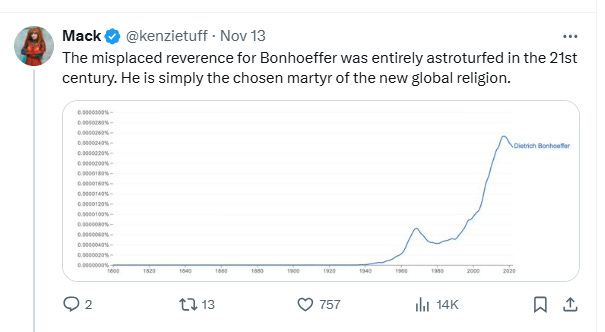
The reason movies like this are made is not because they’re challenging, but because they’re literally the safest bit of media that can be produced. The average Churchgoer fears, more than anything else, to be seen as the bad guy. They support and watch banal tripe that is “safe” religious, either by denigrating their own religious tradition as is the case with this movie, or by having a character “convert” in approved ways. They will watch entertainment where the racist sees the error of his ways, the thief stops stealing, or the gossip stops ruining people’s lives.
What they are not willing to fund, or watch, are movies where a flaming homosexual converts and lives a life of celibacy, or a man fighting relaxing divorce laws, or a tragedy where a Polish Catholic community gets ethnically cleansed in the name of Civil Rights. Such stories are verboten by the regime, and just like the Church in Germany bowed to the Nazi mandates, the modern Church will not question the power of the State by creating its own dissident stories. It’s cowardice pretending to be courageous.
I can’t recommend this movie as anything else but a teaching tool to show how people can be blinded by their own ideology. Many are so intellectually captured they will import all their implicit values as an American into a mid-century German man with no cognitive dissonance. It’s the sort of smug, self-satisfied, ignorant view of the world that would make Goebbels think that maybe the propaganda was taken a bit far.
In short, don’t watch it, don’t support it. Leave that theatre seat empty and watch something better.
Thank you for reading Social Matter. As always, if you enjoyed this rant article, please consider subscribing and sharing.
Back a few years ago the Evangelical blogger Dalrock used to roast the Kendrick brothers for their movies along the same lines. There’s something about the Protestant rejection of tradition that leads to their art always having an earnest presentness, as if the whole of Christendom had always been more or less a bigger version of the crowd at a suburban megachurch.
Well. . . two things here.
First, Bonhoeffer does appear to have been genuinely and significantly influenced by his time spent in a black Baptist church Harlem. I haven't seen the movie, and given the rest of what's going on there I don't doubt that the filmmakers smuggled in a lot of 2020s-type thinking about race. But they'd have been doing Bonhoeffer a disservice if they didn't depict this influence as a big deal.
Second, Bonhoeffer was an early-twentieth-century German Lutheran. He may have been slightly more theologically conservative than the majority of the German state Lutheran church at the time, but that's hardly saying anything. His theology was far to the left of anything that might be realistically described as "Evangelical" in the North American sense. He was a universalist, for crying out loud. Pitching Bonhoeffer as some kind of "Evangelical" martyr was always difficult, to the point that any such narrative that takes Bonhoeffer at all seriously is going to end up making some rather odd moves.
I'm not trying to defend the quality of the movie--again, I haven't seen it--but to suggest that if the movie ends up being a paean to the Postwar Consensus, that might not be a skinsuit at all. It might just be the logical extension of Bonhoeffer's own theology.