


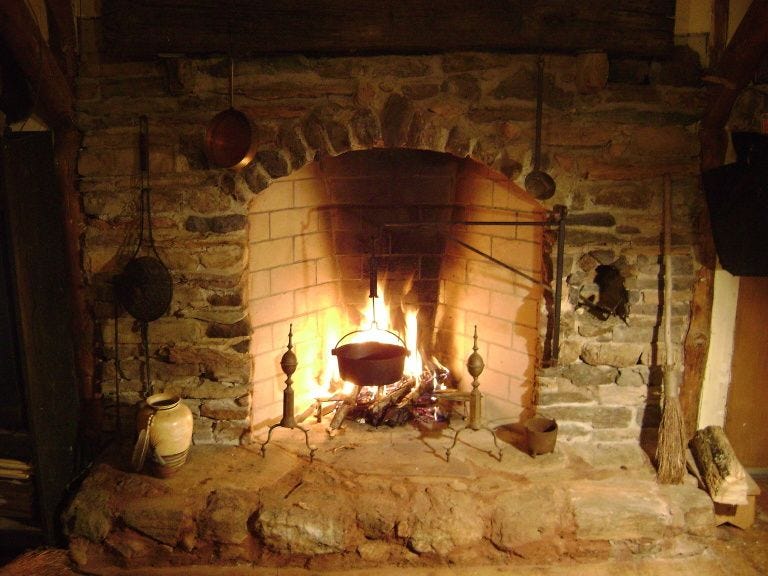
The sacred fire was the Providence of the family. The worship was very simple. The first rule was, that there should always be upon the altar a few live coals; for if this fire was extinguished a god ceased to exist. At certain moments of the day they placed upon the fire dry herbs and wood; then the god manifested himself in a bright flame. They offered sacrifices to him; and the essence of every sacrifice was to sustain and reanimate the sacred fire, to nourish and develop the body of the god.
Coulanges, The Ancient City
It’s been a tradition for forty years to go camping with my extended family. Decades ago, when I was six, I remember retiring to bed in the camper as the older kids and adults stayed awake, listening to raucous banter and jokes I didn’t get as the uncles got a light buzz from their brews. Paired with the merriment were short, witty comments from my grandfather. He suffered a head injury during World War II, leaving him with a mild speech aphasia. His comments were always sparing, so everyone listened.
I would always be the first up in the morning, looking over the rising mist over the lake before the sting of the morning chill made me grab a sweatshirt. I would look at the fire, once a bustling inferno, now white with ash. I would poke it with a stick seeing if some hot coals survived from the previous night. On success, I would grab some dry leaves and small sticks and try to get the fire going. Some days I would get it roaring again, some days not, the uncles getting out the lighter fluid and starting it the easy way.
Once the fire got going, we would congregate to cook breakfast. My grandfather would always be watching the flames dance among the air, its rising and ebbing having a life of its own, those moments in the woods being more enthralling anything happening in the outside world. At some point, every year, he would say the same thing.
“There’s nothing better than a good fire.”
My grandfather is long gone, though the tradition lives on, though only surviving by a thread. The uncles are getting old, reaching the twilight of their lives, and my young relatives spread throughout the country or had no male progeny to keep the tradition going. The tradition is left with myself, my father, my sons, and a single cousin with his two older boys and his dad. I still cling to it, hoping to reinvigorate the ritual, maybe eventually in a different form. Like many of the last couple generations, while I was part of a loving family, we had a dearth of true traditions able to be passed down.
It’s a common, sad story of generational drift, the once tightly coupled families who lived ten miles from each other, sharing the same faith, traditions, and rootedness losing their unique, parochial identity and sense of place within a generation, becoming infused mass society. The little rituals of past ages, bereft of new fuel, burnt out into white ash.
The decimation that I’ve seen in my life has been monumental, and while my childhood had its share of divorces, inter-family rifts, and deterioration of values, there was still that core of belief, of identity, that differentiated my extended family from general culture. Within two generations, the values of my grandfather barely exist anymore in his great-grandchildren.
While the fertility crisis is well known, an equal tragedy has been striking down the bonds between parent and child. Every week another article springs up describing dealing with a parent that is narcissistic, toxic, abusive, take your pick. You have the other side with parents who never see their grandchildren, confused by what great wrong they committed, befuddled by the new wave of morality and social convention that has left them behind. Socially, such separations were a rarity, as it used to be the children in constant fear of destroying the family honor and being cast out into the darkness. Now it’s the parents who often live in fear of ostracism.
There is a lot of explanation for this drastic change. Some talk about woke politics eating the brains of their children. You hear stories of boomers who spend their twilight years spending their retirement on expensive cruises and caring not one lick about helping with the grandkids or giving a proper inheritance. Boomers complain of their children being selfishly overdemanding and controlling. It’s sometimes as simple as the children not wanting to deal with parents who were never even around when they were younger, being essentially strangers who lived in the same house. Maybe it’s a toxic wife who whispers poison in her husband’s ear. Whatever the reasons, it’s a tragedy.
Modernity has created an environment of atomization unseen in human history. While many argue this sort of unparalleled freedom is a boon for man, the truth is it’s a luxury good, and not a beneficial one. Older societies did not have the option of living a purely transactional, mercantilist life. Those who tried to make it alone, died. The idea now is to raise your kids, then giving them free rein to seek their fortune. The core tenet of parents has transformed from ensuring one’s bloodline and values were transmitted to, “I just want you to be happy.”
Ancient man lived by a far different set of rules. Their religious beliefs demanded proper reverence for their ancestors, going as far as to say those who failed to give their dead ancestors food and sustenance doomed their forefathers to walk the earth as a raging ghost, causing countless maladies on the hapless living. He would be born into a family and be initiated into the religious rituals to their household gods over a hearth that never extinguished. The man would grow into adulthood, securing a wife. Upon marriage, the father would literally sever his daughter’s relationship to her family gods. Through a ritual of fake abduction, the young man would take his wife into his new home, take her to his hearth, and initiate her into worshipping the gods of her husband, performing the same ritual as his father, his father’s father, and down the line.
Through it all, the flame of the hearth danced and weaved. If the hearth was ever extinguished, it was the same as the family line being destroyed. The hearth was life, and the root of the household religion. Its secrets were known only to the family and those kin who inherited the same rituals, and it was deemed blasphemous for an outsider to even witness them. The whole of familial spirituality, with all its history and obligations, were the sole property of the man of the household.
They would build a family, the man requiring a son to ensure the rituals will be followed for another generation, so that in his death he would have offspring who would continue the rituals to feed and sustain him. An important aspect of the ancient family was that the highest bond was not blood, but the bond of the family religion. The father, the high priest of the household, could adopt a son if he did not have one of his own to continue his line. He could also banish a child from the hearth, thereby casting him out of the family. The relation of blood was useful only because it gave access to the family religion, a means to an end, to be one of the congregation under the high priest of the small home.
The father took the mantle of the high priest of the family, the owner of all property and total judge of the household. In extreme case, he could lawfully kill his wife or children for transgressions. This massive power came with the enormous responsibility of ensuring the family unit survived another generation, that the ancestral religion continued for generations into the future. Still, the father was not a dictator. He was bound to the code of honor that lied in the hearth, his ancestors from time immemorial controlling the family from the grave. If the father transgressed his ancestors, either through personal faults or through improper ritual, he had to ritually cleanse himself to enter the space of the hearth again. For all his power, the moral code demanded the most from the high priest.
At its core, the property, rituals, authority stemmed from patriarchs far under the earth. The father was not allowed to sell the property, it being inherited by the first born at the death of the father. The son, being the new high priest, then had dominion over the other sons, daughters, and his widowed mother. There was no money transaction to be had, the nature of the ritual planting the son in a plot belonging to the family for generations, overseeing the sacred graves. Familiar obligations were all-encompassing, the path of the first-born son largely set the second he was initiated to the rituals. Only tragedy or great dishonor would bar the way of the son being just like the father. The younger sons, for their part, could stay in the family plot, be adopted by a family without a son, or band together with other men in similar circumstances to ride out and find land of their own.
This cultural makeup sounds harsh and totalitarian to the modern ear. Yet this system maintained a people for centuries, giving a sense of stability and purpose to these ancient peoples. It created traditions and pieties that transcended the physical realm, giving the living spiritual nourishment.
The world where inherited trades, the long generations of patriarchs teaching their progeny the arts of mastery, have evaporated. The idea of a common religious ritual for growth into manhood, marriage, and funerals, have fallen to mass secularization. The banality of high School Graduation has replaced rites of passage into manhood. Individualism has fully replaced any talk of family honor. Friendly, comfortable, ad-hoc vows by the sea have replaced the solemn vows inside a Church wall. There are no longer prayers for the dead, but a celebration of life. Family cemetery plots owned and maintained for generations have passed into throwing ashes to the wind.
Conservative pro-family propaganda has always had a kitsch quality to it. Some of the popular memes come from 1950’s artwork, showing a happy dad playing ball with his boys in the back yard while food is grilling, grandpa sitting on a chair, laughing at the ruckus as the children tussle and play. In progressive circles, this meme gets flipped and the happy family is assumed to be harboring dark secrets, the immaculate outward look of the parents and children are assumed to be hiding all sorts of perversions and trauma. Vitalists, for their part, point and sneer at the adults who sacrificed glory and will to power for a few kids playing in a small yard inside a picket fence.
There are other memes along the same line, like a family in fancy Sunday wear going to Mass, right up to the wife-jak and husband-jak sitting in the car with their screaming kids in back. There’s a disarming wholesomeness to it all, the idea you can have meaning by giving yourself to the family, do woodworking with little boy, love your wife, and have a little castle of your very own. A nice sentiment, but at its core that’s all it is. Sentimentalism.
After a few years of Marriage, I began to realize how much deeper my obligations went. The thought that I had a duty only to my immediate family and living parents was grossly inadequate. Countless generations of ancestors, of whom most names I have never heard, toiled and suffered so I could live. My Grandfather was an orphan at four and his older sister, only sixteen, held the family together. My great grandfather toiled in the fields until his early death, and my great-great grandfather immigrated from Germany to escape Bismarck’s Kulturkampf so the family spirituality could be sustained in peace. Every generation had perils to be overcome in order to live for another generation, and now it’s my turn.
Usually when someone thinks of their religion, they’re thinking of the grand structure in the middle of town, or maybe the massive conference hall where worshippers celebrate every Sunday. In the domestic home, devout Catholics say their rosary, devout Protestants read their Bible, and Muslims do their prayers to Mecca. As the household religion dwindled, the universal religions took their place, each with their delegated forms and rituals of worship.
The enormous success of these religions in ages past succeeded because they could integrate both the personal and the more ethereal. Christians prayed to the Holy Trinity, the Lord and Master of All, but also the Lord who showed Himself to their particular people throughout history, and even through the generations of family that came before them in All Souls Day. My German ancestors had a special devotion to St. Benedict, and every family in my town had their own stories of faithful and heroic ancestors who toiled, fought, and persevered.
The particulars of the domestic church made way to far more abstract and universal pieties. The once universal reverence for one’s ancestors has rotted to the extent many children never even know who their grandparents were. Pastors now have far too much say in the domestic church, largely usurping the household priest. Extensive laws are promulgated to protect spouses, and through their existence and good intentions become a mechanism for prying into the sacred home and enabling its dissolution.
If the practices of our ancestors have taught us anything, it’s that blood relations are not enough for loyalty and cohesion. As can be seen from modern times, even the sharing of the same ancestry will not keep a family together. The genealogical relationship of a father to his children is not sufficient to keep the generations thriving, and countless lines are being extinguished.
There is the missing religious element, the unique identifier that connects the generations together in unique rituals, observations, stories, and pieties that exist solely within the family. They are the stories of one’s ancestors, what they stood for, and who they fought. It is the story of spiritual struggles, hardships, and perseverance that give the fuel for the next of kin to thrive. There are the particulars of one’s own personal existence, a gift that no one else in the world has, a true identity that can never be taken away that is the groundswell to believe that not only is one’s own life worth living, but that the grand story should continue on through countless generations to come. It does not supplant the religion of the people itself but grounds it, makes it personal, and makes it real.
Sentimentalism through 1950’s artwork is not going to reinvigorate the life of the family. Nor will the wholesome visages of your typical family television programming or even lighthearted family events at your local church. While there is nothing wrong with these, what is missing is something more fundamental, more ancient, walking in the realm beyond mere mortals. The family High Priest has an obligation to those who came before, making sure their stories are known, ensure they get their due reverence. Whether these are special commemorative rituals done in the family or just making a point to bring them up in day-to-day living, you must allow their spirit into the home.
Your ancestors still live, and while I don’t believe they become raging demons if forgotten, I do sincerely believe they watch over those who continue the sacred obligations done through the generations. They will hold out their hand to assist you if you have the humility to ask. And those ancient spirits will embrace your children, your children’s children, and so forth, giving of themselves, even in death, to those who keep the flame alive.
Thank you for reading Social Matter, if you enjoyed this article, please consider subscribing and sharing.
There’s much to be learned from “The ancient city” and to a degree implement much of the wisdom within that book in our modern life, Coulanges made a great job of recognizing these customs of ancient European peoples(with great emphasis on the Greeks and romans).
Great article.
I would also like to give my input on how important it is to recognize one’s ancestors and the debt one owns to them:
My grandfather was a fairly devout Catholic (and my grandmother too but that’s not about her, great grandma overall still) still is I suppose, although my family was and still is of Traditional Catholics, I myself am fairly devoted to my faith, but the point here is to talk a bit about how my grandparents raised me(parents had to work a lot you see) specially my grandfather: when I was 6 he gave me a bow and a few arrows and told me to go into the woods to shoot something and be back before dark, he taught me how to make a fire, gave me my first knife, we would go fishing sometimes despite the fact he was terrified of large bodies of water due to a episode where he almost drowned in a river during patrol when he was in the military, he was saved by a native to whom he gave a proper uniform as a gift of gratitude(without any medals or insignias of course as he couldn’t give those to civilians), he taught me fencing and insisted that I learned judo from a young age, and after days full of these adventures, that surely must have been taxing on his aging person, he would sit me down by the hearth while my grandmother made us tea from her herbal garden and baked us bread to serve with butter and eggs, and while we waited my grandpa would read me the Iliad, Odyssey, Aeneid, Lusiad and the Bible, he would tell me about how the Bible was the tales of our religion and our God, the Iliad the tales of the greatest men of pagan times, the odyssey a reminder that the most important thing is your home and your people, the Aeneid the most remote story of my ancestors by my fathers side(Italian) and how the Lusiad was the great epic of the heroes of the people of my mothers side of the family(Portuguese/lusitans) he taught me how to read and write with those books.
He also passed down to me all family lore from his side of the family, all the story of Portugal and Iberia, how and why we came to South America, he told me tragic tales of how our lineage was purged with many of the traditionalists by the Marquis de Pombal, how our lands were seized and how the survivors fled to Spain before changing their names and returning to the motherland, attempted to resume their lives as better kings came to rule the land, he told me about how they were always faithful supporters of the kings, how they became Forresters and rangers and later administered 70 hives of bees as they dedicated to apiculture,he told me about how the republicans, anarchists and socialists burned our bee hives, he told me about how my ancestor at the time(great grandfather) cried in despair at the cruelty of what was done to the bees he so carefully and lovingly tended to since he was young, he told me of the world wars and how Portugal ceased to be a kingdom and although he spoke well of Salazar he told me that he was no king, and how my ancestors moved to South America for a better, simpler life, how they bought their farm, how hard they labored in it, how his father joined the navy and he later joined the air-force and later intelligence, he told me how he met my grandmother in a train ride, he told me our history and the weight of each ancestor he cited weighted on me, I felt admiration and love for them, I came to understand how much I owed them and how much those that come after me will depend upon my choices, it was a very important lesson for a young me.
So yes, I think it is important to preserve family traditions, sorry if this comment was too long, and also for any grammar mistakes or “Reddit spacing”.
In Latin it is called "focus"...