



History is a strange field of study, as it can take on a life of its own long after the events have transpired. Heresies abound. Know then that it is the year 10391. I, Moneo Atreides, under the direction of our gracious God Emperor Leto II, was tasked as court historian to document and analyze all existing artifacts regarding the war against the machines, called the Butlerian Jihad, and its aftermath. While the full report will only be available to the high-priests, Leto II, in his divine wisdom, bestowed upon the general population this general summary that will help to divine the road that has led to his glorious “Golden Path”.
Various historians have given different timelines to the dawn of the “thinking machines”. Some attribute it to the “machine revolution” of mass factories and the growth of technological techniques in human operations in the 19th and 20th centuries. Some attribute the beginning of the era to the early 21st century, just before the Mad Emperor1 dropped atomics and instigated the World Upheaval. I subscribe to the former, as it is now well-understood that one does not necessarily need machines to have a machine-mind. People succumbed to machine slavery long before the first robot appeared.
In the 19th century, the machine revolution had a strong hand in dismantling many traditional practices as instant communication, easy transportation, and a mass propaganda apparatus homogenized countless cultures under a monolithic umbrella. Scaled production and sprawling factories induced labor from farmers and other earthly professions in the hinterlands. With time, material gain increased, but was earned at great cost even then, as the same techniques that produced chairs and textiles at scale were used to create bombs and soldiers that led to two great 20th-century wars. Yet those who refused technique found themselves subjugated by nations who fully utilized them. This short-term advantage in embracing a corrosive and deadening ideology led to disastrous effects later, but those who resisted were destroyed.
Yet few saw the imminent dangers, even after mass slaughter from aerial bombers and armored vehicles. This peacetime’s form of artistic expression, known as “Science-fiction” overflowed with well-trodden, silly tropes. They had human-like cyborgs, ultra-advanced societies with near-magical scientific tools to explore the cosmos, and a powerful, bureaucratic world-government of varying levels of competence espousing the religion of the era.
This religion, called “Liberalism”, was supposed to serve as a buffer against religious fanaticism and charismatic authoritarianism. It served as a religion without the trappings of religion, and its historical documents are rife with nonsense slogans like “separation of Church and State” and “the voice of the people”. Their religion rejected a formalized state religion, all the while being beholden to pieties with harsh legal and extralegal penalties if broken. It was a clever deception, but thoroughly unsustainable, and the edifice collapsed after only a few centuries. Still, there was the intuition in the 20th century that societies of the future would function like they did then on a larger scale.
This isn’t without merit. From their standpoint, it stood to reason that mass democracy conquered monarchies, human rights replaced antiquated religions, and liberalism dissolved various forms of tribalism as part of a continuing evolutionary process. If one assumed the flow of history continued uninterrupted, it would continue to be more of the same.2
Yet the river of human history never flows straight, nor does it stay constant as the banks erode and shift over time, and our current reality is a subversion of these expectations. Instead of a technocratic confederation of allied nations under the same umbrella working together peacefully to solve problems, we entered a world just like the past. Trickery, manipulation, and subterfuge are still a reality of existence. Instead of robots doing their heretical calculations among ships with warp drives, we eliminated them. Instead of an abstract society based on nonsensical human rights, societies are stabilized the way they always have, through religious zeal. One reads these old historical documents and wonders how a people could be so naïve as to assume technology would change man’s nature. Our reality is not dystopian, nor is it a society rejecting all technology. It is the old, natural, and human forms of great houses and disputing factions. Our social forms, though more complicated, could still be easily understood by a soldier of the Roman era.
Instead of a future of metal, we created a future of ecology, dancing with Nature’s relentless guile instead of fighting her. We understand that no matter how advanced a people become, Nature remains an unconquerable adversary. It’s a world populated by actors that don’t solve problems through technical processes, but deep instinct covered through relentless training and millennia of eugenics.
The old visions failed to capture parries within parries, plans within plans, the schemes of hyper-aware savants in a deadly dance for power. Our future felt too strange for the old bards to comprehend in their limited views of the cosmos; forcing it into their constrictive box removes its alienness.
With the rapid ascent of Artificial Intelligence, the seeming victory of Western liberalism, and mass material progress, they believed they were on course to a future of inscrutable technologies, post-scarcity resources, and a stable, democratic world-government. In contrast to the current reality of a single spice on a single planet every interplanetary guild is on a quest for power to control; they were on the cusp of having no wants of all. The growing pains of the machine revolution were assumed to be over, and a new era of prosperity was on the horizon. Such optimism came at an awful price3.

Catalyst for the Jihad
In our holy books, the details of the Butlerian Jihad are purposefully vague4. The mythology of the cosmic struggle is encased in only a few lines of The Orange Catholic Bible:
Once men turned their thinking over to machines in the hope that this would set them free. But that only permitted other men with machines to enslave them. Thou shalt not make a machine in the likeness of a man’s mind,
Theories have abounded, with one camp declaring the robots rebelled against man, leading to a great war that almost annihilated everything.5 Others believe it was a spiritual struggle, with the population rebelling against being controlled by machines. While this mass rebellion is implied by our religious works, our studies have concluded that the rebellion was secondary, used as a tool by natural aristocrats whom machines were impeding from letting them engage in forming history.6
Since the machine revolution, material progress reached heights unheard of, but human beings found themselves at the mercy of a sterile existence. Local shops closed in favor of mass scale, rights like freedom to meet with those of similar backgrounds for business and commerce, once taken for granted, were curbed to reduce economic friction. Laws and customs were flattened to allow the technological machinery to work universally. The effects of mechanization increased human freedom through travel, communication, and longevity, but at the expense of homogenization and a subtle slavery of mind.
In short, the cost of this technological sophistication was the domestication of the population. What was once the realm of the individual turned over to bureaucratic control, where process and procedures replace relational messiness. Disputes were forced into resolution through increasingly impersonal mechanisms; local leadership was bought out and their infrastructure standardized. Elected figures like mayors became figureheads for larger powers. Instead of autonomy, people become subjects to an impersonal system with mandates from above with no redress to a single person. This bureaucratization, called “managerialism”, is a system, a form of computer without silicon, necessary for the functioning of a complex and wholly unnatural mode of being. Mechanical processes, “best practices”, and inhuman Human Resource7 managers were attempts to remove the human from an organization in service of standardization and predictability. Violence became the sole domain of a judicial system that punished those who defended their property or even their own person.
Homogenization from mass communication and the brute military supremacy of the American Empire spanned the globe, becoming what is commonly seen as the first world government, short-lived as it was before the Russo-China Rebellion, the World Upheaval that moved the globe into a multipolar structure. They could travel the entire country and stay at a hotel indistinguishable from the one back home. A man of the 21st century could go to a resort in a far-off country and be inundated with a similar to what he had back home. The business of money and optimization is an all-encompassing beast to feed an ever-more-sophisticated computer world.
While there are small subsets in the technological frontier that mimic the wilder days when new Earthly settlements were possible, once a technique in an industry becomes established with a firm foundation, choices evaporate.8 Creativity and risk-taking become verboten, and the well-defined and predictable get precedence. Even building your own home in an unapproved way would make architectural priests prosecute you. Holistic and ecologically sustainable forms of food production were shut down by a supposedly ecologically conscious government because its form did not match technical documents.9
One does not even need to have machines to act like machines, but the ascent of AI only accelerates this malaise. One can speak openly to those across the world, you can form your cult, but an ever-present algorithm will determine your success. An ever-present surveillance panopticon assures that not only don’t you physically harm others, but that you act in a way amenable to a machine-based society. It subdues human creativity to a sterile, easily transferable technique. As a culture veers towards hyper-optimization above all else, it loses its sense of telos and acts only to serve the ever-increasing complexity of the machine world.
Temples called “data centers”10 were developed across the countryside. New, advanced military thinking machines forced everyone to build ever more complicated ways of facilitating war to ensure short-term survival. Fertility collapsed as the population failed to reproduce due to being relegated to being base animals in a cognitive cage. The process continued long after their art became sterile and decrepit, their food tasteless, and their lives constantly monitored. It continued as a force of its own long after even material benefits declined. The cult of technology became a means to itself. Still, the multipolar states were forced to become like machines in fear of conquest by those who embraced the seemingly unstoppable machine-life.
In order to stop the madness, something deeper that temporal force was necessary. A new form of mind needed to develop that even mass martyrdom could not dissuade. It needed to be living enough to upend life and accept mass hardship to achieve. As the human spirit collapsed into lethargy, a new will to act upon the world in all dimensions had to form. The relationship between man and technology had to be overhauled. It couldn’t be simply state policy; it had to be a religious awakening.
Flesh is Stronger
The ancient philosopher Thulsa Doom, in one of the few existing treatises from the Hyborian era11, spoke of the role technology should have in the hands of man.
Yes! You know what it is don't you boy. Shall I tell you? It's the least I can do. Steel isn't strong boy, flesh is stronger! Look around you. There, on the rocks; that beautiful girl. Come to me my child... That is strength boy! That is power! What is steel compared to the hand that wields it? Look at the strength in your body, the desire in your heart, I gave you this!
Technology, whether it’s the sword or a spaceship, is meant to make manifest the will of the user, not to give ease or comfort. Thulsa advocated hardship for spiritual growth, the primacy of will, and power being based on organization and charisma before brute force.
He realized the core component of a society, for good or ill, was its religious values. He also understood that any attempt at mass movements had to offer more than material gain, it had to have a supernatural purpose, a banner that went beyond material luxury.
Man’s will to survive and grow is built into his very cells upward, the culmination of countless generations who produced offspring. The rest are forgotten by time. Courage and indomitable will is not something possessed through easy climates and a life of robotic living, but hardship. Even in the workings of the mind, every great thinker struggled with the consequences of his discoveries, the riddles of Nature he unblocked, only to be hit with an even more complex puzzle.
Before I continue, I want to again request your financial support for our emperor, Leto II, by paying a tax small contribution to ensure the continued prosperity of our great empire and get the word out on this important document. Paid subscribers get additional important treatises on great ancient works as well as resilience in the Gom Jabbar test.
All of this comes from an intuition of Nature that goes deep into his blood. It’s in the genes he carries, the primordial memories inhabiting his mind. Countless little instincts and subconscious reactions form the human being, closed off to machine reason. An infernal machine will process countless amounts of training data and model itself to ape a human, but that model lacks the instinct of man stemming from his uninterrupted connection to deep earthly instinct. Every synapse activated, every hormone created, every cell reproduced is part of an irreducible dance of what makes a human human.
The greatest heresy of the machine age was the idea that the organic was weak while the machine was destined as the superior form. Countless heretics of this era, like the infamous demon known as “Samuel alt-man”12 proscribed thinking machines would surpass humans in all realms, delegating humanity to, at best, spectators of its own future. Mankind’s telos from the chief priests of this era preached human slavery to the new gods of silicon and titanium. While we failed to surpass our natural limitations, the machines could ascend past Nature itself. Nature had other plans.

Nature’s Revolt
Man had an ally in Nature. While she is a harsh judge to her subjects, she is more vicious to her rebels. As the ever-present drive for efficiency, atomization, and frictionless interaction of countless parts hit roadblocks, the response was always the same: More optimization, more complicated techniques, man relegated to more rigid modes of being. A thinking computer can make a machine that acts like a human, but only a human has that lineage. After the triumph of technique, instead of these machines elevating humanity, it limited him.
Problems of efficiency demanded more silicon. The complexities of human interaction demanded more complicated laws. Non-conformity in the wealthy upper-strata capable of managing these complex networks became impossible, and a chasm developed between those who were subsumed by the machines to their base desires, those who lived a constricted existence to serve the increasingly complicated rules necessary to keep the technocracy running.
The technique that served so well in times past became an albatross around their neck. Scientific achievement plummeted as academic papers proliferated. Man became less educated as they attended more years of schooling. Competence evaporated as credentials became ubiquitous. As the natural forms of personal honor, social trust, and cultural traditions evaporated under the acid of efficiency, so did the mechanisms necessary to keep it running. Cheating ended up being a more efficient way that studying to get ahead. A society where the average man thinks stealing is morally permissible will overwhelm even the most technologically advanced law enforcement apparatus. The ascent of talking machines, deemed Large Language Models, formed an elite class trained to talk like these talking machines, forming a destructive self-feedback loop. On paper, the machinery worked better than ever, yet human beings outside the techno-class saw the deterioration. Nature closed the eyes of the technocrats to the resentment brewing in a new elite class.
Among the lower classes, empty leisure bred the most destructive emotion in all of humanity: Boredom.
Robert Nisbet, a philosopher of this era, stated:
As Gabor further observed, man’s central nervous system evolved over millions of years, during which alertness, vigilance, and aggressiveness were necessary for survival. Being necessary, these traits were bound to enter the very essence of man’s nervous system. If, as is widely assumed by biologists, few if any significant organic changes have taken place during the past five thousand years, there is certain to be something of a traumatic effect on most people from enforced idleness, unwonted leisure, security from predators, or relative abundance of food. Boredom is in sum a response of the human brain to conditions alien to its long formation.
Boredom, that most pernicious of sensations, is a silent malaise that slowly consumes. Man will lay waste to a civilization to escape its maw. The collaboration of a restless new elite and an aimless lower class formed the perfect alliance. The new elites wanted the old elites displaced; the lower classes wanted to burn everything down. Nature smiled on the vitalistic new elites and laughed at those who thought they built a lasting society outside of her grasp.
The jihad was a multi-generational war of attrition. Those inside the mechanical system put their faith in machines modifying their children’s genes, hoping to create humans better equipped to serve the machine. Smart and docile, it was a cruel irony they inherited a world that rewarded instinct and cunning over analytical minds and agreeable demeanors. As algorithms limited communications, subtle forms of coded speech proliferated. As currency became more restrictive, black-market trading took over official economies. As violence became more restricted, petty vandalism and disruptions constantly impeded the machine society. The machine world erased human cultures, but man’s barbarian within reawakened.
It’s inconclusive how much the revolution was instigated by genetic pressures, where those cognitively resistant to machine slavery reproduced at a higher rate, or by social pressures due to a deteriorating quality of life. What started as minor disruptions, cutting power cables, home-grown EMP’s, and signal scramblers, soon wore down infrastructure. Rural mobs pillaged data centers, automated mail-delivery vehicles were overturned, and a lack of will to repress the minor rebellions led to greater ones. Supply chains were maximally optimized, ignoring even basic redundancies. Even a ten percent disruption in supply chains caused a cataclysmic feedback loop. In Russia, China, and America, the rebellion spread in perfect alignment13, like a great spirit took over the heart of man. The cathartic will to destruction went unabated, and local warlords took control as the brittle logistics networks collapsed and the world fell into famine.
The Great Purification
It is estimated that the world population decreased twenty percent in the next fifty years. This, in addition to a century of low fertility, brought the population to four billion. Starving city dwellers flooded out to the countryside, and the machine state was ground to dust. In the surviving literature, little can be found regarding a lament of what was destroyed. As decrepit and harsh life was, either no one wanted to go back or those who wanted to resurrect the old order were eliminated.
Not that all technology was condemned. Small metal shops, building simple motors and tooling, remained running by human workers. Any machine with a whiff of agency, however, was scrapped. Anyone activating a defunct thinking machine was summarily executed. Any warlord who tried to harness thinking machines was invaded and his entire tribe exterminated. Within a decade of instability, a powerful religious taboo formed and spread through the generations. There is some debate whether the shift represented a real shift in sentiment, or whether the ban on thinking machines was a cynical ploy by local warlords to keep power. While more debate can be had, I side with the former.
With time came stability, and local warlords evolved into hereditary houses. While conflict still erupted, commerce and trust formed again. Even more interesting, local bands of like-minded individuals started forming and specialized, forming some of the great guilds still seen today. In the land once called Massachusetts, a collection of scientists and mathematicians congregated and reproduced. Because they could no longer do their work through thinking machines, advanced techniques of mental calculation were created. Strict assessment and education of their youth brought with it a hard eugenic push toward abstract calculation, and the Mentat was born.
The purveyors of apothecary, who were once called doctors, delved into the biological arts. Now freed of bureaucratic controls in the form of “human rights”, these doctors performed profane experiments to unlock biological potential. Like before, the eugenic effects pushed their genetic makeup toward a certain specialization and frame of mind, and the precursor to the Tleilaxu were formed.
Not all guilds had geographic boundaries. Women of a certain disposition learned to communicate amongst themselves in a violent, male-centered world. Because they lacked the physical prowess to work directly in their interests, they learned secret languages, eventually developing the “weirding” method of speech to force compliance.14 Thus, the seed that became the Bene Gesserit sprouted.
Eventually, a loose, globe-spanning confederation formed that brought enough stability for long-term cooperation. While the friction between the great houses, guilds, and orders remained, the power dynamic and interdependencies formed a balance where none could gain the permanent upper hand. The old frictions the managerial order tried to optimize were seen as a facet of existence, a sturdy fence that impeded social decay. Because of the relative “slowness” compared to times past, plans were made with a generational timeline.
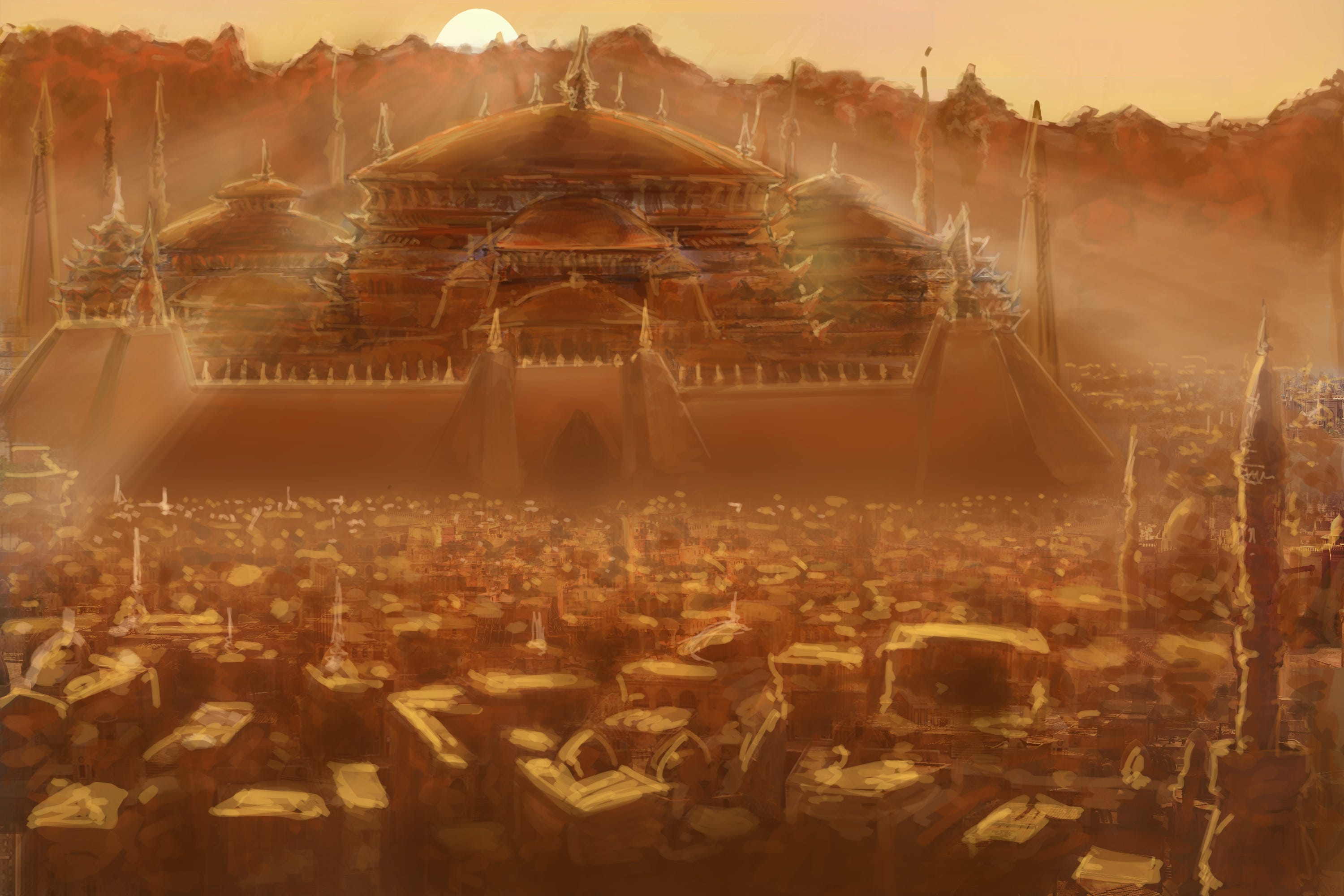
The New Order
When man let the machines think for them, their minds atrophied. When process and procedures were demanded instead of mastery, civilization stagnated. Yet neither of these were corrosive in themselves. Every musician on the lyre needed to learn the right technique. Our great ships are glorious in their simplicity. Our social fabric is awe-inspiring in its stability. Yet only so much of the transformation can be put into simple words; it must be felt.
Every master remembers when he first broke the rules, that his sense of the thing in itself surpassed all written knowledge. He has transcended the crutch of technique and understood at a fundamental level. Like when Paul Atreides became the Kwisatz Haderach, he entered a plane the machine-thinkers could not enter. Such skill only comes through meticulous and ruthless training, facilitated by other masters of the craft. Man was never meant to follow rules and techniques to the letter, but to surpass them. It’s the instinct that allows a blink to say a thousand words, to counter a strike before one’s opponent even contemplates it, the intuition that makes the subjects of an empire pivot without proclamations.
The ethos of the new society would sacrifice efficiency for stability, the organic before the mechanical. Processes and procedures were demoted in favor of fostering true mastery. The simple and robust solution was always chosen over the complicated and optimal one. Instead of abstract and deracinated educational institutions, the guilds formed apprenticeships with its members spanning several generations of transmission from father to son, forming once unfathomable knowledge of their craft. Political organization became hereditary as the people under their authority became extensions of their being. In many ways, individualism waned, though it flourished in new agency within one’s craft and local sphere. The individual has responsibilities and can even wield violence if necessary, but retribution for behaviors that deteriorated social cohesion was punished swiftly and severely.
In mankind’s earlier quest for optimization, he forgot to hone his own senses. As he eyed the numbers moving across the screen, his awareness of his surroundings faltered. This restructuring created a powerful social pressure within humanity. While man of earlier ages sought their salvation in mathematical equations and idealistic systems. As reliance on abstract forms evaporated in favor of the tangible, the elite classes needed to become more radically in tune with their own senses.
While the pace of technology slowed during the new era, projects that spanned multiple generations, once considered unfathomable, became a reality. The first manned starship to Alpha Centauri was seventy years in the making, and several more followed. Technicians who began the work understood they would never see their masterwork travel space, but their grandchildren would.

The Golden Path
It would be easy to scoff at the hubris of the architects of the machine society. Yet the trials and tribulations of this age were a necessary step to understand what we, as human beings made of flesh and blood. Like ancient chess masters who were easily defeated by these thinking machines didn’t fall into myopia and boredom but formed a deeper understanding and appreciation of the game, the machine society brought to the forefront our capabilities as a people. Just as the scaffolding and guardrails of childhood have to be discarded to grow, so it was that humanity had to escape and cast aside the machine society.
Until the last sun burns out from the cosmos, humanity’s future will be one of perpetual struggle. To flee is cowardice. In our current day, our glorious and prescient emperor has, through means no one truly understands, continued this development of humanity. While traitors and subversives have tried to circumvent Leto II’s plans, they will be crushed. The future of mankind depends on it.
We must embrace the struggle. It can’t be offloaded to a machine, nor can we escape to comfort and escape Nature’s jealous grasp. This is the future laid out for us. This is the Golden Path.
The mad emperor’s apprentice, photographed below, saved the world from total destruction.

“Governments, if they endure, always tend increasingly toward aristocratic forms. No government in history has been known to evade this pattern. And as the aristocracy develops, government tends more and more to act exclusively in the interests of the ruling class - whether that class be hereditary royalty, oligarchs of financial empires, or entrenched bureaucracy.
- Politics as Repeat Phenomenon: Bene Gesserit Training Manual”
“There should be a science of discontent. People need hard times to develop psychic muscles. -- Muad'Dib”
The historiography regarding the jihad by a heretic named “Brian Herbert” has been deemed a fabrication and will not be referenced.
This is based off a partially recovered video documentary of this era, “The Matrix”
A court propagandist of the era man called this “The End of History”. It has brought confusion why this Japanese man is referred to as an American in official documents. It’s generally assumed to be an honorarium for his devotion to the Global American Empire
Little is known regarding the holy books of the “Human Resource” cult, as their works were burned and the adherents forced to breed. It is speculated that the Bene Gesserit stemmed from this religion, but there is little evidence to support it.
“Technique is no longer some uncertain and incomplete intermediary between humanity and the natural milieu. The latter is totally dominated and utilized (in Western society). Technique now constitutes a fabric of its own, replacing nature. Technique is the complex and complete milieu in which human beings must live and in relation to which they must define themselves.” - Jacques Ellul
A famous writer of this era, the legendary philosopher Alan Schmidt, talks about this in his essay “Problem Solving the Problem Solving Problem”
Dark creatures called “Kupernetes” allowed these machines to scale to shocking levels
This was documented by Akiro, companion of famous warlord Conan, who later slayed Thulsa Doom and became a great king.
The description of this man in ancient documents is so cartoonish some assume he was a parody and never actually existed
The alignment of this spirit has been hotly contested, with theories an underground cult of discontented former tech worshippers called the “Groypers” were responsible.
Historians argue this skill has been used since ancient times, and was commonly called “nagging”
Homer was already imagining golden robot maids who could help the blacksmith god Hephaestus with his craft while he sits in his floating chair. They could intuit his requirements and possessed all the knowledge of the Gods. The blacksmith then created a shield for Achilles, the one in which the tiny figures could sing and shout. Aristotle warned centuries later that the master is just as responsible for the autobots as he was for his slaves. You can find all this in Andrinne Mayor’s book Gods And Robots.
But the idea of treating men as machine really started with the Hoplites, where men must fight as a unit. It would be perfected by the Romans, who can counter the barbarian with a machine-like stabbing with their short swords. But it was in the 16th century that the Western men really treated man as a machine. This laid the foundation for modernity amid the war of religions and the struggle against the Muslims.
Excellent article. The footnotes are especially humorous.